

You wake up and your arm is gone. Not literally — but it might as well be. Your hand feels like a block of wood. Your fingers won’t quite respond. For a few seconds, you actually shake it just to check it’s still attached.
You’ve probably had this happen more than once. Maybe it’s always the same arm. Maybe it takes a minute of pins and needles before feeling comes back. And maybe, every time, you’ve told yourself the same thing: I must have slept on it wrong.
That explanation works for a while. But if your arm keeps going numb while you sleep — night after night, often on the same side — “slept on it wrong” stops being an explanation and starts being a pattern.
Quick answer
Your arm or hand can go numb while sleeping when a nerve in your neck, shoulder, or arm gets compressed by your sleeping position. This often happens when your arm is tucked under your head, your body, or your pillow for several hours. It’s usually harmless, and the feeling returns once the pressure is relieved. But if it happens regularly, especially on the same side, your pillow and sleep setup may be part of the reason it keeps happening.
Free 7-Night Pillow Test
Not sure if your sleep setup is part of the pattern? Download the free 7-night checklist and track your pillow height, sleep position, and how your arm feels each morning.
In this guide
This article may contain affiliate links. If you purchase through our links, Fondielle may earn a small commission at no extra cost to you. We only recommend products we have researched and genuinely believe can support a better sleep environment.
What Causes Your Arm to Go Numb While You Sleep?
When you wake up with a numb arm or hand, a nerve somewhere along its path — in your neck, shoulder, elbow, or wrist — has been under sustained pressure for too long. Nerves carry signal the same way a cable carries current, and when that cable gets pinched, the signal gets interrupted. The result is the heavy, “dead” sensation, often followed by pins and needles as feeling comes back.
This is often a temporary pressure-related pattern, and it usually resolves once the pressure is removed — which is exactly why moving or shaking out your arm brings the feeling back so quickly.
This same nerve-compression pattern can also happen any time you stay in one position for an extended period — not just at night, but during a long nap or while lying down to rest during the day.
What’s less commonly discussed is why the same nerve keeps getting compressed in the first place. And for side sleepers especially, the answer often has less to do with the arm itself and more to do with what’s happening at the neck.
Why Your Arm Goes Dead When Sleeping
It is an undeniably unsettling sensation: waking up in the middle of the night to find your arm feeling completely heavy, unresponsive, and “dead.” For many women, this midnight wake-up call leaves them feeling stiff, tired, and frustrated before the day even begins. If you frequently experience your arm going to sleep at night, the culprit is almost always temporary nerve pressure rather than anything more ominous.
When your arm goes dead when sleeping, it is typically a mechanical issue stemming from your chosen sleep position. Side sleeping is the most common trigger. When you sleep on your side, the weight of your entire upper body comes directly down on top of your shoulder joint. This extreme shoulder pressure can compress the delicate system of nerves that run from your neck down to your fingertips. The situation is often aggravated by tucking your arm under a heavy pillow or letting your shoulder roll forward into the mattress, restricting the natural structural space your nerves need to move freely. Your pillow height is a quiet, critical element in this equation. If your pillow is too flat or too lofted, it forces your neck into an awkward angle, further pinching the nerves at the root.
While an arm going numb when sleeping is usually just a gentle reminder to adjust your nighttime posture, it is important to pay attention to how your body recovers. You should consult a healthcare professional if your numbness:
* Persists long after you have changed positions and woken up
* Occurs frequently throughout the week
* Is accompanied by noticeable muscle weakness, pain, or grip problems
* Causes visible color changes in your hand or fingers
* Begins happening during daytime hours
For most, resolving that “dead arm” sensation is simply a matter of optimizing your alignment, ensuring your shoulder has breathing room, and finding the right support to keep your spine beautifully neutral until morning.
Is “Sleeping On It Wrong” Actually the Full Story?
For years, I told myself the same thing every time I woke up with a dead hand on the same side. I’d shake it out, wait for the pins and needles to pass, and move on with my morning. I assumed it was random — bad luck, an awkward position, nothing worth thinking about twice.
It wasn’t random. It was happening on the same side, almost every night, and I never once connected it to anything else going on while I slept. I had every reason to think it was “just an arm thing.” It wasn’t.
What I didn’t realize at the time is that the position of your neck overnight directly affects the nerves that run down into your arm. If your neck is held in a misaligned position for hours — often because of a pillow that doesn’t support it properly — it can put pressure on the nerve pathway near your shoulder that feeds into your arm and hand. That pressure adds to whatever is already happening with your arm’s own position, making numbness more likely and more frequent.
“Slept on it wrong” isn’t false. It’s just incomplete. The real question is why you keep sleeping on it wrong, in the same way, night after night — and that’s where your sleep setup comes in. If you also wake up with a headache at the base of your skull, that’s often the same cervical compression showing up differently — we go deeper into that in why you wake up with a headache every morning.
Why Does This Happen on the Same Side Every Time?
If you’re a side sleeper, you have a dominant side — the side you fall asleep on, most nights, without thinking about it. For many side sleepers, that dominant side rarely changes — it’s whichever side feels most natural, and it tends to stay the same for years.
That consistency is part of the problem. The same shoulder bears the same pressure every night. The same arm ends up tucked, trapped, or stretched in the same way. And if your pillow doesn’t give your neck the support it needs on that side, the same nerve pathway near your neck and shoulder is under repeated pressure, night after night.
This is also why the numbness often shows up alongside other familiar morning complaints — a stiff neck, a tender shoulder, or a dull ache between your shoulder blades. They’re not separate problems. They’re different symptoms of the same overnight pattern — the kind we cover in why your pillow is causing your stiff neck every morning and why side sleepers wake up with shoulder pain: your head, neck, and shoulder aren’t being supported the way they need to be for seven or eight hours.
What If Both Arms Go Numb at Night?
Not everyone wakes up with numbness on just one side. If both arms feel numb or “asleep” at the same time, the cause is usually still positional — but the position is different. This often happens to back sleepers whose arms end up raised above the head or tucked under the body on both sides at once, or to anyone whose pillow pushes the neck into a position that compresses both shoulders evenly rather than one dominant side.
The signs to watch for are the same as for one-sided numbness — does it resolve within a few minutes of moving, does it return to the same pattern most nights, does it come with neck or shoulder tension on both sides. If both arms go numb occasionally and clear quickly once you move, that’s consistent with the same overnight nerve compression covered above. If it happens most nights regardless of position, your pillow height and neck support are worth checking first — the same way we cover for one-sided numbness, and the same way we break down for back sleepers in why back sleepers wake up with neck pain.
Signs Your Sleep Setup May Be Part of the Pattern
You don’t need a medical degree to notice these signs — just a bit of attention over a few mornings.
- The numbness is almost always on the same arm or hand
- It happens several times a week, not just occasionally
- It comes with a stiff neck or sore shoulder on the same side
- The feeling returns within a few minutes once you move
- You sleep on your side, and that arm tends to end up under your pillow, your head, or your body
- Your pillow feels flat, shifts during the night, or doesn’t seem to “hold” your neck in place
If two or more of these sound familiar, it’s worth looking at your pillow and sleep position as part of the picture — not the whole story, but a real and changeable part of it.
| Sign you notice | What it may suggest | What to check |
|---|---|---|
| Same arm, almost every night | Dominant sleep side under repeated pressure | Pillow support on that side |
| Comes with a stiff neck or sore shoulder | Cervical compression, not just arm position | Pillow loft and cervical support |
| Feeling returns within minutes | Typical temporary pressure pattern | Usually not a concern on its own |
| Numbness in both arms | Less position-specific | Pillow height overall, or speak with a professional if frequent |
Free 7-Night Pillow Test
If your pillow feels too high, too flat, or unsupportive, use the free 7-night checklist to track your pillow height, sleep position, and morning arm comfort.
Can a Pillow Help With Arm Numbness at Night?
A pillow can’t change where your arm ends up during the night — but it can change what’s happening at your neck and shoulder, which is part of what makes arm numbness more or less likely.
What to Look for in a Pillow
Here’s what to look for if you’re dealing with this regularly:
Stable cervical support. Your pillow should keep your neck supported in a neutral position throughout the night, not just when you first lie down. A pillow that flattens or shifts within an hour leaves your neck — and the nerves running through it — unsupported for most of the night.
Shoulder clearance. If your pillow forces your shoulder into an awkward position to make room for your head, that pressure can carry over into the arm and hand on that side.
Space for your arm and hand. This is the part most standard pillows simply don’t address. A flat, rectangular pillow gives your arm nowhere to go except under your head, under your body, or stretched out behind you — all classic setups for nerve compression.
If you’re not sure what pillow height your neck actually needs in the first place, that’s worth checking before anything else — see what pillow height side sleepers actually need.
A Pillow Designed With This in Mind
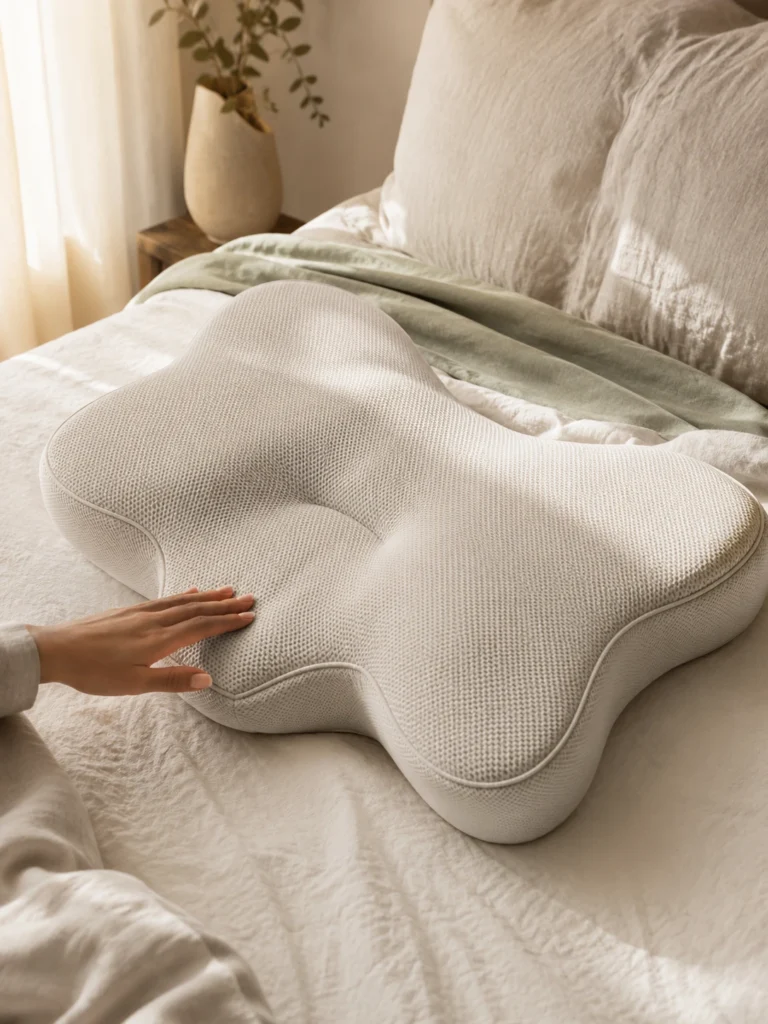
This is where the pillow we recommend stands out. It’s designed with five separate support zones, including a dedicated arm support area — something most standard pillows don’t have at all. The shape allows your arm and hand to rest in a more natural position instead of being trapped underneath your head or body, while the cervical support zone helps keep your neck in a more neutral position on the side you sleep on.
To be clear: an ergonomic pillow isn’t a guaranteed fix, and it won’t override every cause of nighttime numbness. But if your current setup gives your arm nowhere to go but under you, a pillow built with that specific space in mind may help reduce how often it happens — particularly alongside the position changes we covered above. Most people need about 5 to 7 nights to fully adjust to a new pillow shape, so it’s worth giving it a full week before deciding whether it’s making a difference.
Ergonomic Pillow Option
If your current pillow leaves your arm with nowhere to go but underneath you, an ergonomic contour pillow with a dedicated arm support zone may be worth considering. The pillow we recommend is designed around stable cervical support, shoulder clearance, and space for your arm and hand to rest naturally.
When It May Not Be Your Pillow
Your sleep setup may be part of the pattern, but it isn’t the only possible explanation — and it’s worth knowing the difference.
Occasional numbness that resolves within a few minutes of moving is common and, for most people, not a cause for concern. But if the numbness lasts well after you’ve moved, happens during the day as well as at night, spreads beyond your arm, or comes with weakness, persistent tingling, or pain that doesn’t match your sleep position, it’s a good idea to speak with a healthcare professional. These can sometimes point to something beyond sleep posture, and a professional is best placed to look into it properly.
FAQ
Side sleeping puts sustained pressure on the shoulder and arm on your dominant side. If your pillow doesn’t support your neck properly, the nerve pathway near your neck and shoulder can also come under pressure, making numbness in that arm or hand more likely.
Occasional numbness that resolves quickly is common. If it’s happening most nights, especially on the same side, it’s worth looking at your sleep position and pillow setup rather than assuming it’s just “normal.”
A pillow on its own doesn’t directly compress the nerves in your arm, but a pillow that doesn’t support your neck or give your arm room to rest naturally can make existing pressure on those nerves worse and more frequent.
Most people have a dominant sleep side that doesn’t change from night to night. That means the same shoulder, arm, and area of the neck are under the same pressure every night, which is why the numbness tends to repeat on the same side.
For most side sleepers, numbness repeats on whichever arm is pressed into the mattress most often. On its own, recurring left arm numbness that follows your usual sleep-position pattern and clears within a few minutes of moving can be consistent with the pressure pattern described above.
That said, if the numbness feels different than usual, happens during the day, comes with chest discomfort, shortness of breath, sudden weakness, dizziness, trouble speaking, or does not improve after changing position, speak with a healthcare professional rather than assume it is sleep-related.
Start by noticing your sleep position and where your arm ends up — under your pillow, under your body, or stretched overhead are common culprits. From there, a pillow that supports your neck and gives your arm space to rest may help reduce how often it happens.
A “dead arm” feeling happens when a nerve has been under pressure long enough that it briefly stops transmitting signal properly. It’s the same mechanism as pins and needles, just at a more intense stage — and it resolves the same way, once the pressure is relieved.
Yes. Back sleepers can also experience nerve compression, usually when an arm ends up overhead, under a pillow, or pressed against the body during the night. The cause is the same — sustained pressure on a nerve — even though the position is different from side sleeping.
Numbness in both arms is less commonly tied to sleep position alone and more often connects to how the neck is positioned overall, especially with a pillow that’s too high or too flat on both sides. If it happens regularly in both arms, it’s worth checking your pillow height — and worth mentioning to a healthcare professional if it’s frequent or doesn’t ease quickly after moving.
Final Thoughts: Why Your Arm Really Goes Numb at Night
So here’s why your arm goes numb when you sleep: it’s rarely random. A nerve in your neck, shoulder, or arm gets compressed by your position — often the same way, on the same side, night after night — because your pillow isn’t giving your neck and arm the support and space they need.
“I slept on it wrong” isn’t false. It’s just incomplete. The real answer is the pattern behind it — and patterns are something you can actually check and change.
Start by paying attention to where your arm ends up for the next few nights. If your pillow isn’t giving your neck the support it needs — or your arm the space to rest naturally — that’s one of the simplest things to check first.
If this is the first thing you’re checking in your sleep setup, the pillar guide on why your neck hurts every morning walks through the full picture — pillow loft, alignment, and how these symptoms connect. And once you’ve made a change, the 7-night pillow test is the simplest way to track whether it’s working.