

You wake up and your shoulder already hurts.
Not from an injury. Not from a workout. You haven’t done anything. You’ve been lying still for seven or eight hours. And somehow, that shoulder — the one you slept on — is stiff, sore, and complaining before you’ve had a single sip of coffee.
You rotate it slowly. You stretch your arm across your chest. You wait for it to pass. And it does, eventually — after about forty-five minutes of moving around. Until tomorrow morning, when the whole thing starts again.
I slept on my right side every night for three years and woke up with tension in my right shoulder every single morning. I assumed it was how I sat at my desk — I’m a freelancer, I spend hours at a computer. I adjusted my screen height. I tried a standing desk. I did the shoulder stretches my physiotherapist recommended. The pain would ease during the day and be back the next morning, exactly where I’d left it.
It wasn’t my desk. It was my pillow.
Shoulder pain and morning neck pain often share the same root cause — a sleep environment that isn’t supporting your cervical spine the way it should. If your neck is also stiff in the morning, that’s not a coincidence.
This article explains what is actually happening to your shoulder while you sleep on your side, why your pillow is likely contributing to it, and what you can check tonight to start changing your mornings.
Affiliate disclosure: This article may contain affiliate links. If you purchase through our links, Fondielle may earn a small commission at no extra cost to you. We only recommend products we have researched and genuinely believe can support a better sleep environment.
Quick answer
If you sleep on your side and wake up with shoulder pain every morning, your pillow height may be part of the cause. When your pillow is too flat or loses its shape overnight, your head drops toward the mattress. That shifts the weight your pillow should be carrying directly onto your shoulder — for seven or eight hours straight. The shoulder accumulates pressure, the surrounding muscles stay in low-level contraction all night, and you wake up with that familiar dull ache that takes an hour to fade. Your sleep environment is one of the first places to check.
In this guide:
What does side sleeper shoulder pain actually feel like?
Before anything else — if you recognise any of these, this article is written for you.
The pain is almost always on the same side. The shoulder you sleep on. Not both shoulders, not your upper back generally — just that one side, the one that was pressed against the mattress all night.
It tends to feel like a deep, dull ache rather than a sharp pain. Sometimes it sits in the joint itself. Sometimes it’s more like tension between the shoulder blade and the spine — that tight, uncomfortable pressure that makes you roll your shoulder back and feel it creak.
It’s worst in the first thirty to sixty minutes after waking. Then, as you move around, make coffee, start your day, it gradually fades. By mid-morning, it’s mostly gone. Until tomorrow.
This pattern — pain that’s worst on waking and improves with movement — is one of the clearest signs that the cause is positional rather than structural. Your shoulder has been under sustained pressure for hours. Once you start moving, circulation returns, the muscles release, and the pain eases. It comes back the next night because nothing about your sleep setup has changed.
If this is what your mornings feel like, you are not dealing with an injury. You are dealing with an environment problem. And environment problems are fixable.
Why sleeping on your side causes shoulder pain
Side sleeping is the most common sleep position. It has real benefits — it can reduce snoring, support digestion, and feel more comfortable for many people. But it also places a specific mechanical demand on your body that no other sleep position does.
When you lie on your side, the entire weight of your torso — everything above your hips — shifts onto one side. A significant portion of that load concentrates on your shoulder joint. The shoulder becomes the primary contact point between your upper body and the mattress.
For short periods, that is completely manageable. Your shoulder joint is designed to bear load. But for six, seven, eight hours without movement, that sustained compression becomes a problem.
Here is what happens in your shoulder during a full night of side sleeping without proper support.
The bursa — a small fluid-filled sac that cushions the shoulder joint — gets compressed directly. When it’s under sustained pressure, it can become irritated and inflamed, which is why the pain is so familiar and so predictable every morning.
The rotator cuff tendons, which sit in a narrow space between the humerus and the shoulder blade, get squeezed in that same space. Hours of compression can leave those tendons irritated and sensitive, producing the aching stiffness you feel when you try to lift your arm first thing in the morning.
The muscles surrounding the joint — the deltoid, the muscles around the shoulder blade, the upper trapezius — stay in a low-level holding contraction all night. They are not resting. They are stabilising a joint that is under pressure. By morning, they are tired, tense, and unhappy.
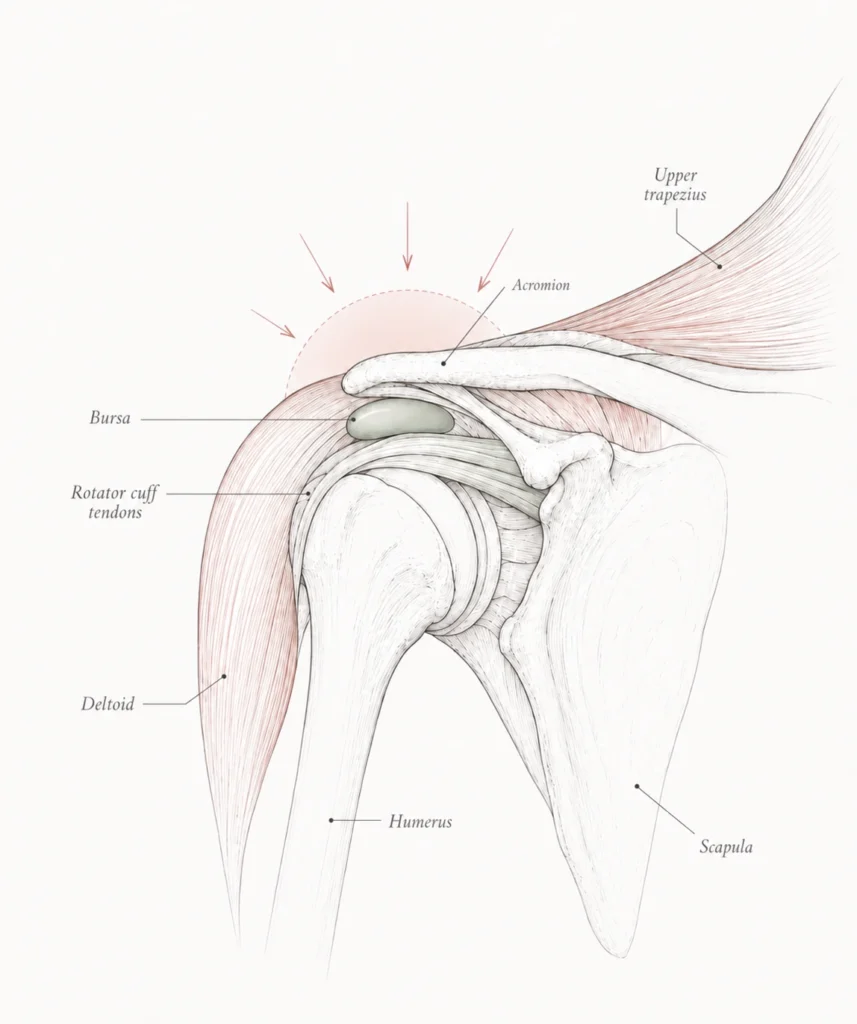
None of this is your fault. And none of it means you need to stop sleeping on your side.
It means your shoulder needs better support than it is currently getting.
The pillow connection — why this matters more than most people realise
Here is the part that most shoulder pain articles miss entirely.
The shoulder pain you feel in the morning is not just about the shoulder. It is about where your head is.
When you sleep on your side, your pillow has one job: to fill the gap between your head and the mattress so that your cervical spine — your neck — stays in a neutral, straight line with the rest of your spine.
When your pillow does that job correctly, your head is level. Your neck is straight. The weight of your head is fully supported. And crucially, very little of that weight transfers down to your shoulder.
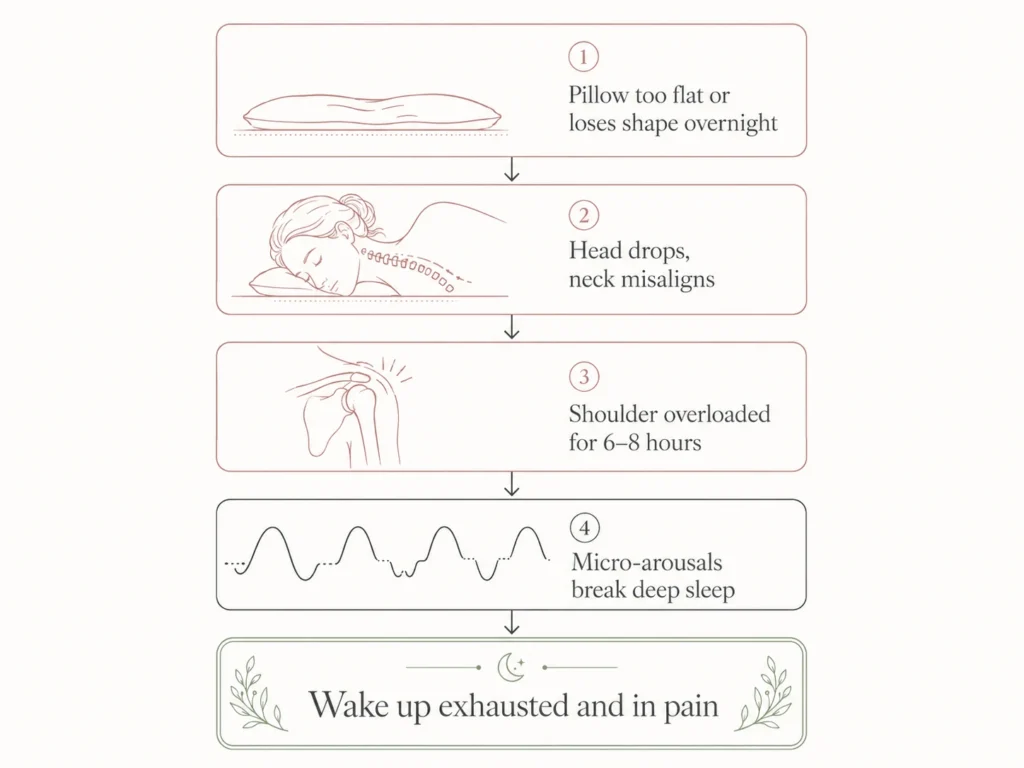
When your pillow fails at that job — because it is too flat, too thin, or because it loses its shape overnight — your head drops toward the mattress. Even a small drop, two or three centimetres, is enough to create a lateral curve in your cervical spine.
That curve changes everything below it.
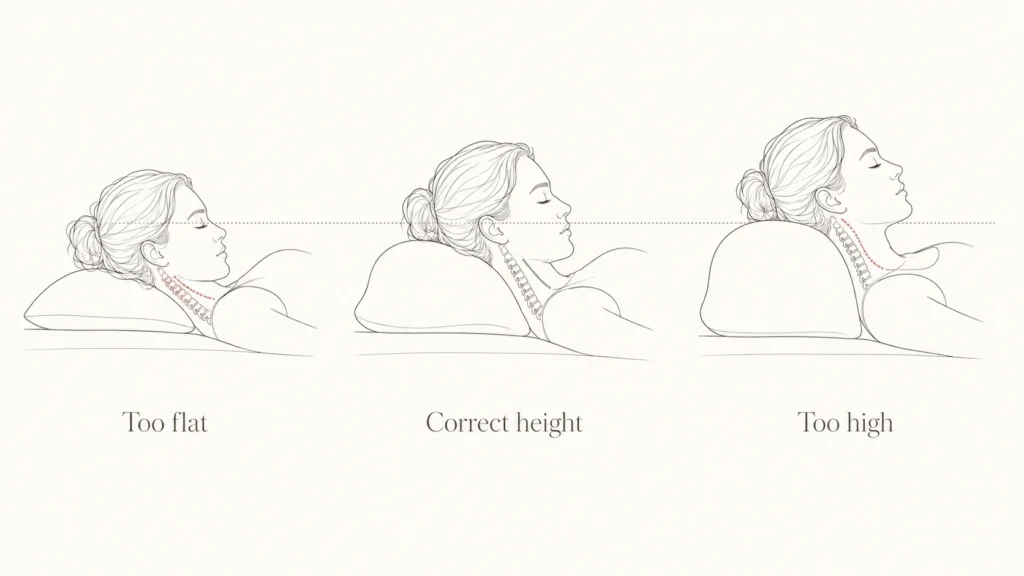
Your shoulder, instead of resting in a neutral position, gets pushed upward relative to your head. The muscles around the joint tighten to compensate for the misalignment. The pressure on the joint increases. The bursa gets more compressed. And all of that happens for the entire duration of your sleep.
This is why the problem keeps coming back. It is not that your shoulder is getting injured. It is that every single night, the same mechanical situation repeats — head drops, neck curves, shoulder overloads — because the pillow that is supposed to prevent it is not doing its job.
I spent three years thinking my shoulder pain was a desk problem. When I finally understood that it was a pillow problem, I ordered a different pillow that night. Within a week, the morning tension in my right shoulder was noticeably less. Within two weeks, most mornings it was gone.
The fix is physical. And physical things can be changed.
The two ways your pillow makes shoulder pain worse
There are two distinct pillow problems that contribute to side sleeper shoulder pain. Understanding which one applies to you helps you find the right solution.
Problem one — your pillow is too flat or collapses overnight
This is the most common scenario. Your pillow starts at a reasonable height when you first lie down, but by two or three in the morning it has flattened out. Your head gradually sinks toward the mattress. The shoulder takes on more and more weight as the night progresses.
Signs this is your situation: the pain is often worst after a full night’s sleep rather than after a short nap. The pillow looks noticeably thinner in the morning than when you placed your head on it. You wake up with your ear almost touching your shoulder.
Problem two — your pillow is too high
This creates the opposite problem, and it is less commonly recognised. When your pillow is too thick for your shoulder width, it pushes your head upward, tilting your cervical spine in the other direction. Your top shoulder gets compressed downward. The muscles on the underside of your neck stay shortened and contracted all night.
Signs this is your situation: the pain feels more like a pinching or compression than a dull ache. You often notice neck stiffness on the same side as the shoulder pain. You sleep with your shoulder hunched toward your ear.
The right pillow sits exactly at the intersection between these two problems — high enough to support your head, shaped correctly to let your shoulder rest without compression, and stable enough to hold that position for eight hours.
For most side sleepers, that means a loft of approximately four to six inches, depending on shoulder width and mattress firmness. The goal is a straight line from your ear to your shoulder to your hip when you’re lying on your side.
For a complete guide to measuring your ideal pillow height, this article on pillow loft for side sleepers covers the exact measurements and how to test them at home.
What a pillow designed for side sleepers actually does differently
A standard rectangular pillow is not designed with your shoulder in mind. It provides uniform height across its entire surface. It does not account for the fact that when you are lying on your side, your shoulder is taking up space that the pillow needs to accommodate.
The result is that your shoulder gets pushed forward and upward by the edge of the pillow, or compressed against the mattress at a slightly unnatural angle. Either way, the joint is not in a neutral position.
A pillow designed specifically for side sleepers addresses this in two ways.
First, it maintains consistent loft throughout the night. High-density memory foam, unlike standard polyester fill, holds its shape under the sustained weight of your head. The pillow that supports you at eleven at night is still providing the same support at five in the morning. Your head does not drop. The chain reaction — head drops, neck curves, shoulder overloads — does not happen.
Second, a well-designed ergonomic pillow creates dedicated space for the shoulder. Rather than a flat rectangle that pushes the shoulder into an awkward position, the shape of the pillow allows the shoulder to settle naturally, with less compression against the mattress and less upward pressure from the pillow edge.
This is what the cervical bolster — the raised area that supports the neck — actually does for your shoulder. By supporting the neck correctly, it removes the need for the shoulder to compensate. The shoulder can rest. The muscles around it can actually release during the night, rather than spending eight hours in a holding pattern.
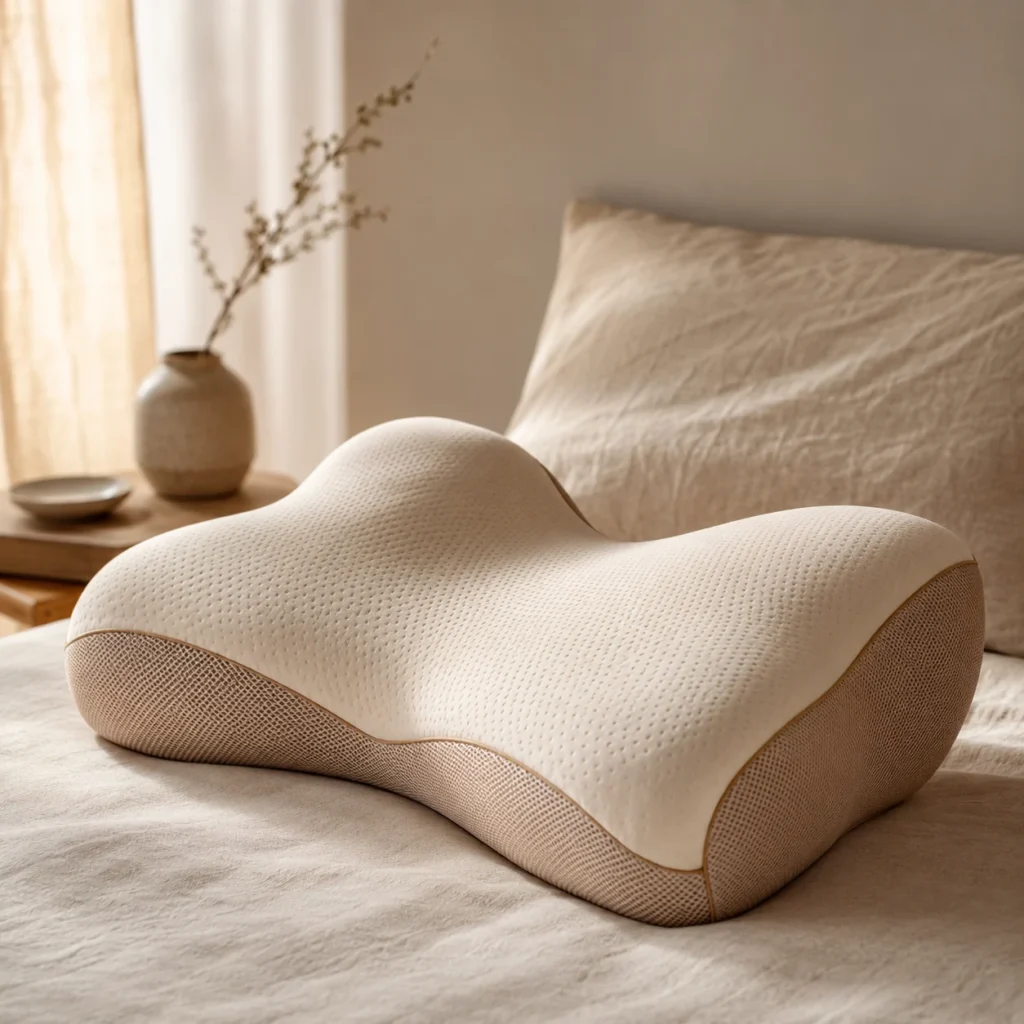
The pillow we recommend for side sleepers is built around exactly these criteria. It is designed with five distinct support zones — including a dedicated shoulder support area and a neck support zone that works together to keep the head level and the shoulder free from excess pressure. The high-density memory foam holds its shape through the full night.
If your current pillow loses shape, leaves your neck unsupported, or creates the sensation that your shoulder is being pushed into an uncomfortable position, an ergonomic contour pillow may be worth considering.
The ergonomic pillow we recommend for side sleepers
Designed with five support zones including dedicated cervical and shoulder support. High-density memory foam maintains its loft from the moment you lie down to the moment you wake up. Includes a cooling cover. 60-day return policy.
What to check tonight — a practical starting point
You do not need to buy anything before doing this. Start by understanding what your current setup is actually doing.
Check your pillow loft when you are lying down. Lie on your side in your normal sleep position and have someone look at your neck from behind, or take a photo. Your ear, shoulder, and hip should form a roughly straight line. If your head is drooping toward the mattress, your pillow is too flat. If your head is pushed up toward the ceiling, your pillow is too thick.
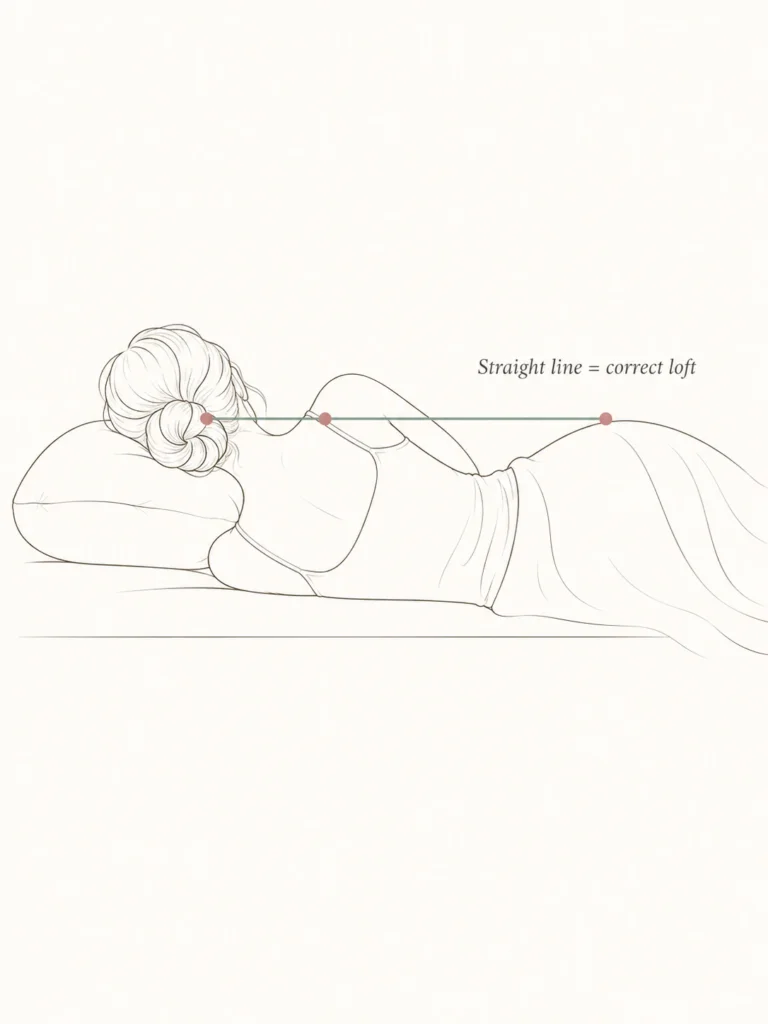
Check whether your pillow holds its shape overnight. In the morning, before you lift your head, notice where your head is relative to where it was when you lay down. If your ear is significantly closer to the mattress than it was at the start of the night, your pillow has compressed during sleep.
Check your shoulder position when you first lie down. When you lie on your side, does your shoulder feel like it is being pushed upward by the edge of the pillow? Does the pillow seem to sit on top of your shoulder rather than beside it? That is a sign the pillow shape is not designed for side sleeping.
Check the consistency. If you sleep on your right side and wake up with right shoulder pain, but the pain is absent on nights when you happened to sleep more on your back or left side — that is strong evidence that the issue is positional and linked to your sleep surface.
These checks cost nothing. But they can tell you a great deal about whether your sleep environment is contributing to your shoulder pain.
For a complete side-by-side look at what cervical pillow design actually changes mechanically, this comparison of cervical pillows versus regular pillows explains the structural differences in plain terms.
Free 7-Night Pillow Test Checklist
Not sure if your current pillow is contributing to your shoulder pain? The free 7-night checklist tracks your pillow height, shoulder comfort, and morning pain level over one week — so you can see exactly what is changing and what isn’t.
The connection most people miss — shoulder pain and broken sleep
There is one more thing worth understanding, because it explains why shoulder pain from side sleeping affects more than just your shoulder.
When your body is in low-level discomfort during sleep — even discomfort you never consciously register — your brain responds with micro-arousals. These are tiny, brief moments where your nervous system partially activates, shifts your body or changes your breathing, and then returns to sleep. You never fully wake up. You have no memory of it. But these micro-arousals interrupt the deeper stages of sleep where physical recovery actually happens.
The result is that you can sleep eight hours and still wake up exhausted, because a significant portion of those hours was spent in lighter, less restorative sleep stages. The shoulder pain caused the fragmentation. The fragmentation caused the fatigue. And the fatigue makes the next day harder, which makes you more sensitive to the pain the following morning.
If this cycle sounds familiar — shoulder pain plus unexplained morning exhaustion despite adequate sleep hours — this article on waking up more tired than when you went to bed explains the mechanism in full.
The two problems often have the same physical root. And they can often be addressed together.
When to look beyond your sleep setup
Your pillow may be part of what is causing your shoulder pain. But it is not the only possible cause, and it is important to know when to look further.
If any of the following apply to you, speak with a healthcare professional rather than adjusting your sleep setup as a first step.
The pain does not ease with movement and remains throughout the day. Pain that improves after forty-five minutes of activity is consistent with positional discomfort. Pain that stays constant or worsens with movement suggests something else.
The pain came on suddenly after a specific event — a fall, a lift, an unusual movement. That points to an acute injury that needs assessment, not a pillow adjustment.
You have weakness in the arm or shoulder, or difficulty raising your arm above shoulder height. This can indicate rotator cuff involvement that requires professional evaluation.
The pain is accompanied by numbness, tingling, or pain that radiates down the arm. This may point to nerve involvement, either at the shoulder or in the cervical spine. If you also wake up with a numb arm, this article on arm numbness during sleep covers the most common causes in detail.
You have had the pain for several months with no improvement despite trying different pillows and sleep positions.
Fondielle is a sleep environment resource, not a medical clinic. The information here is about the physical setup of your bedroom and sleep surface. When symptoms suggest something beyond that, the right next step is a conversation with a professional.
FAQ
Yes, it can contribute to it — particularly for side sleepers. When a pillow is too flat, too thick, or loses its shape overnight, it affects how your neck is aligned. That misalignment changes how weight is distributed across the shoulder joint during sleep. Over hours and nights, this accumulated pressure may cause the aching stiffness many side sleepers experience every morning.
Because that is the side under sustained pressure throughout the night. The shoulder in contact with the mattress absorbs the weight of your torso for hours. The other shoulder, resting on top, is not under the same load. If your pain consistently matches your preferred sleeping side, that is a strong indication the cause is positional.
Not inherently. Side sleeping is a natural, common position with its own benefits. The issue is not the position itself but whether your sleep surface — primarily your pillow — is providing the support that position requires. With the right pillow loft and shape, many side sleepers experience no shoulder discomfort at all.
Lie on your side in your normal sleep position. Your cervical spine — your neck — should form a straight line with the rest of your spine. If your head droops toward the mattress, your pillow is too flat. If your head tilts upward, your pillow is too thick. For most side sleepers, a loft of four to six inches tends to be the right range, though this varies with shoulder width and mattress firmness.
Most people need five to seven nights to adjust to a different pillow and begin noticing consistent changes in their morning comfort. The first night or two may feel unfamiliar. Track how your shoulder feels each morning over a full week before drawing conclusions. The 7-night pillow test gives you a simple framework for doing this.
If the pain does not improve with movement and lasts throughout the day, if it came on after an injury, if you have weakness or reduced range of motion in the arm, or if the pain is accompanied by numbness or tingling — speak with a healthcare professional. Those symptoms go beyond what a sleep environment adjustment can address.
The bottom line
If you sleep on your side and wake up with shoulder pain every morning, the cause is most likely physical and positional — not structural, not age-related, not something you have to simply live with.
Your pillow’s job is to keep your head level and your cervical spine neutral so that your shoulder carries no more load than it needs to. When your pillow fails at that job — because it is too flat, the wrong shape, or collapses overnight — your shoulder pays the price.
Start tonight. Check your pillow height. Notice whether it holds its shape by morning. If it doesn’t, that is the first thing to change.
You’ve been waking up this way for months. Possibly years. The cause is physical. And physical things can be checked, tested, and changed.