

You’ve tried three different pillows. Maybe four. Each one felt promising in the store, or looked right on the product page. And yet every single morning, you wake up with that same stiffness on one side of your neck — or that familiar tension deep in your shoulder — and you can’t figure out why you wake up with neck pain no matter what you try.
Here’s what I spent years not knowing: the problem usually isn’t the pillow brand. It isn’t the filling. It isn’t even whether it’s memory foam or down or some hybrid material the packaging described with seven adjectives.
The problem is the height.
Most side sleepers have never measured the actual gap their pillow needs to fill. I hadn’t. Not once in three years of waking up stiff and blaming everything except the one physical object my head rested on every single night.
This article covers exactly what pillow height you need as a side sleeper, why it matters more than almost any other pillow feature, and how to figure out the right measurement for your body — tonight, before you go to sleep.
This article may contain affiliate links. If you purchase through our links, Fondielle may earn a small commission at no extra cost to you. We only recommend products we have researched and genuinely believe can support a better sleep environment.
Quick Answer
Most side sleepers need a pillow with a loft — compressed height — somewhere between 4 and 6 inches. The exact number depends on your shoulder width and how firm your mattress is. A pillow that is too flat leaves your neck tilted downward for seven or eight hours straight. A pillow that is too high pushes your neck in the opposite direction. Either way, the muscles along your cervical spine spend the entire night in mild contraction — and that contraction is what you feel when your alarm goes off.
Free 7-Night Pillow Test
Not sure if your current pillow height is right for you? Download the free 7-night checklist and track your pillow height, sleep position, and morning neck comfort — one simple check per morning.
In This Guide
What Is Pillow Loft and Why Does It Matter for Side Sleepers?
Pillow loft is simply the compressed height of your pillow once your head is resting on it. Not the fluffy height when it’s sitting on an empty bed — the actual height under the weight and warmth of your head during sleep.
For a side sleeper, this number matters more than any other feature on the label.
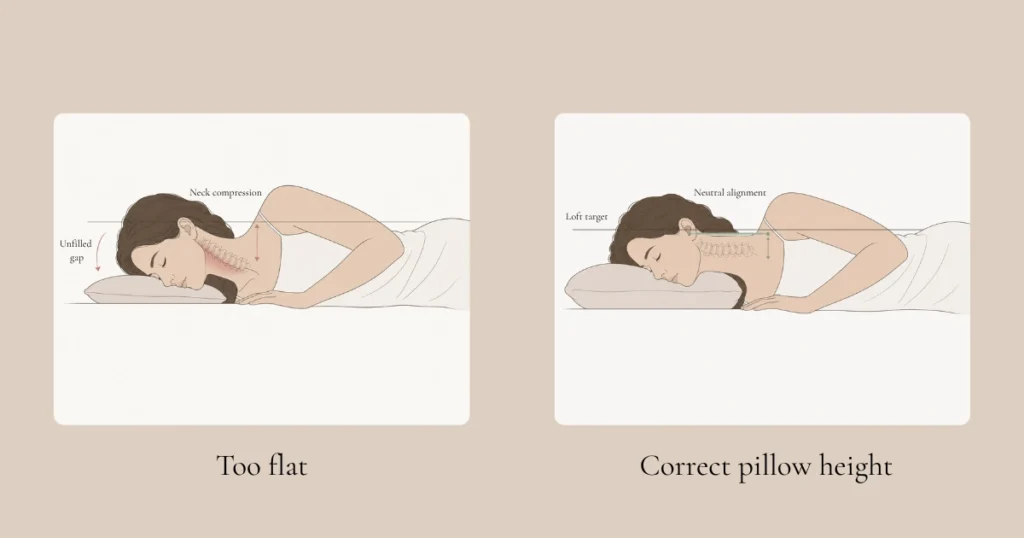
When you lie on your side, a gap opens between your ear and your shoulder. Your pillow’s job is to fill that gap completely — not partially, not approximately — so that your head stays level and your cervical spine maintains a neutral position through the night.
If the gap is filled correctly, the muscles along your neck and upper shoulder can fully relax. There is no tension holding your head up. There is no strain pulling it down. The physical position your spine is in during sleep is close enough to the position it holds when you’re standing upright that your muscles can genuinely switch off for a few hours.
If the gap is not filled correctly — in either direction — those muscles can’t fully let go. They compensate. The tension holds. And for seven or eight hours while you sleep through it entirely, that quiet low-level work continues. In the morning, you feel it.
What Happens When Your Pillow Is Too Flat?
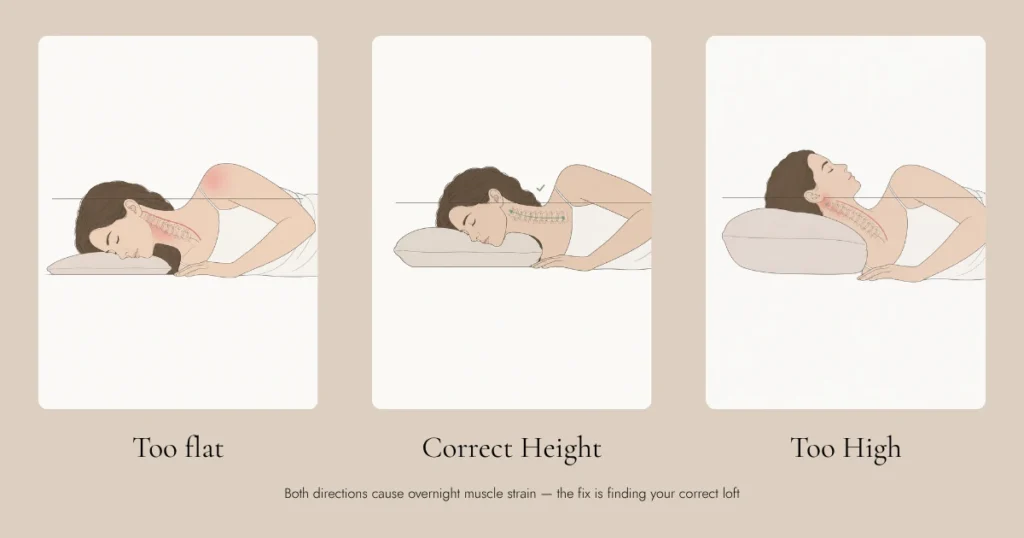
A flat pillow — or a pillow that starts at the right height but loses shape during the night — leaves your neck in a downward tilt while you sleep on your side. Your ear drifts toward your shoulder. The muscles on the opposite side of your neck stretch. The muscles on the side closest to the mattress compress.
This is the most common pillow problem for side sleepers, and it produces very specific symptoms.
The neck stiffness you feel on the side you slept on? That is sustained muscle compression — the tissue that spent hours slightly shortened. The tight sensation between your shoulder blade and spine? That is what happens when the upper trapezius and rhomboid muscles spend a full night in mild strain because your shoulder was carrying partial weight it shouldn’t have been carrying.
Why a flat pillow also affects how deeply you sleep
There is also a less obvious consequence: sleep fragmentation. When your body is in prolonged physical discomfort, even mild discomfort, your brain registers it without fully waking you. These are called micro-arousals — tiny interruptions in your sleep cycle that prevent you from spending enough time in deep, restorative sleep stages. You don’t remember them. You don’t feel them happening. But you feel their effect in the morning, in the particular kind of exhaustion that eight hours of sleep does not seem to fix.
I tracked my sleep for over a year. Seven hours, eight hours, once eight and a half. The number never changed how I felt. That was how I eventually understood that duration and depth are completely different things — and that my pillow was affecting one of them in a way I had never thought to question.
What Happens When Your Pillow Is Too High?
A pillow that is too thick pushes your neck in the opposite direction — head tilted upward, chin toward your chest, cervical spine in lateral flexion away from the mattress.
This version of the problem is less frequently discussed, but the mechanism is identical. Your neck muscles spend the night in compensatory tension. The compression moves to the upper vertebrae on the opposite side. Morning stiffness may feel slightly different — sometimes a tighter feeling higher on the neck, or a headache at the base of the skull — but the root cause is the same misalignment held in place for hours.
It is also worth noting that a pillow that is too high affects shoulder positioning. If your head is pushed too far upward, your shoulder has less natural clearance. The pressure on the shoulder joint from the mattress increases. For women who already experience shoulder discomfort from side sleeping, a pillow that is too thick can make this significantly worse.
The fix, in both cases, starts in the same place: measurement.
How to Measure the Right Pillow Height for Your Body
There is a simple physical measurement that most people have never taken — and it tells you exactly what loft your pillow needs to provide.
Method 1: The Shoulder-to-Ear Measurement
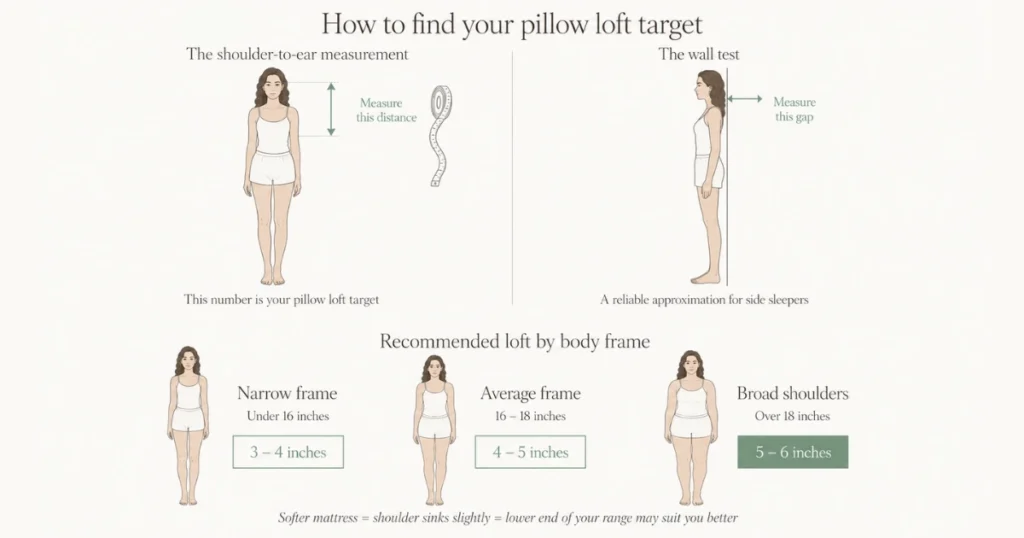
Stand in front of a mirror with your posture natural and relaxed. Have someone measure the distance from the top of your shoulder to the top of your ear in a straight line — not along the curve of your neck, but vertically. That number is your pillow loft target.
If you’re measuring alone, you can press your shoulder gently against a wall, stand straight, and use a flexible tape measure.
Method 2: The Wall Test
Stand with your back and shoulders flat against a wall. Keep your chin level. Have someone measure the gap between the back of your head and the wall. This gives you a close approximation of the loft needed to keep your head in a neutral position when lying on your side.
Reference Table: Recommended Pillow Loft by Frame
| Body Frame | Shoulder Width | Recommended Loft |
|---|---|---|
| Narrow frame | Under 16 inches | 3 – 4 inches |
| Average frame | 16 – 18 inches | 4 – 5 inches |
| Broad shoulders | Over 18 inches | 5 – 6 inches |
One important adjustment: mattress firmness affects the equation. On a very firm mattress, your shoulder does not sink in at all — so the full gap between ear and shoulder needs to be filled by the pillow. On a softer mattress, your shoulder sinks slightly into the surface, reducing the gap. If your mattress is on the softer side, you may find that a pillow at the lower end of your range works better than one at the higher end.
Signs Your Current Pillow Height May Be Wrong
These are the signs I lived with for three years before I understood what was causing them. If you recognize two or more of these in your own mornings, your pillow height is one of the first things worth checking.
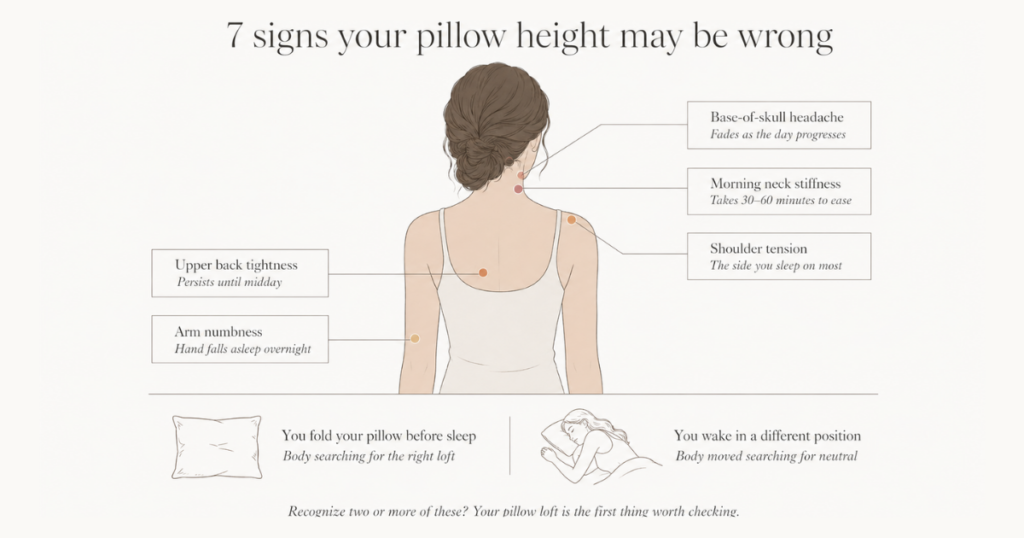
- Neck stiffness on one specific side — the side you sleep on most often — that takes 30 to 60 minutes to ease after waking
- Tension in your shoulder or the area between your shoulder blade and spine, particularly on your dominant sleep side
- A headache at the base of your skull in the mornings, which fades as the day progresses
- Your arm going numb during the night or at the point of waking
- An instinct to fold, punch, or adjust your pillow before you can get comfortable — because your body is trying to find the right loft manually
- Waking up in a completely different position than the one you fell asleep in — your body was searching during the night for somewhere that felt neutral
- Your pillow feels flat or collapsed by the time you wake up — the loft it started with is not the loft it maintained
That last point matters more than most people realize. A pillow that starts at 5 inches and compresses to 2 inches by 3am is functionally the same as a flat pillow for the second half of your night. Material durability — the ability of a pillow to hold its shape through the full night — is just as important as the starting height.
Free 7-Night Pillow Test
If you recognized more than two signs above, use the free 7-night checklist to track your pillow height, sleep position, and morning comfort each day. It takes two minutes each morning and gives you a clear pattern in a week.
What to Look for in a Side Sleeper Pillow
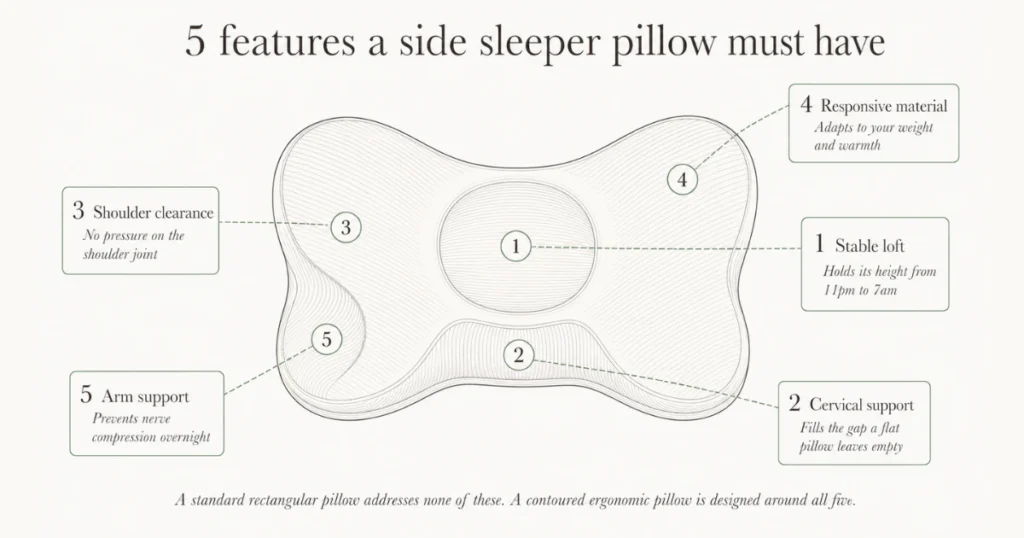
Before I suggest any specific product, here are the five criteria that actually matter — because these are the things that will determine whether a new pillow changes your mornings or ends up in the same pile as the others.
1. Stable loft throughout the night
The pillow needs to maintain its compressed height from the moment you fall asleep until the moment you wake up. Fibre-filled pillows and many foam pillows compress and do not fully recover. If the loft at hour seven is meaningfully different from the loft at hour one, your cervical alignment shifts during the night — and your muscles compensate.
2. Genuine cervical support
A side sleeper pillow needs to support more than just the back of the head. The gap between the base of your skull and your neck — the cervical curve — needs to be filled. Most standard pillows support the head but leave the neck unsupported — which means the cervical muscles are still working to hold the position.
3. Shoulder clearance
The design of the pillow should allow your shoulder to sit naturally without being forced into an awkward position. Rectangular pillows that extend uniformly from edge to edge often push against the shoulder joint in a way that increases overnight pressure.
4. A material that responds to your specific weight and warmth
High-density memory foam responds to both body weight and body temperature. It adapts to your specific morphology rather than offering a uniform firmness to every person. This matters because two women with different shoulder widths and different body weights will have meaningfully different support needs — and a responsive material addresses both without requiring you to choose between too firm and too soft.
5. A shape that accounts for the geometry of a real sleeping body
Your head, neck, and shoulder do not form a flat surface. A pillow that is simply a rectangle of foam is not accounting for the three-dimensional reality of your sleep position. The shape of a pillow — particularly whether it has any contour or curvature — affects how well it can address all four criteria above.
An Ergonomic Pillow Option Designed Around These Criteria
If you recognize more than two of the signs described above — and if your current pillow fails two or more of the criteria above — an ergonomic contour pillow may be worth considering as a next step.
The pillow we recommend for side sleepers with neck and shoulder discomfort is a high-density memory foam pillow designed around five distinct support zones — each of which corresponds directly to a specific physical problem that a flat or standard pillow does not address.
Zone 2 — Cervical Support:
The neck massage ridge is designed to fill the gap between the base of the skull and the mattress — the space a flat pillow leaves empty — and allow the cervical muscles to decompress passively during sleep. This is the zone most directly responsible for morning neck stiffness and base-of-skull headaches.
Zone 3 — Shoulder Support:
The pillow accounts for the shoulder’s position, helping distribute weight in a way that reduces the pressure accumulation that causes shoulder pain after side sleeping.
Zone 5 — Arm Support:
The butterfly shape of the pillow creates natural space for arm positioning during sleep, which may help reduce the brachial plexus compression that causes arm numbness overnight.
The butterfly design also means this is not a standard rectangle. The shape is contoured specifically to cradle the head in a neutral position, provide cervical support, and create clearance for the shoulder — which addresses the geometry problem that a uniform rectangular pillow does not.
The memory foam maintains its loft through the night. It does not compress to half its starting height by 3am.
What to expect in the first week:
Most people need five to seven nights to adjust to a new ergonomic pillow. This is normal. Your muscles have spent months — possibly years — compensating for a different position. The adjustment period is your body learning that it no longer needs to do that work. The manufacturer confirms in their FAQ that full benefits typically become clearer after five to seven nights, which is an honest and realistic expectation.
The pillow comes with a 60-day return policy — which means you have enough time to complete the full adjustment period and genuinely evaluate whether it is making a difference before making a final decision.
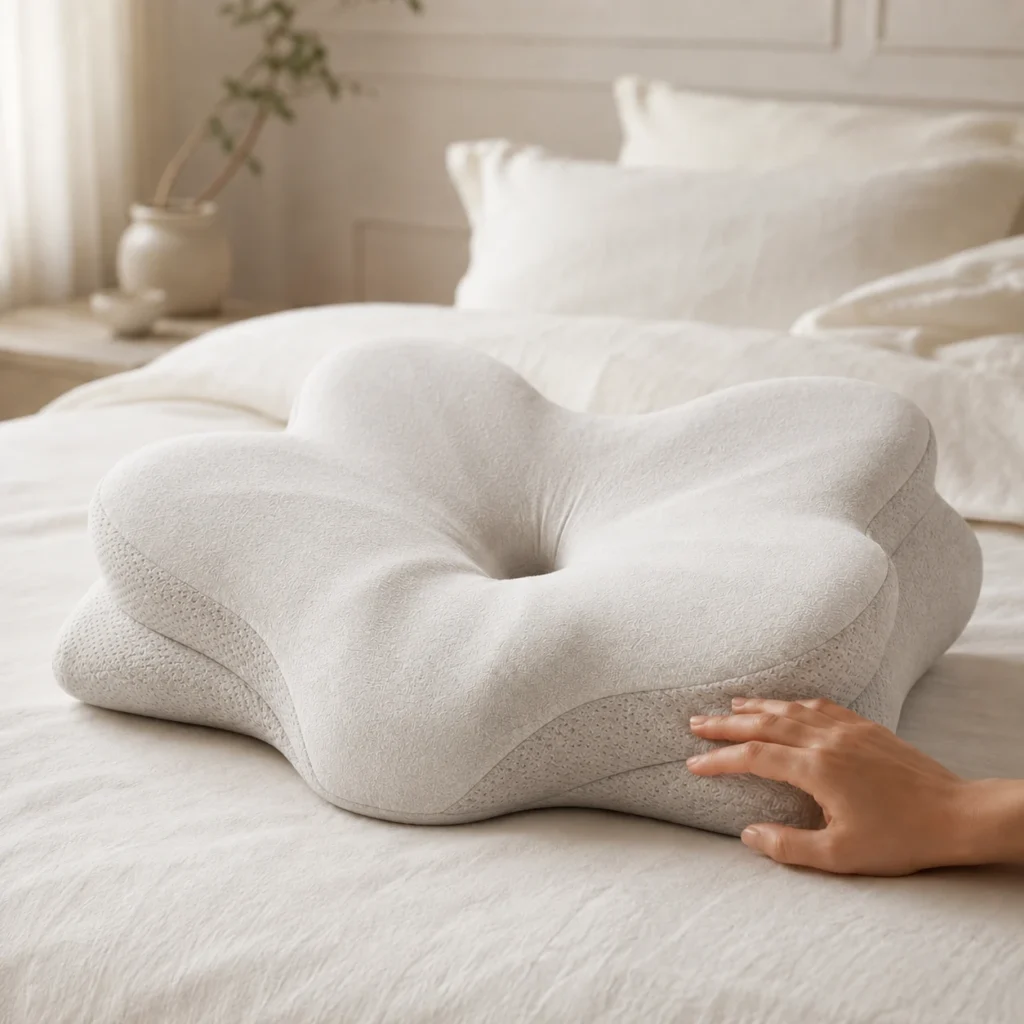
Ergonomic Pillow Option for Side Sleepers
If your current pillow loses shape overnight, leaves your neck unsupported, or doesn’t
account for your shoulder width, an ergonomic contour pillow may be worth trying. The
pillow we recommend is designed around stable loft, cervical support, shoulder clearance,
and a contoured shape made specifically for side sleepers.
When to Look Beyond Your Pillow
Your pillow height may be contributing to your neck stiffness or shoulder discomfort — but it is not the only possible cause, and it is important to be honest about that.
If your neck pain is severe, appeared suddenly after an injury or accident, spreads down your arm, or is accompanied by numbness, tingling, weakness, fever, or persistent headaches that do not improve during the day, speak with a healthcare professional. These symptoms can have causes that a pillow change will not address.
A pillow is one part of your physical sleep environment. It is often an underestimated part, and fixing it can make a significant difference. But it is not a medical intervention, and Fondielle does not present it as one.
If your pain is mild, positional, worst in the morning and better as the day progresses, and has no other accompanying symptoms, your sleep setup is a reasonable and practical place to start.
FAQ
Yes — a pillow with insufficient loft leaves the cervical spine in a downward tilt for the duration of sleep. The muscles along the neck and upper shoulder compensate for this position throughout the night, which may result in stiffness, tension, and discomfort in the morning.
If you consistently wake up with stiffness or tension on the side you sleep on, find yourself adjusting or folding your pillow before you can get comfortable, or notice that your pillow feels significantly flatter in the morning than it did at bedtime, your pillow height may be a factor worth examining.
Most side sleepers find a loft between 4 and 6 inches appropriate, depending on shoulder width. Narrower frames typically need 3 to 4 inches. Average frames typically need 4 to 5 inches. Broader shoulders typically need 5 to 6 inches. Mattress firmness also plays a role — softer mattresses allow the shoulder to sink slightly, which reduces the loft needed.
Yes — when a pillow is too flat, the shoulder on the side you sleep on absorbs more of the head’s weight than it should. This sustained pressure accumulation over a full night may contribute to the shoulder pain and tension some side sleepers experience every morning.
Most people need five to seven nights to fully adjust to a new ergonomic pillow. Some people notice a difference within the first two or three nights. The adjustment period reflects the body adapting to a new sleep position rather than the pillow not working.
If your neck pain is severe, sudden, follows an injury, spreads into your arm, or is accompanied by numbness, tingling, weakness, or symptoms that feel unusual for you, speak with a healthcare professional. A pillow change is appropriate for mild, positional, morning-specific stiffness — not for pain that has other characteristics.
Conclusion
If you wake up with a stiff neck or shoulder tension every morning and you sleep on your side, your pillow height is one of the simplest parts of your sleep setup to check — and one of the most consistently overlooked.
The right pillow does one thing: it fills the gap between your ear and your shoulder completely, keeps your cervical spine in a neutral position, and maintains that support for the full night. That is not a complicated ask. But it is a specific one, and most standard pillows are not designed to meet it.
Start with the measurement tonight. If your current pillow is too flat, collapses overnight, or doesn’t account for your shoulder width, an ergonomic contour pillow may be the simplest next step.