

You went to bed fine. You woke up with that familiar tightness across your upper back — somewhere between your shoulder blades, along your spine, maybe creeping up toward the base of your neck. It takes an hour to loosen. Sometimes two.
And then, by midday, it’s mostly gone.
Until tomorrow morning, when it starts again.
If this pattern sounds familiar, you’ve probably spent time blaming your desk chair, your laptop posture, or the hours you spend looking at a screen. It makes sense — your upper back hurts, you work at a computer, the connection feels obvious.
But here’s what that explanation doesn’t account for: if the problem were happening during the day, the pain would be worse at the end of the day, not the beginning. The fact that it peaks every morning and fades as you move points somewhere else entirely.
It points to what’s happening while you sleep.
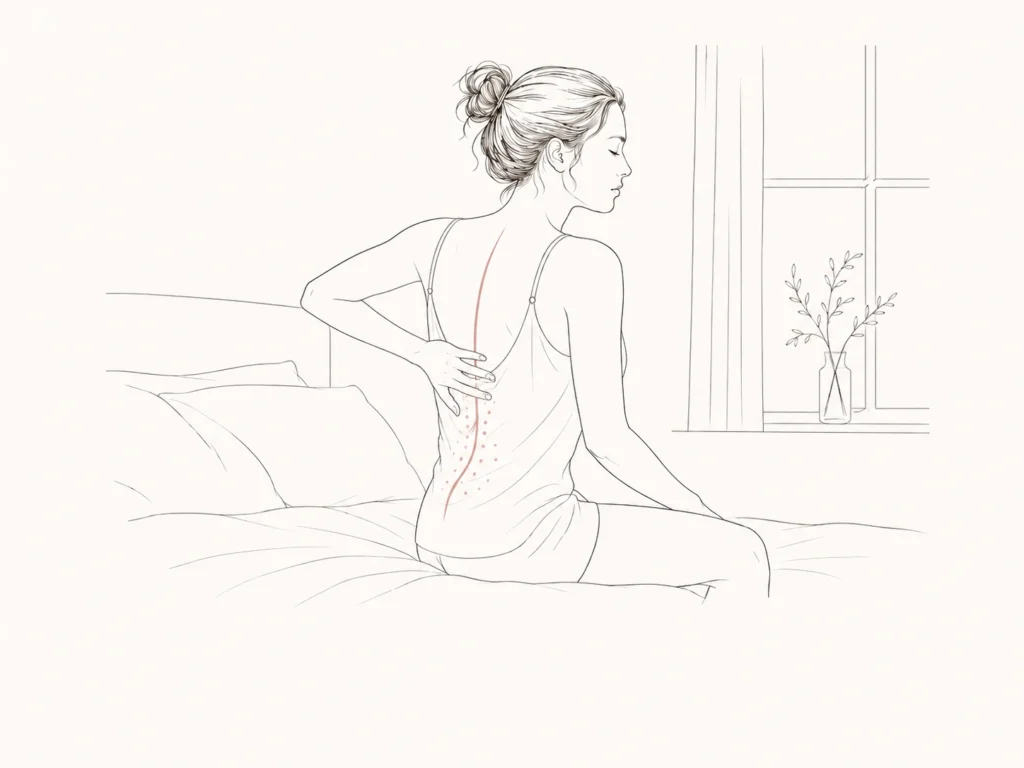
This article explains the physical mechanism behind upper back pain after sleeping — why your thoracic spine and the muscles surrounding it accumulate tension overnight, how your pillow is more involved than most people realize, and what you can check in your sleep setup tonight. If your pain also travels into your neck or you wake up exhausted despite a full night’s sleep, the broader picture is covered in why your neck hurts every morning.
This article may contain affiliate links. If you purchase through our links, Fondielle may earn a small commission at no extra cost to you. We only recommend products we have researched and genuinely believe can support a better sleep environment.
Quick Answer
Upper back pain after sleeping is usually a sign that the muscles in your thoracic spine — the region between your shoulder blades and the base of your neck — were working overnight instead of recovering. When your pillow does not maintain proper cervical alignment, the postural muscles of your upper back compensate for hours, accumulating tension that shows up as stiffness and soreness by morning. The pain tends to fade during the day because movement gradually releases that tension. Your sleep setup — specifically your pillow height, pillow support, and mattress surface — is one of the first places to check.
Free 7-Night Pillow Test Checklist
Not sure if your sleep setup is contributing to your upper back pain? Download the free checklist and track your pillow height, sleep position, and morning comfort over seven nights.
In this guide
Why Does Upper Back Pain Feel Worse in the Morning?
The timing is the clue most people overlook.
If you wake up with upper back pain every morning and it improves throughout the day, the cause is almost certainly nocturnal. Your body spent the night in a position that placed sustained demand on the muscles of your thoracic spine. Those muscles arrived at 7am exhausted — not rested.
This is the opposite of what should happen during sleep. Your postural muscles are supposed to use the night to decompress, recover, and release the tension they accumulated during the day. When your sleep position does not allow that release — when your spine is misaligned, when your pillow is too flat or too thick, when your shoulder has nowhere to go — those muscles maintain a low but continuous level of contraction throughout the night. Seven or eight hours of that contraction is enough to produce real pain by morning.
Movement during the day loosens things gradually. That’s why the pain fades. But the next night, if nothing changes, the cycle repeats.
The pattern of worse in the morning, better by midday is one of the clearest signs that the cause is positional and nocturnal — not occupational or stress-related. If you have been blaming stress or your personality for years of poor sleep, the connection between stress, neck pain and your sleep environment unpacks exactly why that belief keeps so many women stuck.
What Is Your Upper Back Actually Doing While You Sleep?
Most people think of sleep as a passive state. The body lies still. Everything rests. In an ideal setup, that’s largely true. But when your sleep position creates misalignment, certain muscle groups stay active all night to compensate.
Your upper back — the thoracic spine — is a dense, layered region. It connects your neck to your lower spine and anchors your shoulder blades, ribs, and the muscles that hold your posture together throughout the day. Several of these muscles are particularly vulnerable during sleep.
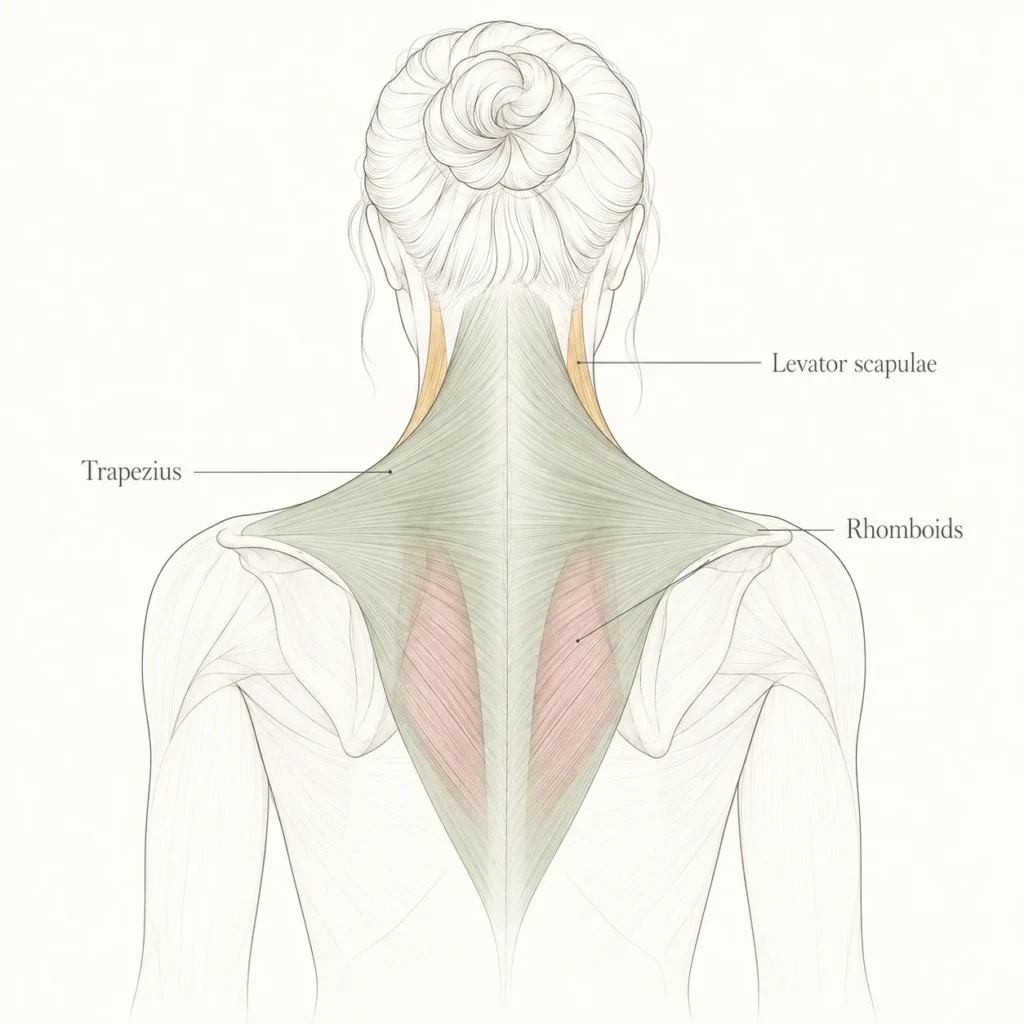
The rhomboids run between your shoulder blades and your spine. Their job is to stabilize the shoulder blade and keep it from winging out. When you sleep on your side with an unsupportive pillow, your top shoulder tends to roll forward. This overstretches the rhomboids for the entire night — and they respond with that characteristic ache between the shoulder blades that greets you in the morning. This is also why women who wake up with a stiff neck every morning often notice upper back tension at the same time — the two symptoms share the same root cause.
The trapezius covers a wide area from the base of your skull down through the upper and mid back. When your head is not properly supported — when your pillow is too flat and your neck angles downward — the upper trapezius holds a low-level contraction to prevent your head from dropping further. Over eight hours, that low-level contraction becomes significant tension.
The levator scapulae connect your cervical spine to the top of your shoulder blade. This muscle is the direct link between your neck position and your upper back pain. When your pillow does not maintain a neutral cervical position, the levator scapulae absorbs the misalignment — and transmits it straight into your upper back by morning.
I blamed my desk chair for two years. I did everything I was supposed to — adjusted my screen height, sat up straighter, took breaks. The upper back tension came back every morning regardless. It wasn’t until I changed my pillow that the morning pain finally stopped. The desk had nothing to do with it.
How Your Pillow Height Affects Your Upper Back
This is the connection that almost nobody makes — and it’s the one that matters most for morning upper back pain.
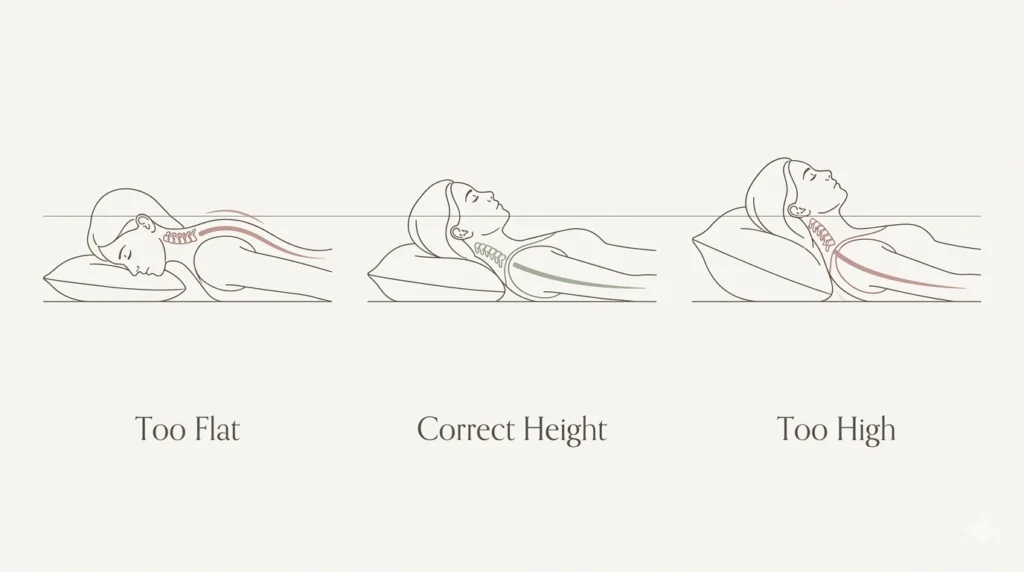
Your pillow determines the angle of your cervical spine during sleep. When that angle is off — when your pillow is too flat, too thick, or has lost its shape by 2am — a chain of muscular compensation begins in your neck and travels directly into your upper back.
There is one habit worth mentioning before we get to the sequence, because it makes everything that follows worse. Many women spend the last fifteen to thirty minutes before sleep scrolling on their phone, propped against the headboard, head tilted forward and chin dropped toward the chest. This position — sometimes called text neck — places the levator scapulae under load at the exact moment it should be winding down. Research on cervical spine mechanics suggests that a head tilted forward at just thirty degrees can multiply the effective load on the neck muscles significantly compared to a neutral position. By the time you put the phone down and close your eyes, your levator scapulae is already fatigued. It then spends the next seven or eight hours in a misaligned position determined by your pillow. The two compound each other. If this habit sounds familiar, it is worth noting — not as a reason to feel guilty, but as one more variable that is entirely within your control to change.
Here is the physical sequence:
Step one: Your pillow does not adequately fill the space between your neck and the mattress. Your head either drops down or angles up — depending on whether the pillow is too flat or too thick.
Step two: Your levator scapulae and upper trapezius register the misalignment. They begin a compensatory hold to stabilize the position of your head and neck.
Step three: That compensation is transmitted to the rhomboids and the muscles along the thoracic spine. They engage to support the chain of tension coming from above.
Step four: This engagement continues for the entire night. By morning, those muscles are fatigued, contracted, and painful.
The critical point is this: the pain you feel between your shoulder blades and along your upper spine may be originating in your neck — specifically in the gap between your neck and your mattress that your pillow is failing to fill.
For side sleepers, the pillow must fill the full distance between your ear and the mattress — which is essentially the width of your shoulder. A pillow that is too thin leaves your neck angled downward. A pillow that is too thick pushes your head up and compresses the cervical vertebrae on the opposite side. Either direction creates muscular compensation that travels down into the thoracic spine. If you are not sure what height your pillow should actually be, the right pillow height for side sleepers explains exactly how to measure it.
The right pillow height keeps your head, neck, and spine in a straight, horizontal line when you’re lying on your side. Your ear should be directly above your shoulder. Your chin should be neither tucked down nor lifted up. In this position, the muscles of your upper back can finally release.
What Your Mattress May Be Doing to Your Shoulder Blades
The pillow is the first thing to check — but the mattress is the second.
Your shoulder blades are prominent bony structures. When you lie on your side, the lower shoulder blade bears significant pressure against the mattress surface. A mattress that is too firm does not allow the shoulder to sink in naturally, which creates localized pressure at the blade and forces the surrounding muscles into a protective contraction. A mattress that is too soft allows the entire shoulder and hip to sink too far, pulling the thoracic spine into lateral flexion throughout the night. This pressure dynamic is also why side sleepers often wake up with shoulder pain — the shoulder and the upper back are part of the same overnight pressure chain.
A mattress that is worn, sagging in the middle, or uneven in its support creates asymmetrical pressure on the thoracic spine — meaning one side of your upper back may be under more strain than the other, which can explain why the pain is worse on your dominant sleeping side.
The relationship between your mattress and your upper back pain is harder to isolate than the pillow — because mattresses are expensive and difficult to test in one night. But if you have already addressed your pillow and the morning upper back pain persists, the mattress surface is the logical next variable to examine.
A medium-firm surface that allows your shoulder to sink slightly while maintaining the natural curve of your thoracic spine is generally the most supportive configuration for side sleepers with upper back discomfort.
Signs Your Upper Back Pain May Be Coming From Your Sleep Setup
The following signs suggest your morning upper back pain has a positional, nocturnal cause — rather than a structural or medical one.
- The pain is present at the moment you wake up and decreases noticeably within the first one to two hours of movement
- The pain is consistently worse after a longer night of sleep than after a shorter one
- The soreness is concentrated between your shoulder blades, along your thoracic spine, or in the upper trapezius area — rather than in a sharp, localized point
- The pain is more pronounced on the side you sleep on most — your dominant sleep side
- You tend to wake up in a noticeably different position from where you fell asleep — your body has been searching for comfort overnight
- Your current pillow feels noticeably flat by the time you wake up, or you find yourself using your arm to prop your head
- Gentle movement in the first hour — walking, light stretching, morning activity — relieves most of the discomfort
- You sleep a full seven or eight hours and still feel unrestored — if this is familiar, the physical discomfort overnight may also be fragmenting your deep sleep through micro-arousals, which is covered in detail in why you wake up more tired than when you went to bed
If most of these apply, your sleep setup is a logical first place to address. The cause is physical and environmental. Physical and environmental causes have physical and environmental solutions.
How to Check Your Sleep Setup Tonight
You do not need to buy anything tonight to begin diagnosing this. Start with three checks.
Check one — Your pillow height
Lie in your usual sleep position and have someone look at your head and neck alignment, or use a mirror or photograph. Your head should form a continuous line with your spine — not angled down toward the mattress, and not pushed up away from it. If your pillow has compressed significantly since you bought it, or if it feels flat under your neck within the first hour of sleep, the loft is insufficient.
For side sleepers, the fill distance from your ear to your shoulder is the measurement your pillow needs to match. Most standard pillows do not account for shoulder width and collapse before morning.
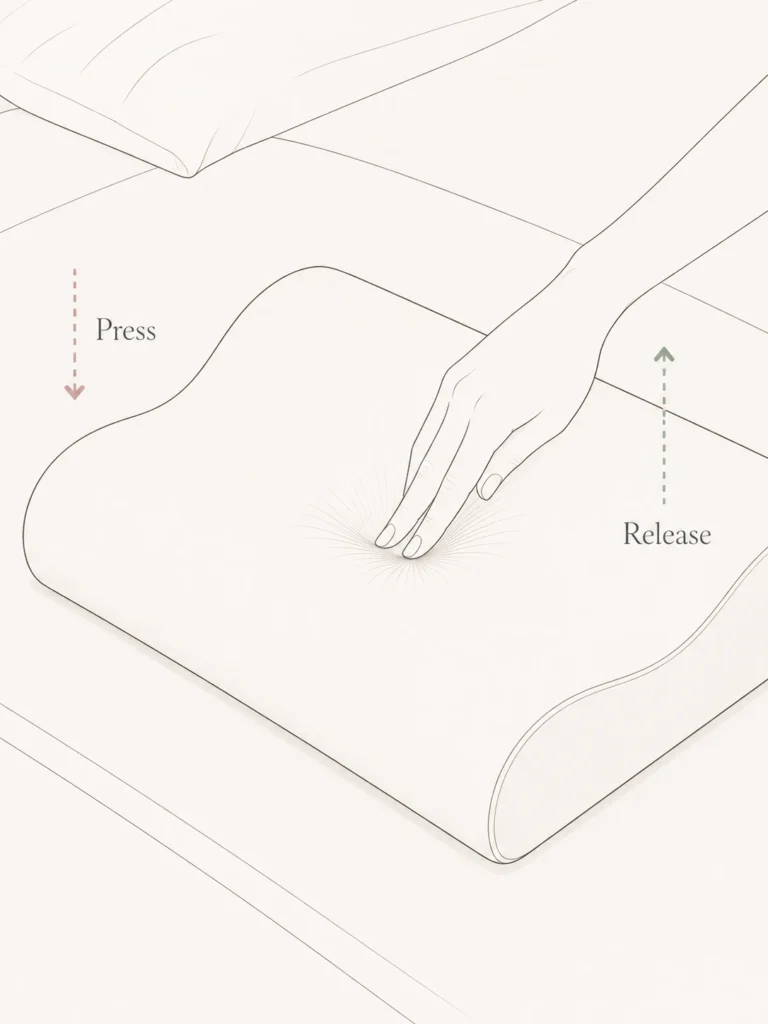
Check two — Your pillow’s shape consistency
Press your pillow firmly in the center and release. Does it return to its original shape within a few seconds, or does it stay compressed? A pillow that does not recover its shape is a pillow that is failing you by 2am — long before you wake up.
Memory foam that holds its density, or a pillow with a contoured design that maintains its structure, addresses this directly.
Check three — Your mattress surface at shoulder level
Lie on your side and feel where your shoulder meets the mattress. Is there pressure at the blade? Does your shoulder feel as though it is being pushed inward or upward? Is there a slight sagging in the mattress beneath your hip or shoulder that creates a tilt in your thoracic spine?
If you can identify pressure or misalignment at shoulder level, the mattress surface is contributing to your morning pain.
Ergonomic Pillow Option
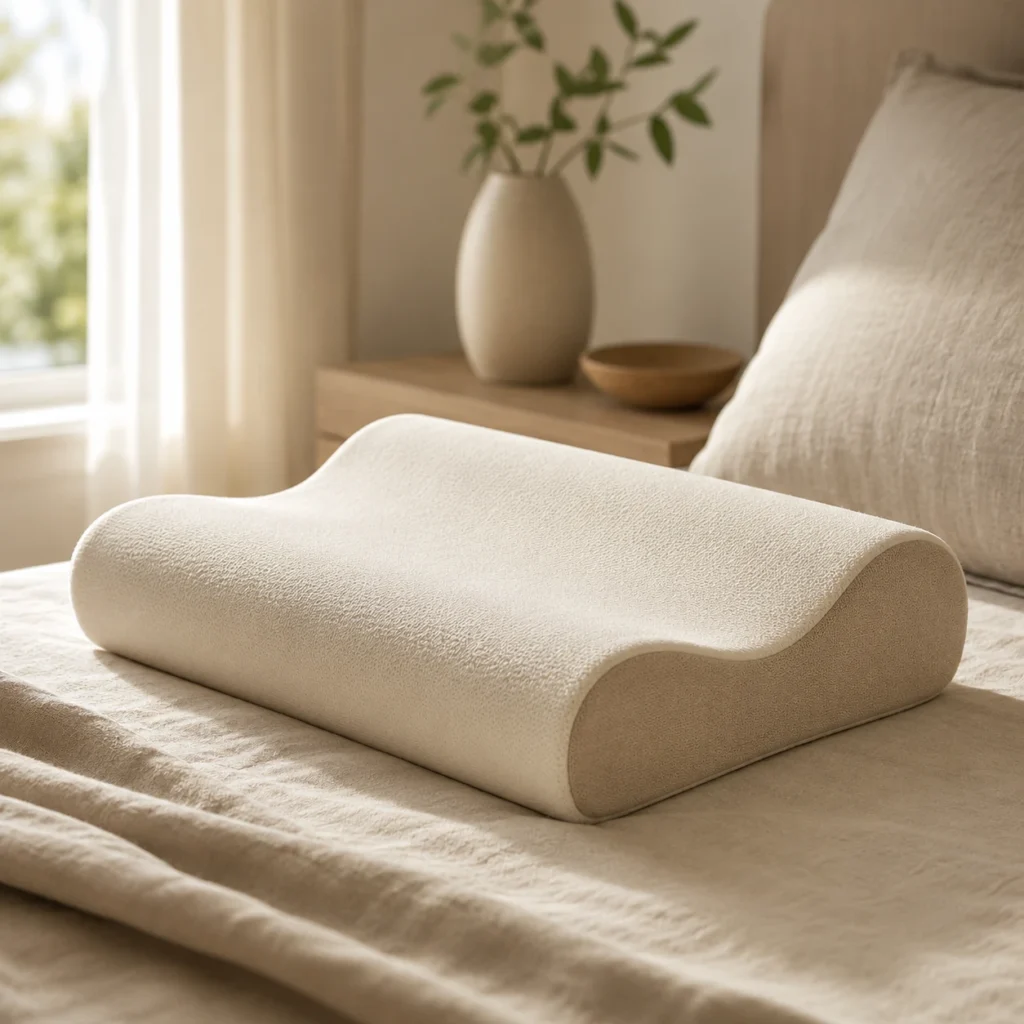
If your current pillow loses shape overnight, feels too flat by morning, or leaves your neck angled and unsupported, an ergonomic contour pillow may be worth considering. The pillow we recommend is designed around stable loft, cervical support across five dedicated zones — including shoulder clearance and arm support — and a material that maintains its shape from the moment you fall asleep to the moment you wake up.
A contour design also creates natural space for the shoulder, which directly reduces the pressure on the rhomboid muscles and upper trapezius that side sleepers accumulate overnight.
When It May Not Be Your Sleep Setup
Your sleep setup is one of the most common and most overlooked contributors to morning upper back pain — but it is not the only possible cause.
If your upper back pain is severe, worsens progressively over weeks, or does not improve at all with movement during the day, speak with a healthcare professional. The same applies if the pain radiates into your arm, is accompanied by numbness or tingling in your hands, follows an injury, or is present with other symptoms such as fever, difficulty breathing, or unexplained fatigue.
Upper back pain that wakes you up during the night — rather than being present when you wake up — may also indicate something that warrants professional evaluation.
For most women who wake up with morning upper back stiffness that fades by midday, the cause is positional and addressable. But your own body is the best guide. If something feels different from the pattern described here, take it seriously and get a proper assessment.
Frequently Asked Questions
If the pain peaks in the morning and fades as you move through the day, the cause is almost certainly nocturnal. Your postural muscles — particularly the rhomboids, trapezius, and levator scapulae — accumulate tension overnight when your spine is not properly supported. Movement during the day releases that tension gradually. The pattern of worse in the morning, better by afternoon is a strong indicator that your sleep setup is contributing to the problem.
Yes — more directly than most people expect. Your pillow determines the angle of your cervical spine during sleep. When that angle is off, a chain of muscular compensation travels from your neck into the muscles of your upper back. A pillow that is too flat, too thick, or loses its shape overnight can contribute to the morning upper back stiffness and soreness that many women experience.
Morning stiffness in the upper back is typically the result of muscles that contracted overnight rather than releasing. Your thoracic spine muscles are postural muscles — they engage during the day to hold you upright. At night, they should decompress. When your sleep position creates misalignment, they stay partially engaged, accumulating the stiffness you feel at the moment of waking.
A mattress that is too firm can create pressure points at the shoulder blades, forcing surrounding muscles into a protective contraction. A mattress that is too soft or has begun to sag may allow the thoracic spine to fall into lateral flexion overnight. Both configurations can contribute to morning upper back pain, particularly for side sleepers. If you have addressed your pillow and the pain persists, the mattress surface is worth examining.
For most people, upper back pain that originates from a sleep setup issue fades within one to two hours of waking as movement gradually releases overnight muscle tension. If the pain lasts through most of the day, does not improve with movement, or is severe enough to interfere with daily activity, it is worth speaking with a healthcare professional.
Speak with a healthcare professional if the pain is severe, worsening, or not improving with movement. Also seek professional evaluation if the pain is accompanied by numbness, tingling, or weakness in the arms or hands — radiating symptoms that suggest nerve involvement. Pain that wakes you during the night, rather than being present only on waking, also warrants a proper assessment.
Start With One Thing Tonight
If you wake up with upper back pain every morning and the pain fades by midday, your sleep setup is one of the most logical places to start.
The muscles that hurt — the rhomboids, the trapezius, the levator scapulae — do not accumulate eight hours of tension for no reason. They were compensating for a position your body could not sustain comfortably. That position was determined by your pillow, your mattress, and the alignment of your cervical and thoracic spine throughout the night.
Start with your pillow tonight. Check whether it maintains its height from when you fall asleep to when you wake up. Check whether your head and neck form a straight line with your spine when you lie on your side. If either of those is off, you have found something concrete to change.
The problem is physical. Physical problems have physical solutions. And physical solutions can be tested starting tonight.
Free 7-Night Pillow Test Checklist
Track your pillow height, sleep position, and morning upper back comfort over seven nights. A simple, structured way to know whether your sleep setup is contributing to your morning pain.