

You slept eight hours last night. You went to bed early. You did everything right.
And yet here you are — waking up with a stiff neck before you’ve even had your first coffee.
That tightness that takes 45 minutes to fade. That dull ache on the side you slept on. The feeling that your body should be rested — but something is clearly wrong.
If this sounds like your mornings, you are not imagining it. And you are not broken. There is a physical reason this keeps happening. — and it is one of the most common reasons women wake up with neck pain every morning. In most cases, it is lying right there under your head.
I know this because I lived it for three full years.
I am a 34-year-old freelance copywriter. I work from home, manage my own schedule, and have every possible advantage for good sleep — no commute, no fixed alarm, no one waking me up. And from the age of 30 to 33, I woke up with a stiff neck almost every single morning. I blamed my desk posture. I blamed the stress of running my own business. I assumed it was just what getting older felt like. I tried chamomile tea, morning neck stretches, and eventually bought three different standard pillows — each time hoping that a new one would finally fix it.
None of them did. Not because I chose poorly. But because I had never understood the actual mechanical problem. Every one of those pillows compressed under the weight of my head during the night and left my cervical spine unsupported for hours. The pillow loft — the height the pillow maintains while you are lying on it — was the issue. Nobody had ever told me that was something to think about.
This article may contain affiliate links. If you purchase through our links, Fondielle may earn a small commission at no extra cost to you. We only recommend products we have researched and genuinely believe can support a better sleep environment.
Quick Answer
If you wake up with a stiff neck every morning, your pillow is one of the most likely physical causes. A pillow that is too flat, too soft, or has lost its shape overnight may leave your cervical spine unsupported for seven or eight hours straight. That sustained misalignment can cause the neck muscles to remain under tension all night — which is why the stiffness is worst first thing in the morning and tends to ease as you move during the day. Checking your pillow height, shape, and material is one of the simplest first steps you can take tonight.
Free 7-Night Pillow Test
Not sure if your pillow is causing your stiff neck? Download the free checklist and track your pillow height, sleep position, and morning neck comfort over seven nights.
In This Guide
Why Is My Neck Stiff Every Morning — But Fine by the Afternoon?
This pattern is one of the clearest signs that the cause is positional, not structural.
When morning neck stiffness fades within an hour or two of moving around, it usually means the muscles have been held in a compressed or overstretched position during the night — and movement gradually releases that tension. If the cause were a serious underlying condition, the stiffness would typically persist throughout the day or worsen with activity rather than improve.
The neck has a natural lordotic curve — a gentle C-shape that faces forward. This curve acts as a shock absorber, distributing the weight of the head across the joints, discs, and ligaments of the cervical spine. When you are upright during the day, your muscles actively maintain this curve. When you lie down at night, your pillow takes over that job.
If your pillow does not support that curve correctly, your muscles do not fully switch off. They remain in a low-level state of tension — working to compensate for the lack of support — for the entire duration of your sleep. Seven or eight hours of that is enough to produce the stiffness you feel when you wake up.
The reason it clears during the day is simple: movement restores circulation to the muscles, and your body resumes active postural control. The problem is not that your neck healed overnight. The problem is that it never actually rested.
What Your Pillow Is Actually Doing to Your Neck While You Sleep
Most people think of a pillow as a comfort item. Something soft to rest your head on. But for a side sleeper especially, a pillow is a structural support device. Its job is to fill the gap between your head and the mattress and hold your cervical spine in a neutral position for the full duration of your sleep.
When that gap is not properly filled, the physics are straightforward and unavoidable.
The Gap Problem
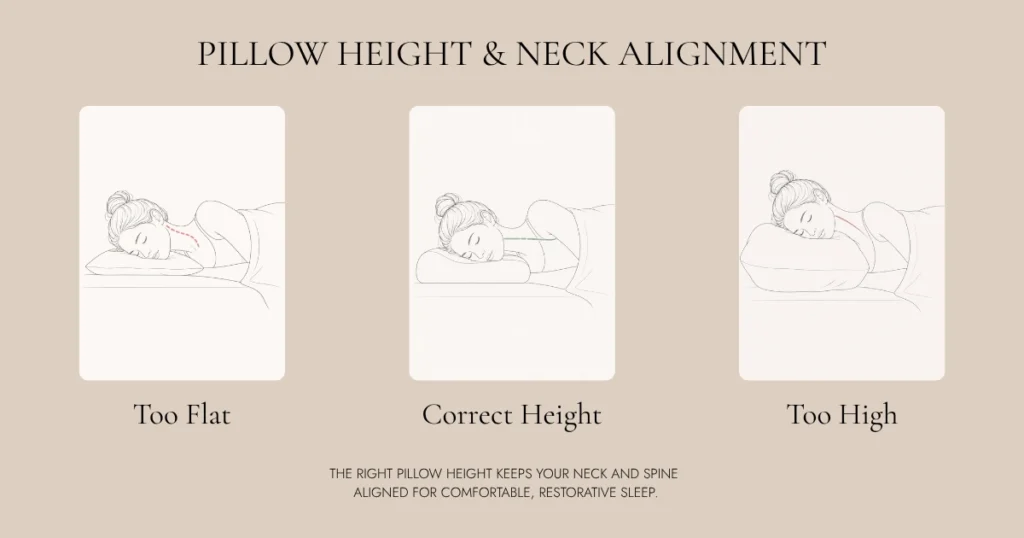
When you lie on your side, there is a space between your ear and your shoulder. That space needs to be filled precisely by your pillow. If the pillow is too flat, your head drops toward the mattress and your cervical spine bends downward. The muscles on the upper side of your neck are stretched. The muscles on the lower side are compressed. Both groups respond the same way: they tighten.
If the pillow is too high, the opposite happens. Your head is pushed upward, the cervical spine bends toward your shoulder, and the muscles on the lower side are now the ones under strain.
In either case, those muscles spend the entire night working against the position rather than resting in it.
The Loft Problem
Pillow loft is the term for a pillow’s height when you are lying on it. Not the height it shows on the shelf, but the height it maintains under the weight of your head throughout the night.
This distinction matters because most standard pillows — especially those filled with down, down alternative, or lower-density foam — compress significantly under the weight of the head. A pillow that starts at four inches of loft may compress to two inches or less by 3am. At that point, the support you thought you had has disappeared, and your neck spends the second half of the night without it. The pillow feels fine when you lie down. By the time the problem is doing its damage, you are already asleep.
The Micro-Arousal Problem
There is a third mechanism that connects pillow support to sleep quality more broadly.
When your body registers physical discomfort during sleep — even at a level too low to fully wake you — the brain briefly activates to assess the situation. These moments are called micro-arousals. They last only a few seconds and most people have no memory of them. But they interrupt the deeper stages of sleep, including the stages where physical recovery and muscle restoration actually happen.
A pillow that leaves your neck poorly supported can generate micro-arousals throughout the night. The result is not just morning stiffness — it is also the feeling of waking up unrefreshed despite having slept a full seven or eight hours.
How Much Pillow Height Do Side Sleepers Actually Need?
For a side sleeper, the correct pillow height is the distance between the mattress and the side of your head when your spine is in a neutral position. That measurement is roughly equal to the width of your shoulder. If you want to go deeper on this, we cover the exact numbers by body type in our guide to what pillow height side sleepers actually need.
In practical terms, most side sleepers need a pillow with a loft of between three and five inches when compressed under the weight of the head. The exact number depends on:
- Shoulder width — broader shoulders create a larger gap and require more loft
- Mattress firmness — a softer mattress allows the shoulder to sink further, which reduces the gap slightly; a firmer mattress keeps the shoulder higher, which increases it
- Head size and weight — a heavier head compresses the pillow more, so a higher starting loft is needed to maintain the correct resting height
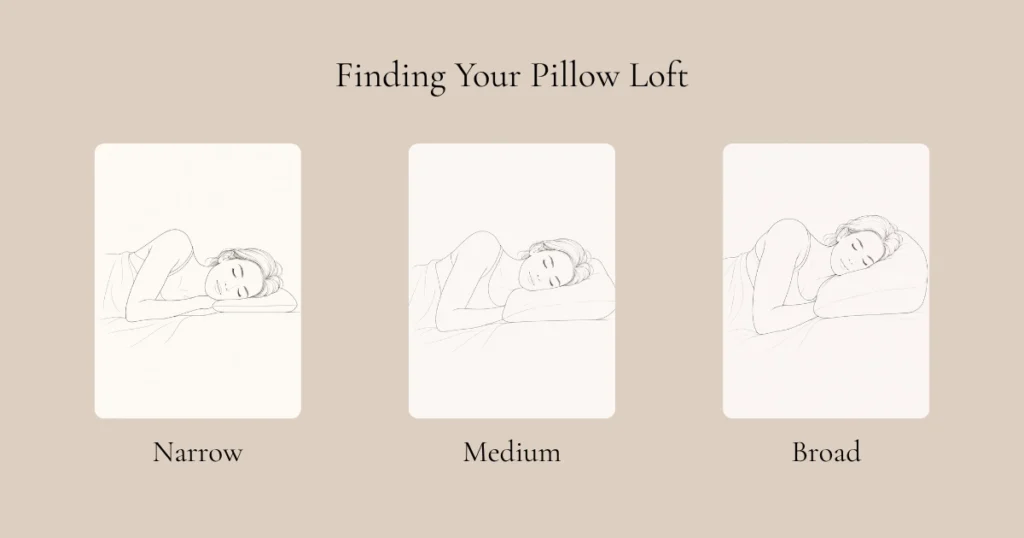
The clearest way to check whether your current pillow is at the right height is to look at your neck position from a lateral view — ideally in a mirror or on video. If your neck is angled downward toward the mattress, the pillow is too flat. If it is angled upward toward the ceiling, the pillow is too high. If your ear is level with your shoulder and your spine forms a straight line, the height is correct.
Signs Your Pillow May Be Causing Your Stiff Neck
These are the patterns to look for. If two or more of these describe your mornings, your pillow is a reasonable first place to investigate.
The stiffness is worst immediately after waking and improves within an hour or two. This pattern points to a positional cause rather than a structural one.
The stiffness is on one side — specifically the side you sleep on. Bilateral morning stiffness can have multiple causes. One-sided stiffness that matches your sleep position is a more direct signal.
You wake up in a different position from where you started. If your body is moving around significantly during the night, it may be searching for a position where the neck is more comfortable. This is a sign of postural discomfort, not restlessness.
Your pillow is flat, folded, or misshapen by morning. If you find yourself folding the pillow in half or stacking two pillows, the loft of your current pillow is insufficient.
You have had the pillow for more than two years. Most pillows — particularly those filled with synthetic fibres or standard foam — lose a significant proportion of their loft and support within eighteen months to two years of regular use.
The stiffness has been consistent for months and nothing has changed it. If neck stretches, posture improvements, and sleep hygiene changes have made no difference, the cause may be environmental rather than habitual.
Free 7-Night Pillow Test
If you recognise two or more of the signs above, use the free 7-night checklist to track your pillow height, sleep position, and morning neck comfort systematically.
What to Look for in the Best Side Sleeper Pillow for Neck Pain (UK Guide)
Before considering any specific product, it helps to understand the criteria a pillow needs to meet. Whether you are looking for the best pillows for side sleepers in the UK or simply trying to work out why your current one keeps failing, these are the functional requirements — not marketing descriptions.
Stable loft throughout the night. The pillow must maintain its height from the time you fall asleep to the time you wake up. A pillow that compresses to half its height by midnight has stopped doing its job. High-density memory foam is the material most consistently associated with stable overnight loft.
A contoured or cervical shape. A flat rectangular pillow provides uniform height across its surface. A contoured pillow is designed to be slightly lower in the centre — where the head rests — and slightly higher at the edges — where the neck and cervical curve need more support. This shape actively fills the gap between the neck and the mattress rather than just supporting the head.
Adequate firmness for side sleeping. A pillow that is too soft will compress under the weight of the head regardless of its starting loft. For side sleepers, a medium-firm to firm density is generally more effective at maintaining neutral alignment.
Shoulder clearance. A standard rectangular pillow does not account for the shoulder. When a side sleeper’s shoulder contacts the edge of the pillow, it can push the pillow upward and create pressure on the neck. This is particularly relevant if you are looking for a pillow for neck and shoulder pain as a side sleeper — the shoulder position is not a secondary consideration, it is part of the same alignment problem. A pillow designed specifically for side sleepers will either be shaped to accommodate the shoulder or sized to prevent this contact.
A cooling cover. Heat discomfort during the night can contribute to tossing and turning, which compounds postural problems. A breathable cover helps regulate sleep surface temperature and reduces this variable.
The ergonomic pillow we recommend is designed around all five of these criteria. It uses high-density memory foam that maintains its loft throughout the night, a contoured shape with a dedicated Zone 2 Cervical Bolster (Neck Massage Area) that fills the gap between the neck and the mattress, and a butterfly design that creates space for the shoulder to rest without creating upward pressure on the pillow. It is designed for side and back sleepers, and it includes a cooling cover as standard.
Most people begin to notice a difference within five to seven nights, as the body adjusts to the new support position. The first two or three nights can sometimes feel different — not uncomfortable, but unfamiliar — as muscles that have been compensating for a poorly supported neck begin to release that tension.
Imagine waking up and your
first thought isn’t your neck.
No stiffness. No tight shoulders. Just the quiet clarity of a body that actually rested overnight.
Your morning stiffness was never about your stress or your age. It was mechanical. And mechanical things can be fixed — tonight.
The pillow we recommend was designed around one idea: your neck deserves full support for the entire night, not just the first hour.
Give it seven nights. Your body will tell you everything.
Risk-free · 60-day trial

A Simple Test You Can Do Tonight
Before purchasing anything, there is a quick test that can tell you a great deal about your current pillow.
Place your pillow on a flat surface and fold it in half. Press down firmly and release. Watch what happens.
If the pillow slowly returns to its original shape over several seconds, the material has reasonable recovery properties. If it flops back immediately with no resistance, the fill is too soft and likely to compress significantly under your head. If it stays folded and does not return to shape on its own, the fill has already broken down.
A second test: lie on the pillow in your usual sleep position and have someone look at the alignment of your ear and shoulder. If your neck is visibly angled rather than level, the pillow height is not correct.
Neither test is definitive. But both can give you useful information about whether your current pillow is structurally capable of supporting your neck through the night.
When Morning Neck Stiffness May Not Be About Your Pillow
Your pillow may be contributing to the problem, but it is not the only possible cause of morning neck stiffness. It is worth being aware of the following.
If your neck stiffness lasts longer than an hour or two in the morning without improving, this is worth noting. Stiffness from a positional cause typically eases with movement. Stiffness that persists throughout the day or worsens with activity may suggest a different cause.
If the stiffness is accompanied by pain that radiates into your arm or hand, numbness or tingling in your fingers, weakness in your arm, severe headaches, or fever, these symptoms warrant a conversation with a healthcare professional rather than a pillow change.
If you have had a recent neck injury, a fall, or any impact to the head or neck, the stiffness should be assessed professionally before you attribute it to your sleep setup.
Morning neck stiffness is extremely common and, in most cases, related to sleep position and pillow support. But the symptoms above suggest causes that fall outside the scope of a sleep environment guide. If you are in any doubt, speaking with a healthcare professional is the right first step.
FAQ
Yes, it can contribute significantly. A pillow that does not maintain correct cervical alignment — because it is too flat, too soft, or has lost its shape — can place the neck muscles under sustained tension for the full duration of sleep. When this happens every night, the stiffness becomes a consistent morning pattern. It is one of the most common and most overlooked causes of recurring morning neck discomfort.
Because movement restores circulation to the muscles and your body resumes active postural control. The stiffness that clears within an hour or two of waking is typically the result of muscles releasing tension that accumulated overnight. If the cause were structural rather than positional, the stiffness would not resolve so predictably with movement.
Side sleepers generally need a pillow with enough loft to fill the gap between their ear and shoulder when lying on their side — roughly equal to their shoulder width. This is typically between three and five inches of compressed height, though it varies depending on shoulder width, mattress firmness, and head weight. If your neck angles downward toward the mattress, the pillow is too flat. If it angles upward, the pillow is too high.
The most consistent indicators are: stiffness that is worst immediately after waking and improves within an hour, stiffness on the same side you sleep on, a pillow that is flat or misshapen by morning, and no improvement from stretching or posture changes. If two or more of these describe your situation, checking your pillow is a reasonable starting point.
Most pillows benefit from replacement every one to two years, particularly those filled with synthetic fibres or standard foam. A simple fold test — folding the pillow in half and checking whether it returns to its original shape — can give you a basic sense of whether the fill has broken down. High-density memory foam pillows generally maintain their loft longer than softer fills.
If the stiffness does not improve with movement, is accompanied by pain radiating into the arm or hand, numbness, tingling, weakness, or severe headaches, or if it follows an injury, speak with a healthcare professional. These symptoms suggest causes that a pillow change would not address.
The Physical Cause Has a Physical Fix
You have been waking up with a stiff neck every morning. Possibly for months. You have probably blamed your stress, your mattress, your posture at your desk, or just the way your body works.
But if the stiffness is worst when you wake up and clears during the day, the cause is most likely postural. And postural causes are physical. Physical things can be measured, tested, and changed. If you want the full picture of why your neck hurts every morning — beyond just the pillow — our complete guide covers every mechanism at play.
Start with your pillow tonight. Check whether it maintains its height. Check whether your neck is level when you lie on it. Give it seven nights of honest observation.
Your mornings will tell you what you need to know.
Not sure where to start? Download the free 7-night pillow test checklist and track your pillow height, sleep position, and morning neck comfort in one simple guide.
Or, if your current pillow is already flat, misshapen, or failing the fold test: