

You slept eight hours. You tracked it, you went to bed on time, you even avoided your phone for the last thirty minutes. And yet you woke up this morning feeling like the night barely happened.
If this keeps happening, you’ve probably started asking yourself: why am I still tired after 8 hours of sleep? You might blame your schedule, your age, or your stress levels. Maybe you’ve decided you’re just “one of those people” who needs more sleep than everyone else.
Here’s what nobody tells you: the number of hours you sleep and how rested you feel are two different things. You can get a full eight hours and still wake up exhausted if your body never settles into deep, uninterrupted sleep — and your bedroom setup is one of the most common reasons that happens. If mornings also come with a stiff neck or that dull, draining tiredness you can’t quite explain, our guide on why you wake up with neck pain covers the bigger picture of how pillow support and sleep posture tie into both problems.
Quick answer
If you sleep 7–9 hours but still wake up tired, the problem is usually sleep quality, not sleep duration. Physical discomfort from your pillow, mattress, or bedroom temperature can trigger repeated micro-arousals — brief moments where your brain partially wakes to adjust to discomfort, without you remembering it the next day. These interruptions fragment deep sleep, which is the stage your body relies on to feel rested. Some medical or hormonal factors can also play a role, but checking your sleep setup — pillow support, mattress pressure points, and room temperature — is one of the easiest first steps.
Free Sleep Environment Checklist
Not sure where to start? Download the free Sleep Environment Checklist and check your pillow, bedding, room temperature, and morning comfort in one simple tracker.
In this guide
Still Tired After 8 Hours of Sleep? What’s Actually Happening at Night
Feeling exhausted despite a full night’s sleep usually means your sleep isn’t reaching — or staying in — its deepest stages. Sleep happens in cycles, and within each cycle your body moves through lighter stages and deeper, more restorative ones. If something interrupts that progression repeatedly throughout the night, you can spend eight hours in bed without getting the deep sleep your body actually needs to recover.
The interruptions don’t have to be big. They don’t have to wake you up in any way you’d notice. A stiff neck, a shoulder under pressure, or a room that’s slightly too warm can be enough to pull your brain out of deep sleep over and over again — while you stay asleep the entire time.
This is why two people can both sleep eight hours and wake up feeling completely different. The hours are the same. What happened during those hours wasn’t.
Sleep Duration vs Sleep Quality: Why the Clock Lies
Sleep duration is simply how many hours you spend asleep. Sleep quality is how much of that time was spent in the deeper stages your body needs for physical recovery — and your clock has no way of telling you which one you actually got.
You can think of it like this: spending eight hours in a noisy waiting room is not the same as spending eight hours in a quiet bed, even though the clock says the same thing. Your body needs uninterrupted time in deep sleep to repair tissue, consolidate memory, and reset for the next day. If that time keeps getting cut short — even by a few seconds at a time — duration stops being a useful measure of how rested you’ll feel.
This is also why sleep trackers can be misleading. Many trackers measure time asleep, not the quality of that sleep. A tracker might tell you that you got 8 hours and 12 minutes — and still miss the dozens of small disruptions that happened along the way.
What are micro-arousals, and why don’t I notice them?
Micro-arousals are brief moments where your brain partially wakes up — often for only a few seconds — usually in response to physical discomfort, noise, light, or temperature change. They’re too short to remember, and most people have no idea they’re happening.
Here’s the part that surprises most women: you don’t have to fully wake up for a micro-arousal to affect your sleep. Your brain can shift you out of deep sleep, adjust your position, and settle you back down — all without you ever becoming consciously aware of it. Repeat that process dozens of times a night, and you can understand why eight hours in bed doesn’t always translate to eight hours of real rest.
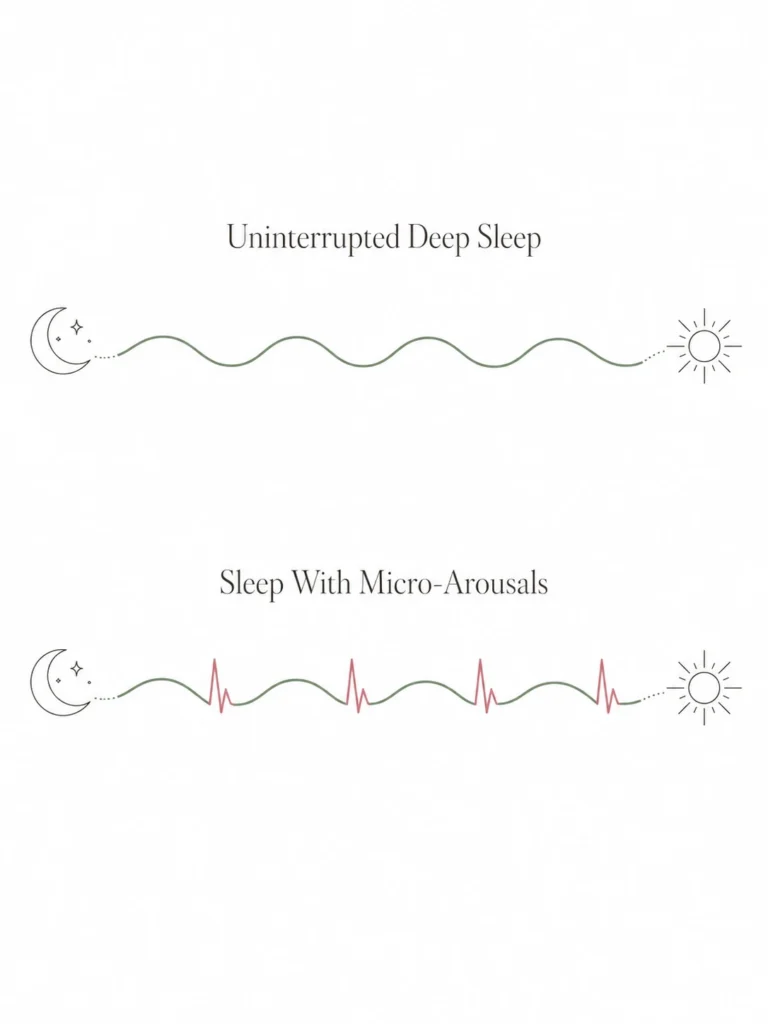
Common physical triggers for micro-arousals include:
- A pillow that doesn’t support your neck in a neutral position
- Shoulder pressure on the side you sleep on
- A mattress that no longer distributes your weight evenly
- A bedroom that’s too warm for deep sleep
- Light or noise that filters in during the night
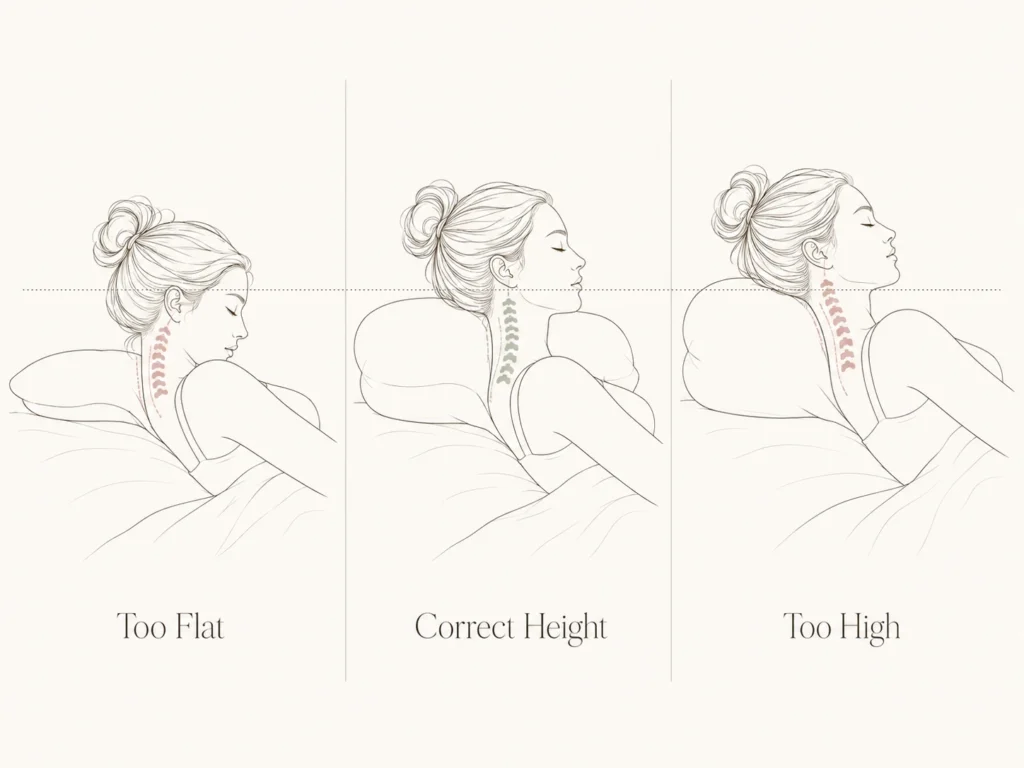
None of these have to be dramatic to add up. A pillow that’s slightly too flat, night after night, can be enough — and if your pillow is also causing a stiff neck every morning, that’s often the clearest sign that the same underlying issue is behind both problems.
Non-Restorative Sleep Causes: The Role of Your Pillow and Mattress
Yes, your pillow and mattress can absolutely affect how rested you feel — and this is often the part of the sleep environment that gets overlooked the longest, because it’s so familiar that it stops being questioned.
If your pillow doesn’t keep your head, neck, and spine in a neutral line, your neck muscles stay slightly engaged all night, even while you’re asleep. Your body registers that tension and responds with small positional adjustments — the micro-arousals described above. The same applies to a mattress that no longer holds its shape: pressure builds under your hips or shoulders, and your body shifts to relieve it, disrupting the sleep cycle each time.
This is exactly the situation many women find themselves in for years without connecting the dots. The pillow looks fine. It feels normal, because it’s the only thing they’ve ever slept on. But “normal” and “supportive” aren’t always the same thing — and a pillow that has lost its shape can be quietly working against deep sleep every single night. If you sleep on your side, what pillow height side sleepers actually need goes into more detail on how to tell whether your current pillow is the right size for your shoulders in the first place.
Signs your sleep environment may be fragmenting your sleep
You may not remember waking up during the night, but your environment may still be interrupting your sleep if you recognize several of these signs:
- You sleep 7–9 hours but still feel drained in the morning
- You wake up in a completely different position than you fell asleep in
- Your pillow feels flat, lumpy, or different from when you bought it
- You sometimes wake up with a stiff neck, sore shoulder, or numb arm
- Your bedroom feels warm or stuffy by the middle of the night
- You feel more rested after a short nap in a different spot (like the couch) than after a full night in bed
Recognizing two or three of these doesn’t mean your sleep environment is the only factor — but it’s a strong sign it’s worth checking first, since it’s one of the easiest things to test. If repositioning is the sign that stands out most for you, why you can’t find a comfortable sleeping position looks specifically at restless, tossing-and-turning nights and what they often point to.
Free 7-Night Pillow Test
If your pillow feels too flat, too high, or unsupportive, use the free 7-night checklist to track your pillow height, sleep position, and morning comfort over a week.
What to check in your bedroom tonight
Before changing anything major, a simple audit of your current setup can tell you a lot. Here’s where to start.
| What to check | What it may affect | What to look for |
|---|---|---|
| Pillow loft and shape | Cervical alignment, neck tension | Does your pillow keep your head level with your spine, or does it tilt up or down? |
| Pillow material | How long support lasts through the night | Does it flatten out by 3 a.m., or hold its shape? |
| Mattress pressure points | Shoulder and hip pressure | Do you wake up with a sore shoulder or hip on the side you sleep on? |
| Bedroom temperature | Deep sleep stability | Does your room feel warm or stuffy partway through the night? |
| Sleep position consistency | Number of repositioning events | Do you wake up in a different spot than where you fell asleep? |
A pillow that has lost its shape is one of the most common — and most overlooked — issues in this list. Memory foam, in particular, can compress over time and stop returning to its original height, which means the support you had when you bought it may not be the support you’re getting now. This applies whether you sleep on your side or your back — if you sleep mostly on your back, why back sleepers wake up with neck pain explains how a pillow that’s too thick can have a similar fragmenting effect from a different angle.
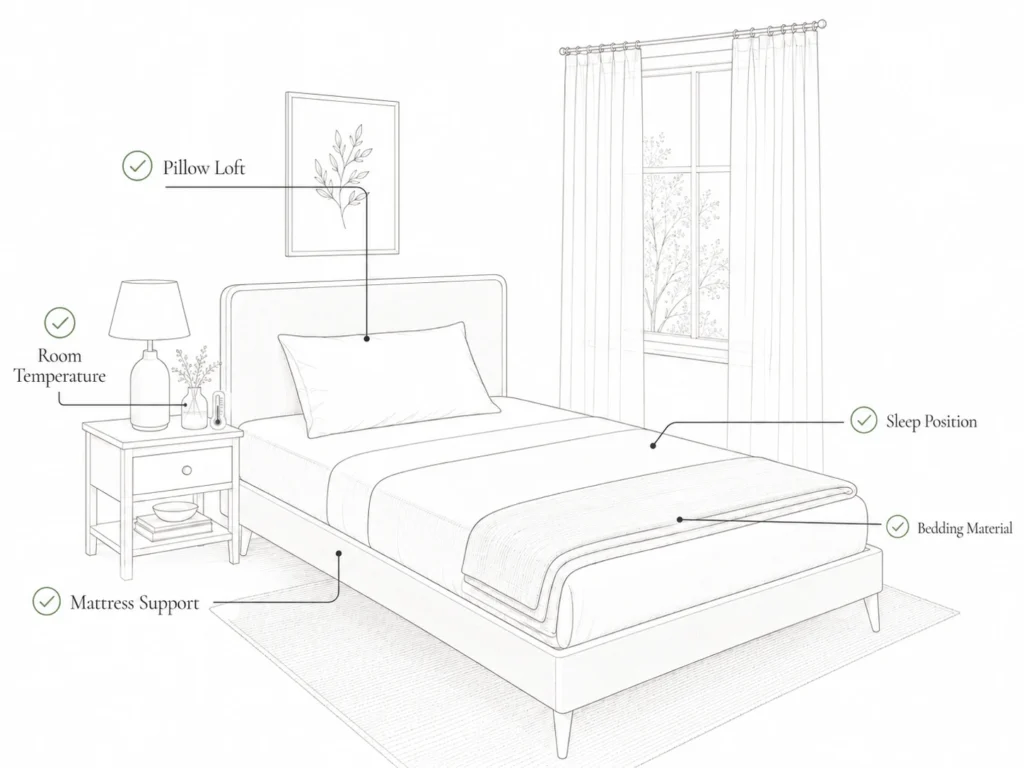
This matters because of exactly the mechanism described earlier: a pillow that no longer holds your head and neck steady gives your body a reason to keep adjusting itself all night, and each adjustment is another small interruption to deep sleep. The fix isn’t about comfort in the moment — it’s about removing the trigger for those repeated micro-arousals in the first place.
Ergonomic Pillow Option
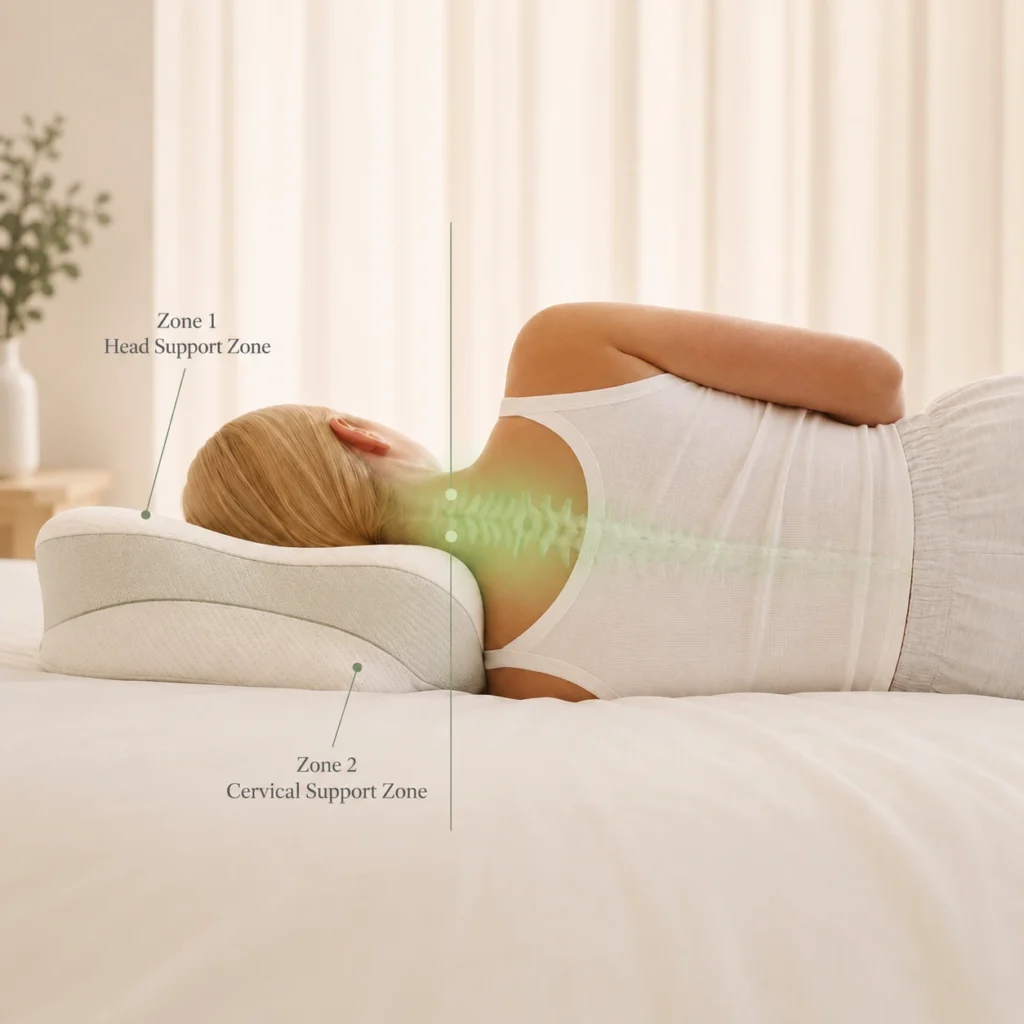
If your current pillow loses shape overnight, feels too flat, or leaves your neck unsupported, an ergonomic contour pillow may be worth considering. The pillow we recommend is built around a two-zone design that works together to keep your head and neck stable through the night:
- Head Support Zone — cradles and stabilizes the skull in a neutral position, which may help reduce the constant small repositioning that disrupts deep sleep.
- Cervical Support Zone — designed to maintain natural spinal alignment and passively decompress the neck muscles, which may help reduce the tension that triggers micro-arousals in the first place.
Together, these two zones are designed to give your body fewer reasons to shift, adjust, or wake itself slightly during the night — which is exactly where non-restorative sleep often begins.
This article may contain affiliate links. If you purchase through our links, Fondielle may earn a small commission at no extra cost to you. We only recommend products we have researched and genuinely believe can support a better sleep environment.
Still waking up tired despite a full night?
Press your palm flat on your current pillow. If it doesn’t spring back — or barely does — it has likely lost the loft it needs to keep your neck aligned through the night.
If you recognized more than two signs above, your pillow is one of the simplest things to change. The ergonomic contour pillow we recommend is designed around stable loft, a dedicated cervical support zone, and a shape that holds through the night — not just the first hour.
When to look beyond your sleep setup
Your sleep environment may be one possible reason you wake up tired, but it isn’t the only one. If you experience loud snoring, gasping during sleep, severe daytime sleepiness, persistent low mood, or fatigue that doesn’t improve no matter what you change, it’s worth speaking with a healthcare professional. These can sometimes point to causes that go beyond pillow support or room temperature, and a professional can help you rule them out.
Questions Women Ask About Waking Up Tired
Yes. Eight hours measures time spent asleep, not the quality of that sleep. If your sleep is repeatedly interrupted by discomfort, temperature, or poor support — even without waking you up — your body may not get enough deep sleep to feel rested.
This is often a sign that your sleep is being fragmented before it reaches its deepest stages. Physical discomfort from your pillow, mattress, or bedroom temperature is one of the most common and fixable causes.
Fragmented sleep can be caused by physical discomfort (an unsupportive pillow, mattress pressure points), environmental factors (light, noise, temperature), and in some cases, underlying health conditions. Checking your sleep setup is a simple first step.
Signs include waking up in a different position than you fell asleep, morning neck or shoulder stiffness, and a pillow that feels flatter or less supportive than when you bought it.
It’s common, but it isn’t something you have to accept as permanent. If it happens regularly, it’s worth checking the physical factors in your sleep environment before assuming it’s just how your body works.
You don’t have to accept feeling this way
If you’re still tired after 8 hours of sleep, the cause is often physical — and physical things can be checked, tested, and changed. Your pillow, mattress, and bedroom temperature all play a role in whether your sleep reaches the deep stages your body needs.
Start with one thing tonight: check whether your pillow still holds its shape and keeps your neck level with your spine. If it doesn’t, an ergonomic pillow built for stable support may be worth considering. And if you decide to make the switch, give it time before judging the results — most women need the 7-night pillow test period to feel the full difference, so don’t expect everything to change after one night.
If you’re still waking up tired after a full night’s sleep, your sleep environment is one of the simplest places to check first.
See the Ergonomic Pillow We Recommend →Download the Free Sleep Checklist