

You fall asleep on your right side. You wake up on your stomach, arm twisted under your head, neck already stiff before you have opened your eyes. Every single morning, you are somewhere different from where you started.
You have been called a restless sleeper. You have probably called yourself one too. But if you spend your hours tossing and turning all night, it feels like something hardwired — a personality trait, like being a light sleeper or a morning person. Some people sleep still. You are not one of them.
But here is what nobody has told you: tossing and turning all night is not who you are. It is what your body is doing because something in your sleep setup is not working. And when you understand what is actually happening during those hours, the restlessness starts to look a lot less like a character flaw and a lot more like a fixable physical problem.
This article explains exactly what is going on when your body refuses to stay still — and what to check in your bedroom tonight.
This article may contain affiliate links. If you purchase through our links, Fondielle may earn a small commission at no extra cost to you. We only recommend products we have researched and genuinely believe can support a better sleep environment.
Quick Answer
Tossing and turning all night is most often a physical response to postural discomfort — not anxiety, not stress, and not a sign that you are a bad sleeper by nature. When your pillow fails to support your head and neck at the correct height, your body shifts position instinctively throughout the night to reduce cervical tension. These movements can happen dozens of times without fully waking you. Checking your pillow height, loft stability, and sleeping position alignment is one of the most practical first steps you can take.
Free 7-Night Pillow Test
If you wake up in a different position every morning, your sleep setup may be the reason. Use the free checklist to track your pillow height, sleep position, and morning comfort over seven nights.
In This Guide
Why Tossing and Turning Is Not Who You Are
I used to wake up in completely different positions from where I started. On my back. On my stomach. Arms everywhere, pillow shoved sideways, duvet half on the floor. I thought I was just a restless sleeper. I thought it was my personality — that some people were built for still, quiet sleep and I simply was not one of them.
That belief stayed with me for years.
What finally changed it was not a better bedtime routine or a sleep tracking app. It was understanding a simple physical principle: your body does not move while you sleep randomly. It moves for a reason. And that reason is almost always discomfort.
When your body finds a position that genuinely works — where your spine is supported, your neck is not under tension, your shoulder is not carrying pressure it cannot bear — it stays there. It does not need to move. The restlessness is your body searching, all night long, for the position your sleep setup should already be providing.
What Is Actually Happening When You Move All Night
Here is the mechanism, explained simply.
When you lie down, your body begins to settle into a position. If that position places your cervical spine — the section of your spine running through your neck — in a neutral alignment, your muscles can relax. Your body stays relatively still.
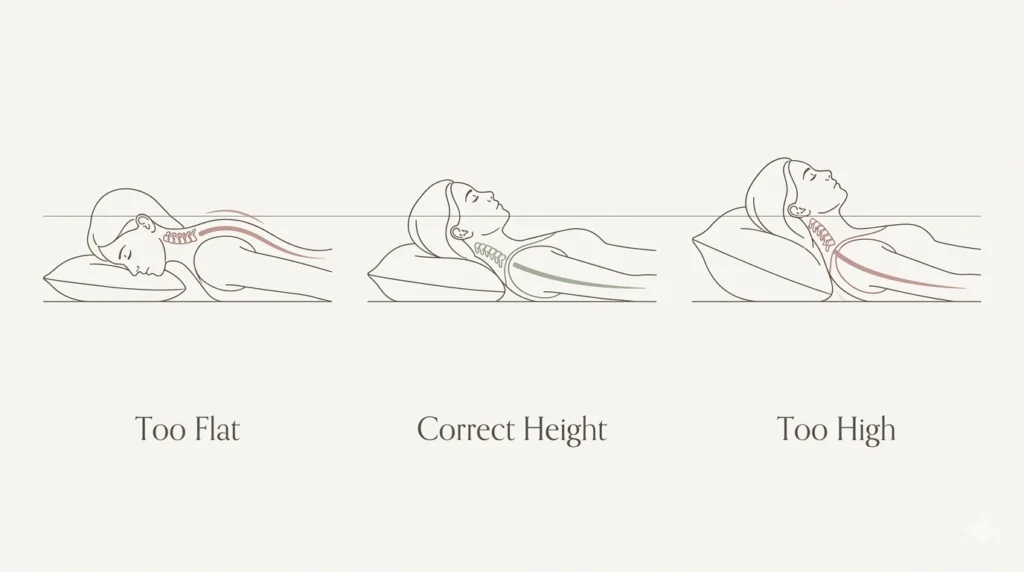
But if your pillow is too flat, your neck angles downward. If your pillow is too high, your head is pushed forward, compressing the back of the neck. If your pillow collapses during the night, the support you started with disappears by 2am.
In any of these cases, the muscles along your neck and shoulders begin to experience low-level tension. Not enough to wake you fully. But enough for your brain to register the signal: this position is not working.
So your body moves. You roll from your right side to your left. You shift onto your back. You pull the pillow up or push it flat. You end up on your stomach without remembering how you got there.
This process is connected to what sleep researchers call micro-arousals — moments where your brain partially activates to respond to physical discomfort, then drops back into sleep without you ever consciously waking. You do not remember them. But they interrupt your sleep architecture throughout the night, pulling you out of deep sleep and into lighter stages repeatedly.
The result is not just a different position in the morning. It is fragmented sleep, incomplete recovery, and that familiar exhaustion that follows you into your day even after seven or eight hours in bed.
The research on this is actually quite clear. Studies on sleep posture and sleep quality consistently show that spinal alignment during sleep affects both sleep continuity and morning muscle discomfort. What most people never connect is that their nighttime movement is the symptom — and the cause is often the physical surface their head and neck are resting on. If you also wake up with neck pain every morning, the two problems are almost always connected at the root.
Cervical Spine Alignment: The Pillow Connection Most People Miss
Your pillow has one job: to fill the gap between your head and the mattress, keeping your cervical spine level with the rest of your body.
For a side sleeper, that gap is roughly the width of your shoulder. For a back sleeper, it is shallower. If your pillow does not match that gap precisely — if it is too thin, too thick, or if it loses its shape during the night — your neck spends hours in a position it was not designed to hold.
A standard pillow starts the night at a reasonable height. By 3am, it has often compressed under the weight of your head, flattening progressively until the support it offered at bedtime no longer exists. Your body responds by moving — searching for a position where the gap is filled by something else. Your arm. Your bent elbow. The edge of the mattress. Whatever it can find. This same collapse is also one of the most common reasons women wake up with a stiff neck every morning — a connection that most people never make because they are looking at habits, not hardware.
I tested three different pillows across eighteen months before I understood this. None of them worked — not because they were bad pillows, but because I had never thought to check whether they held their shape through the night. I was evaluating comfort at 10pm when the real test was at 3am.
The shift happened when I moved to an ergonomic pillow with stable loft — one designed to maintain its height from the moment I lay down until the moment I woke up. Within a week, I noticed something I had not experienced in years: I woke up in roughly the same position I had fallen asleep in.
Not perfectly still. But close enough that it felt like a completely different relationship with sleep.
Sleep Environment Assessment: Signs Your Setup Triggers Restlessness
You do not need a sleep tracker to recognise whether your sleep setup is contributing to your nighttime movement. These are the signs worth paying attention to.
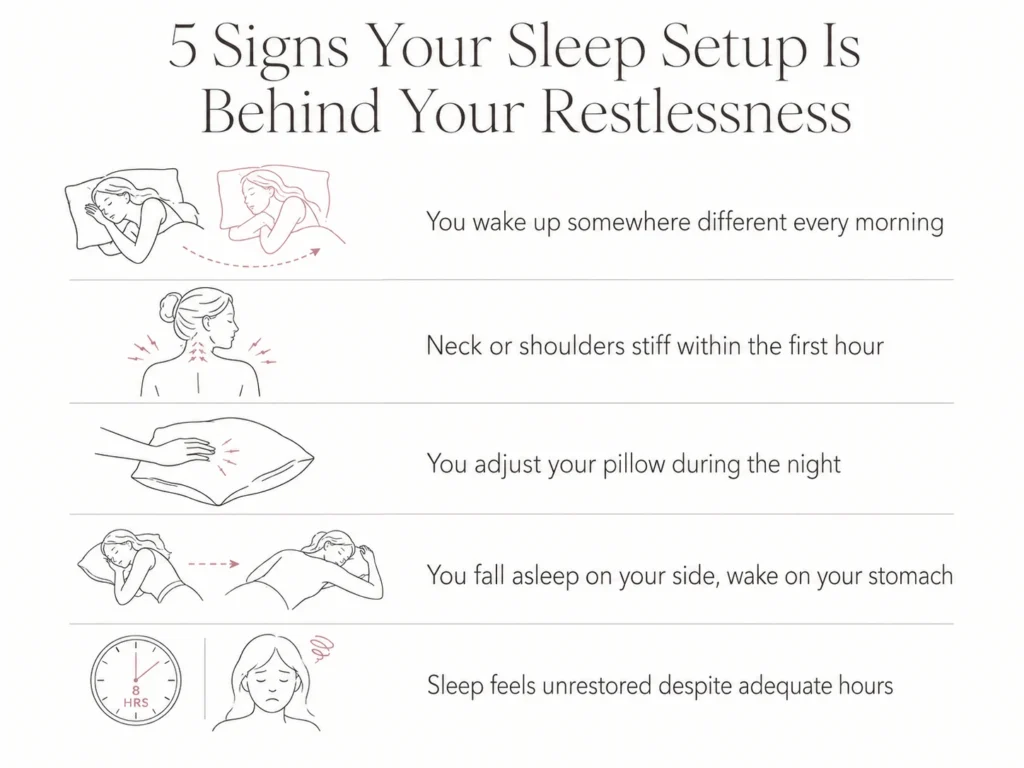
You consistently wake up in a completely different position from where you started. This is the clearest signal. It means your body moved significantly during the night — not a small adjustment, but a full repositioning.
Your neck or shoulders feel stiff within the first hour of waking. If you are tossing and turning because of cervical tension, that tension does not disappear when you wake up. It lingers for 30 to 60 minutes, fading gradually as you move around and your muscles release. If the tension is concentrated in one shoulder — specifically the side you sleep on — this may point to a separate but closely related issue. The guide on why side sleepers wake up with shoulder pain explains exactly why that happens and what it means for your setup.
You are aware of adjusting your pillow during the night. Folding it, pushing it flat, pulling it under your neck — these are conscious versions of what your body is doing unconsciously all night long.
You sleep on your side but sometimes wake up on your stomach. Stomach sleeping puts the neck in an extended, rotated position. It is rarely a position people choose deliberately. It is a position people end up in after their original position became uncomfortable enough that any alternative felt better.
Your sleep feels light and unrestored even when the hours were adequate. Fragmented sleep — the result of repeated micro-arousals — produces exactly this feeling. You were technically asleep. But the quality was not there. If this exhaustion after a full night is something you recognise, the full explanation of why you wake up more tired than when you went to bed covers the deeper mechanics of what sleep fragmentation does to recovery.
If you recognise two or more of these, your sleep setup is worth examining before you draw any other conclusions.
What to Check in Your Bedroom Tonight
These are practical, setup-based checks you can do without buying anything.
Check your pillow height. Lie on your side and have someone look at your neck from the end of the bed, or take a photo. Is your neck level with your spine? Or is it angling down toward the mattress, or pushed upward? A neutral position means your ear should be directly above your shoulder, with your spine forming a straight line. If you are unsure what height that actually means in practice, the guide on what pillow height side sleepers actually need gives you a concrete measurement framework based on shoulder width.
Check your pillow stability. Press your pillow flat, then release it. Does it spring back fully? Or does it stay partially compressed? Now check it again after you have been lying on it for 15 minutes. A pillow that loses shape quickly cannot maintain alignment through the night.
Note your position before sleep and at waking. Do this for three nights in a row. If you are consistently waking in a completely different position from where you started, the pattern is consistent enough to act on.
Check whether your shoulder is carrying your head’s weight. For side sleepers, if your pillow is not filling the gap adequately, your shoulder takes on some of the load. Over a full night, this creates the accumulated tension you feel in the morning — and it is also what triggers the body to shift.
Consider your mattress surface. A mattress that is too firm does not allow the shoulder to sink in appropriately, which raises the body higher and increases the gap your pillow needs to fill. A mattress that is too soft may let the shoulder sink too far, creating a different alignment problem. Your pillow and mattress work together — the height of one is affected by the depth of the other.
What a More Stable Sleep Position Can Feel Like
I know this sounds almost too simple. I spent years assuming that my restlessness was psychological — connected to my stress levels, my freelance schedule, the fact that I worked from home and never fully disconnected. I was so convinced the problem was mental that I never thought to look at something physical. If that belief feels familiar — the sense that you are tired because you are stressed, not because anything in your bedroom is actually wrong — it is worth reading why blaming stress for your neck pain may be keeping you stuck. The two things are easier to separate than most people think.
But the difference, once the alignment issue was addressed, was immediate enough to be surprising.
The first thing I noticed was not waking up refreshed. It was waking up where I had fallen asleep. That was the first signal that something had changed. My body had found its position and stayed there because it did not need to search anymore.
The morning stiffness did not disappear on night one. But within seven days, it was measurably less. And the feeling of waking up exhausted despite eight hours — that specific, inexplicable fatigue — began to lift.
Not because I had changed my habits. Because I had changed one physical object in my bedroom.
What to Look For in an Ergonomic Pillow
If your current pillow is contributing to your nighttime restlessness, these are the criteria worth understanding before considering a replacement.
Loft that holds through the night. Not just at 10pm. High-density memory foam maintains its height under pressure — fibre and low-density foam do not. The test is 4am, not bedtime.
A cervical bolster, not just a flat surface. The neck has a natural inward curve. A raised ridge built into the lower section of the pillow fills that gap passively. Your neck muscles stop compensating and finally release.
A butterfly shape with shoulder clearance. Standard pillows are rectangles. A butterfly contour is not. Its wings create a recessed zone so your shoulder drops naturally rather than being pressed upward. Neck tension and shoulder compression — the two main triggers of nighttime shifting — are removed by the shape alone.
A contoured centre that stops the head from drifting. No lateral roll. No unconscious self-correction. The contour cradles the skull in position, so your body stays where you placed it.
The Pillow We Recommend
Stable loft. Cervical bolster. Butterfly shape for shoulder clearance. Built for side sleepers who move too much at night and wake up somewhere they did not start. Most people notice a difference within 5 to 7 nights.

When to Look Beyond Your Sleep Setup
Your sleep setup is one of the first and most practical places to check when you cannot find a comfortable sleeping position — but it is not the only possible cause.
If you experience frequent involuntary leg movements or an urge to move your legs at night, this may be worth discussing with a healthcare professional, as Restless Legs Syndrome is a recognised condition that affects nighttime comfort independently of your sleep environment.
If your restlessness is accompanied by severe anxiety, difficulty breathing during sleep, or waking with a racing heart, these symptoms deserve professional attention rather than a pillow adjustment.
And if you have addressed your sleep setup and your sleep remains significantly fragmented or unrestored, speaking with a healthcare professional is a reasonable next step.
Fondielle is a sleep environment guide, not a clinic. The information here is practical and setup-based. When the problem is beyond the bedroom, it belongs in a professional’s hands.
Restless Sleep FAQ: Causes, Signs and Setup Fixes
Yes. A pillow that is too flat, too high, or that loses shape during the night forces the cervical spine out of neutral alignment. The body responds by shifting position repeatedly to reduce the tension. This can happen dozens of times per night, fragmenting sleep without fully waking you.
Side sleeping requires more precise pillow support than back sleeping. The gap between the head and the mattress is wider, meaning a pillow that is even slightly insufficient leaves the neck angled downward. The body moves to compensate — sometimes throughout the night.
Occasional position changes are normal. Consistently waking up in a completely different position from where you started — particularly if accompanied by morning stiffness or fragmented sleep — is a sign that your body has been repositioning regularly in response to discomfort.
When lying on your side, your ear should sit directly above your shoulder, and your spine should form a straight horizontal line. If your head is angling down toward the mattress or your neck is pushed upward, your pillow loft is not matched to your shoulder width.
Most people need between 5 and 7 nights to adjust to a new pillow, particularly if switching from a standard to a contoured design. During that window, position and morning comfort tend to improve progressively rather than immediately on night one.
If your restlessness is accompanied by involuntary leg movements, breathing irregularities, severe anxiety, or chest symptoms, a healthcare professional can help identify whether there is an underlying cause beyond your sleep environment.
Stop Searching. Start Sleeping.
If you cannot find a comfortable sleeping position — if you toss and turn all night and wake up somewhere different from where you started — your bedroom is one of the first places worth checking. And if morning neck pain is part of what you are dealing with, the complete guide to why your neck hurts every morning covers the full picture, from pillow loft to spinal alignment to the micro-arousals behind it all.
The cause is often physical. Your body is searching all night for the alignment your sleep setup should already be providing. And physical causes have physical solutions: a pillow that holds its shape, a loft that matches your shoulder width, a surface that lets your cervical spine rest in a neutral position from 10pm to 7am.
You have been told you are a restless sleeper. Maybe it was never that simple.
Start with your pillow tonight. Check its height. Press it and watch whether it returns to shape. Note where you fall asleep and where you wake up. Give it seven nights — and if you want a structured way to track what is actually changing, the 7-Night Pillow Test gives you a simple framework to follow each morning. Your mornings will tell you everything you need to know.
Get the Free 7-Night Pillow
Test Track your pillow height, sleep position, and morning comfort for seven nights with the free checklist.