

You ordered a new pillow. You read the reviews. You were cautiously hopeful.
First night: you wake up with the same stiff neck. You tell yourself it was just the first night.
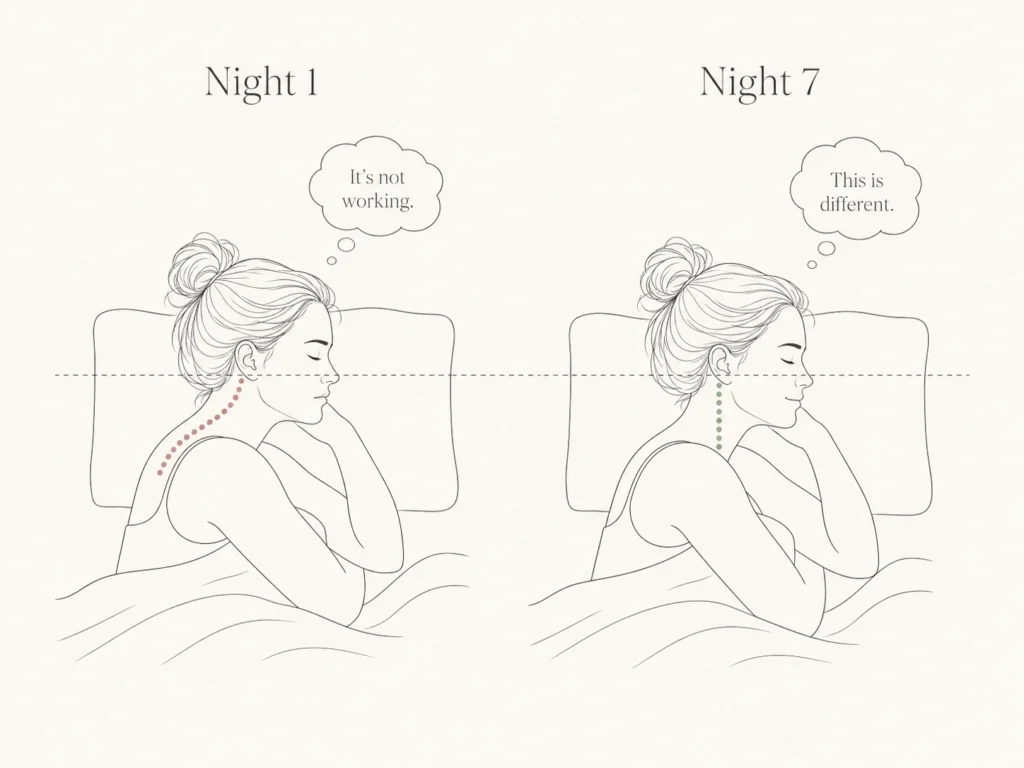
Second night: same thing. You start to wonder. By night three, you’re already convinced it’s not working — and you’re thinking about returning it.
Here is what most people never find out: that moment of doubt is exactly when the pillow starts working.
Most women abandon a pillow too early — not because the pillow was wrong, but because they had no framework for understanding what their body actually goes through when it adjusts to a new sleep position. The problem was never the pillow. The problem was the expectation of instant results.
This article gives you what you were missing: a clear, night-by-night method for testing your pillow honestly — and a simple way to know whether to keep it, give it more time, or consider something different.
Quick Answer
How long does it take to adjust to a new pillow?
Most people need 5 to 7 nights to adjust to a new pillow — especially an ergonomic or memory foam one. During the first few nights, your cervical muscles are adapting to a new support position. This is normal and does not mean the pillow is wrong for you. Improvement typically becomes noticeable between Night 4 and Night 7. Evaluating a pillow after one or two nights is not a reliable test.
This article may contain affiliate links. If you purchase through our links, Fondielle may earn a small commission at no extra cost to you. We only recommend products we have researched and genuinely believe can support a better sleep environment.
📋 Free 7-Night Pillow Test Checklist
Track your morning neck comfort, shoulder tension, and sleep quality for each of the 7 nights — with a simple printable checklist designed to help you evaluate your pillow honestly, not based on gut feeling.
In this guide
- Why most pillow tests fail before they even begin
- How long it actually takes to adjust to a new pillow
- What happens in your body during the adjustment period
- The 7-Night Pillow Test: what to track each morning
- Signs your pillow is working — and signs it may not be right for you
- What to look for in a pillow worth testing
- After the 7 nights: how to evaluate your results
- When to look beyond your pillow
- FAQ
Why most pillow tests fail before they even begin
Most women test a new pillow the same way: sleep on it once, notice whether they feel different in the morning, and make a decision. If there is no dramatic improvement, the pillow goes back in the box.
This method almost always produces a false negative.
Switching pillows is not like switching a lamp. Your body has been sleeping in a specific position for months or years. Your cervical muscles, your shoulder positioning, and your sleep posture have all adapted — however uncomfortably — to your old pillow. When you introduce a new support structure overnight, your muscles do not instantly relax into it. They resist it.
This initial resistance is not a sign that the pillow is wrong. It is a sign that your body is in the process of adjusting.
The mistake is treating Night 1 as a valid test. It is not. Night 1 is the beginning of the test. Night 7 is when you have enough information to evaluate honestly.
If you have been waking up stiff for months, it is also worth understanding why your pillow may be causing your neck pain in the first place — because knowing the physical mechanism makes the adjustment period easier to commit to.
“I had tried three different pillows before I found the right one. Looking back, I probably returned at least one good pillow too soon. I had no idea what I was actually waiting for.”
How long does it take to adjust to a new pillow?
For most people, the full benefit of a new ergonomic or memory foam pillow becomes noticeable after 5 to 7 nights. This is not a marketing claim — it reflects the time your cervical spine and surrounding musculature need to adapt to a change in support.
Some women notice a difference as early as Night 3 or 4. Others need the full 7 nights. A small number may need up to two weeks if they have had chronic cervical tension for a long period.
Several factors affect how quickly you adjust:
- How long you have been sleeping on a flat or unsupportive pillow
- How much existing tension you carry in your neck and shoulders
- Whether you are a side sleeper, back sleeper, or combination sleeper
- The loft and density of your new pillow relative to your shoulder width
- Whether the pillow loft is appropriate for your sleep position
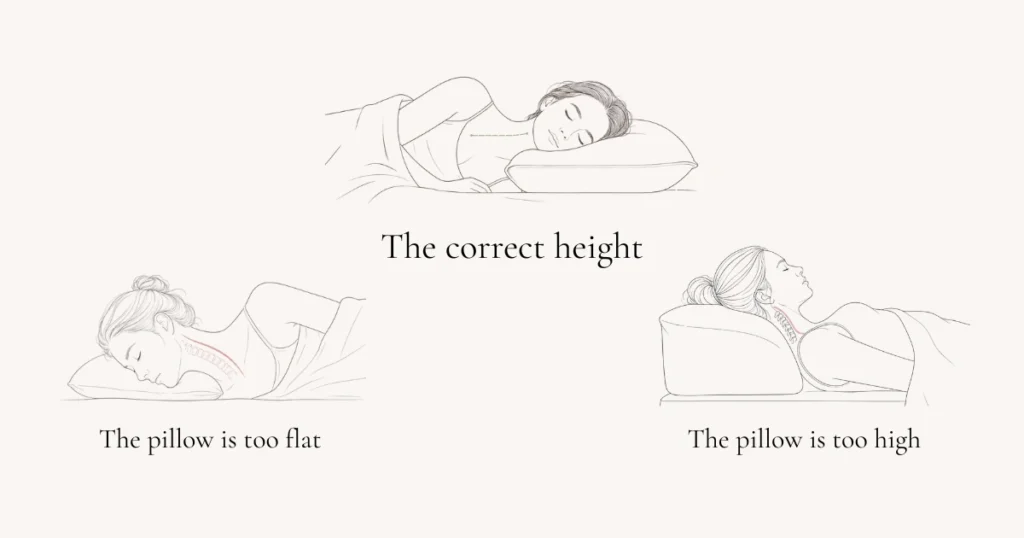
If you are a side sleeper and you have never checked whether your pillow height matches your shoulder-to-ear gap, that is worth doing before you begin the test. What Pillow Height Do Side Sleepers Actually Need? walks through exactly how to measure this.
Memory foam pillows specifically have a break-in period that goes beyond muscle adaptation. High-density foam can feel firmer in the first few nights as it adjusts to your body temperature and responds to your specific pressure pattern. This is expected behaviour, not a defect.
What actually happens in your body during the adjustment period
Understanding the physical mechanism makes the 7-night wait easier to commit to — because it stops feeling like waiting and starts feeling like something that is actively happening.
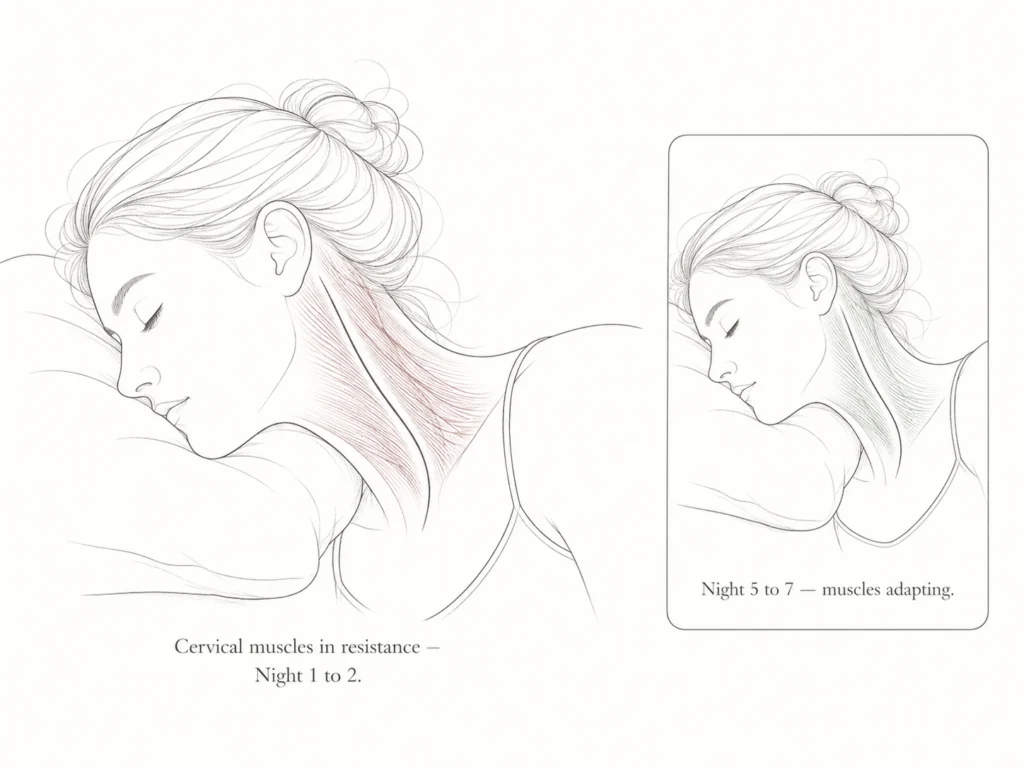
Night 1 and 2: muscular resistance
Your cervical muscles have memory. They have spent months or years holding a particular position. When you introduce a pillow with a different loft or contour, those muscles do not immediately relax. They resist the new alignment — sometimes creating more noticeable tension in the first night or two than you felt with your old pillow.
This is the phase where most women give up. The stiffness feels worse. The conclusion seems obvious. But what is actually happening is that your muscles are being asked to stop compensating for an unsupportive surface — and that process begins with resistance, not with immediate relief.
Night 3 and 4: early adaptation
By Night 3 or 4, cervical muscles begin to relax into the new support position. You may not feel dramatically better, but you might notice that your morning stiffness clears more quickly than before, or that you are waking up in roughly the same position you fell asleep in — a sign that your body is no longer searching for a more comfortable position throughout the night.
Micro-arousals — the brief, partial wakings your brain generates in response to physical discomfort — begin to reduce during this phase. You may not be aware of them consciously, but you will likely notice that your sleep feels slightly less fragmented. If you want to understand why fragmented sleep leaves you so drained even after 8 hours, Why You Wake Up More Tired Than When You Went to Bed explains the mechanism behind micro-arousals and deep sleep disruption.
Night 5 to 7: results become observable
This is the window where most people experience their first meaningful morning. Neck stiffness takes noticeably less time to fade. Shoulder tension on the dominant sleep side is reduced. For some women, the change is incremental. For others, Night 5 or 6 feels like a clear before-and-after moment.
Deep sleep — the restorative stage where physical recovery happens — becomes more accessible when postural discomfort is reduced. This is why some women report not just less pain after 7 nights, but also a different quality of rest: less drained upon waking, rather than simply less stiff.
Night-by-night: what may be happening and what to observe
| Night | What may be happening in your body | What to observe each morning |
|---|---|---|
| Night 1–2 | Muscles may feel tense or unfamiliar. Some initial stiffness is normal. | Note how quickly the stiffness fades in the morning. Faster than usual? |
| Night 3–4 | Cervical muscles begin to relax into the new support position. | Is your neck pain appearing later in the morning than before? |
| Night 5 | First clear signals of improvement often emerge. | Are you waking up before your alarm? Sleeping through without adjusting position? |
| Night 6 | Shoulder and upper back tension may noticeably reduce. | Check shoulder comfort on the side you sleep on. Any difference? |
| Night 7 | Full first cycle complete. Evaluate honestly. | Compare Night 7 morning to Night 1 morning. What has changed? |
The 7-Night Pillow Test: what to track each morning
The goal of this test is to replace subjective impression with observable data. “I think I slept better” is not useful information. “My neck stiffness cleared in 20 minutes instead of 60” is.
Each morning after waking, spend 2 minutes noting the following five things:
- Morning neck stiffness — Rate 1 to 10 (10 = severe). How quickly does it fade?
- Shoulder comfort on your sleep side — Is there pressure or tension on the side you slept on?
- Overall rest quality — Rate 1 to 10 (10 = fully rested). Ignore the number itself — has it changed?
- Sleep position at waking — Did you wake up in roughly the same position you fell asleep in? Or were you in a completely different position?
- Time to feel like yourself — How many minutes after waking before the stiffness, grogginess, or tension fades?
Use the tracker below to record your observations each morning:
| Night | Morning neck stiffness (1–10) | Shoulder comfort (1–10) | Overall rest quality (1–10) |
|---|---|---|---|
| Night 1 | |||
| Night 2 | |||
| Night 3 | |||
| Night 4 | |||
| Night 5 | |||
| Night 6 | |||
| Night 7 |
The numbers matter less than the direction of change. A consistent downward trend in stiffness, even a small one, is meaningful. A flat line across all 7 nights is also meaningful — and suggests the pillow may not be addressing your specific needs.
📋 Free 7-Night Pillow Test Checklist
Print the full version of this tracker and use it every morning for 7 nights. It includes morning observation prompts, a simple scoring system, and a final evaluation guide to help you decide what to do next.
Signs your pillow is working — and signs it may not be right for you
Not all discomfort during the adjustment period means your pillow is wrong. But some signals do indicate a genuine mismatch between the pillow and your sleep position or body structure.
| Signs your pillow may be working | Signs your pillow may not be right for you |
|---|---|
| Morning neck stiffness clears faster than before | Neck pain is worse than before you switched pillows |
| You wake up in roughly the same position you fell asleep in | You are tossing and turning significantly more than before |
| Shoulder pressure feels reduced on your dominant sleep side | Shoulder pain has intensified, not just continued |
| You feel slightly less drained upon waking, even if not fully rested | You are waking up with new symptoms: numbness, tingling, headache at the base of the skull |
| You are waking up naturally before your alarm | Pain does not improve at all between Night 1 and Night 7 |
The key distinction is direction of change. Some initial discomfort followed by gradual improvement is normal adaptation. No change across 7 nights, or worsening symptoms, suggests the pillow loft, firmness, or design may not be suited to your sleep position.
If shoulder pain is one of your main symptoms, it is worth reading Why Side Sleepers Wake Up With Shoulder Pain — the mechanics there are directly relevant to whether your pillow is addressing the right problem.
Similarly, if you are waking up with a headache at the base of your skull alongside stiffness, Why You Wake Up With a Headache Every Morning explains the cervical connection.
What to look for in a pillow worth testing for 7 nights
Not every pillow deserves a 7-night commitment. Before you begin the test, it is worth checking whether your pillow meets the basic structural criteria that make the adjustment period worthwhile.
A pillow that is genuinely worth testing for 7 nights should:
- Maintains its loft throughout the night — not collapsing to half its height by 3am.
- Properly matches your sleep position, as side sleepers need a higher loft than back sleepers to fill the gap between ear and shoulder.
- Supports the cervical curve through a contoured or ergonomic design that fills the space between your neck and the mattress.
- Designed to address shoulder comfort, allowing the shoulder to sit naturally without absorbing the full weight of the head.
- Use a material that responds to pressure — high-density memory foam adapts to body heat and pressure over the course of a night, distributing weight more evenly than standard foam or fibre
If your current pillow loses its shape by the middle of the night, or if it is a standard rectangle with no cervical contouring, the 7-night test may not produce meaningful results — because the problem is structural, not about adaptation time.
For a detailed comparison of what makes an ergonomic pillow structurally different from a standard one, Cervical Pillow vs Regular Pillow: What’s Actually Different? covers the key design distinctions.
If you sleep on your back and have been wondering whether a different pillow height might help, Why Back Sleepers Wake Up With Neck Pain is also worth reading before you commit to 7 nights — back and side sleepers need different loft profiles, and starting with the right one makes the adjustment period more productive.
The Pillow We Recommend for This Test
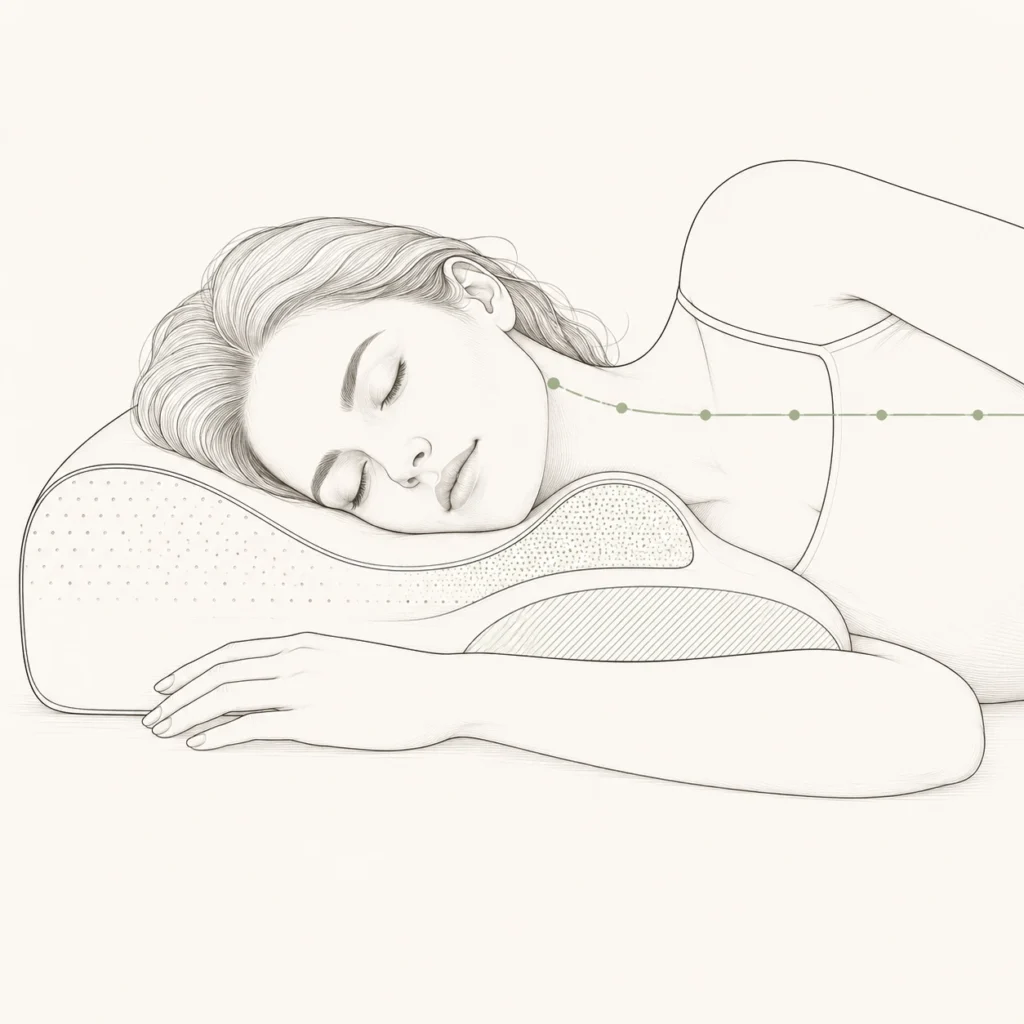
If your current pillow does not meet the criteria above — stable loft, cervical support, shoulder-aware design, and pressure-responsive material — an ergonomic contour pillow may be worth considering before beginning the 7-night test.
The pillow we have researched and recommend is designed around five specific support zones, including a dedicated cervical bolster for the neck, a shoulder support area for side sleepers, and an arm support zone that most standard pillows do not address. It is built in high-density memory foam with a cooling cover and comes with a 60-day return policy — giving you well beyond the 7 nights needed to evaluate it fairly.
After the 7 nights: how to evaluate your results
Once you have completed the test, compare Night 7 to Night 1 in each category. Ask yourself:
- Did my morning stiffness score improve, even slightly?
- Does my neck pain clear faster in the morning than it did before?
- Did I wake up in fewer positions, or more comfortably than before?
- Has my overall rest quality trend moved upward, downward, or stayed flat?
If the trend is upward — even modestly — the pillow is working. Continue for another week and reassess. Physical changes in cervical comfort can continue to develop beyond the initial 7 nights, particularly if you have had chronic neck tension for a long time.
If the trend is completely flat with no observable change in any category, the pillow loft may not be matched to your shoulder width and sleep position. This is a structural issue that no amount of time will resolve. In that case, review pillow loft recommendations for your specific sleep position before trying again.
If your symptoms have worsened across all 7 nights without any sign of improvement, stop the test. A pillow that consistently makes things worse is not in an adjustment period — it is not the right design for you.
When to look beyond your pillow
If you have made it through the 7-night test and your morning stiffness still has not improved, it may be worth zooming out. A pillow is only one part of the larger picture — loft, cervical alignment, and micro-arousals all interact to determine how you feel each morning. Why Does My Neck Hurt Every Morning? covers the full picture of what causes morning neck pain beyond the pillow itself, including posture, spinal alignment, and sleep position.
⚠️ When your pillow may not be the only cause
Your pillow may be part of the reason you wake up with neck or shoulder pain — but it is not the only possible cause. If your symptoms include any of the following, it is worth speaking with a healthcare professional:
- Neck pain that radiates into your arm or hand, or is accompanied by numbness or tingling
- Pain that appeared after an injury, accident, or sudden movement
- Headaches at the base of the skull that do not improve with any change in pillow or sleep position
- Worsening pain that has continued for more than a few weeks regardless of sleep setup changes
This article addresses the physical sleep environment as one possible contributor to morning discomfort. It is not a substitute for professional medical assessment.
FAQ
Most people need 5 to 7 nights to adjust to a new ergonomic or memory foam pillow. During the first few nights, your cervical muscles adapt to the new support position. Improvement typically becomes noticeable between Night 4 and Night 7. Evaluating a pillow after one or two nights is not a reliable test.
Increased stiffness in the first one or two nights is common when switching to a new pillow, particularly an ergonomic one with a different loft or contour. Your cervical muscles are used to a specific position and may resist the change initially. If the pain worsens consistently across 7 nights with no improvement, the pillow loft may not be right for your shoulder width or sleep position.
A pillow is the right height when your spine stays in a neutral alignment from your neck through your upper back during the night. For side sleepers, the pillow should fill the gap between your ear and your shoulder without pushing your head up or letting it drop down. Signs your pillow may be too high or too low include waking with neck tension on one side, shoulder pressure, or consistently rolling to a different position during the night.
Yes. High-density memory foam responds to body heat and pressure over time. In the first few nights it may feel firmer than expected. As it adapts to your body temperature and specific pressure pattern, it becomes more responsive. This is expected behaviour and does not indicate a defect.
Give any ergonomic pillow at least 7 nights before making a return decision. If your symptoms show no improvement across the full 7 nights, or if your pain worsens consistently with no positive change in any category, the pillow design or loft may not be suited to your sleep position. A 7-night honest evaluation gives you enough data to make a clear decision rather than an emotional one.
Morning headaches at the base of the skull are sometimes linked to cervical tension during sleep. A pillow that supports the natural curve of the cervical spine may reduce the muscular tension that can contribute to this type of headache. However, headaches have multiple possible causes. If your headaches are severe, persistent, or accompanied by other symptoms, speak with a healthcare professional.
One test. Seven nights. An honest answer.
You have probably already done the one-night test. Maybe twice. And each time, you concluded the pillow was not working — without ever giving your body enough time to tell you.
The 7-night test is not about patience for the sake of it. It is about collecting enough data to make a real decision. Five tracked data points across seven mornings is more useful than a gut feeling on Day 1.
Your cervical muscles need time to stop compensating for years of inadequate support. Your deep sleep needs time to rebuild once postural discomfort is reduced. These are physical processes that happen on a biological timeline — not overnight.
Start the test tonight. Track what changes. Give it the 7 nights. And at the end, you will have something you probably have not had before when evaluating a pillow: an actual answer.