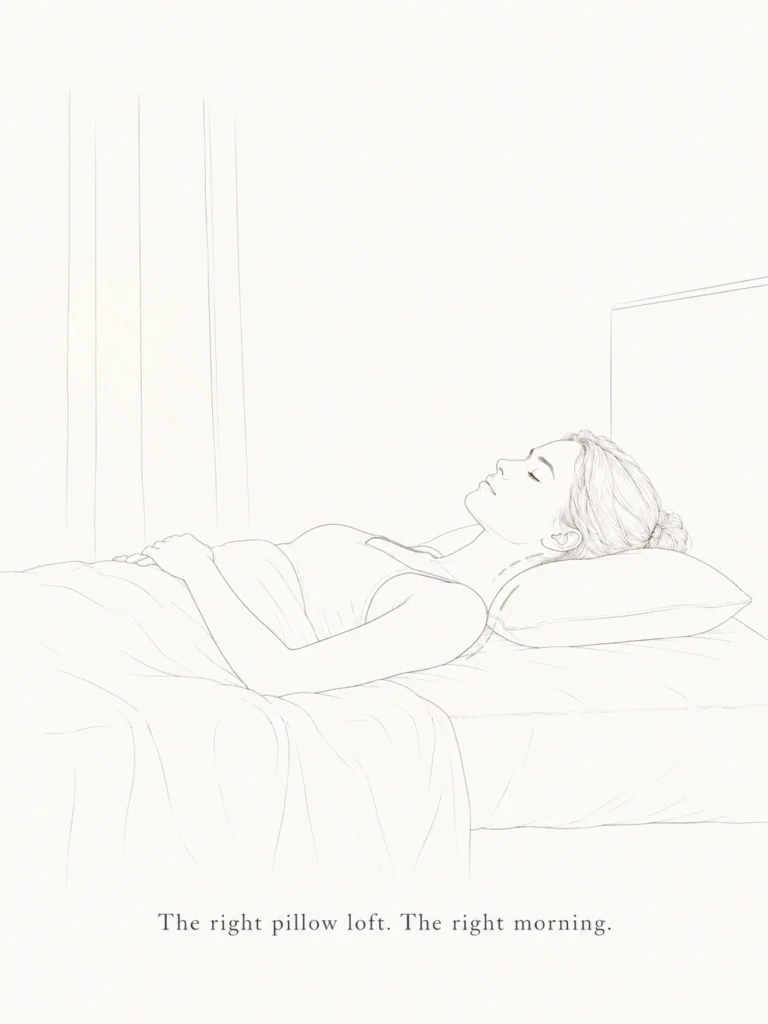

You sleep on your back. You have always slept on your back. You have read that it is one of the better sleep positions for your spine — and you believed it. And yet, every single morning, your neck is stiff. A dull tension at the base of your skull. A tightness that takes thirty, sometimes sixty minutes to fade after your first coffee.
There is a precise, biomechanical reason why back sleepers wake up with neck pain — and it has nothing to do with your sleep position. It has everything to do with the object sitting directly beneath your head for seven or eight hours every night. Your pillow is almost certainly the wrong height. And that single measurement may be responsible for every stiff morning you have had.
This article may contain affiliate links. If you purchase through our links, Fondielle may earn a small commission at no extra cost to you. We only recommend products we have researched and genuinely believe can support a better sleep environment.
Quick Answer
Back sleepers often wake up with neck pain because their pillow is too thick, which pushes the head forward and holds the cervical spine in a flexed position for the entire night. This sustained forward flexion puts pressure on the cervical discs and creates tension in the surrounding muscles, leading to stiffness and pain by morning. The problem is almost never the sleep position itself — it is the pillow loft, which needs to be significantly lower for back sleeping than for side sleeping.
Free 7-Night Pillow Test Checklist
Not sure if your pillow is the right height for back sleeping? Download the free checklist and track your pillow height, morning neck comfort, and sleep position over seven nights.
In This Guide
Why Your Sleep Position Is Not the Problem
Back sleeping — the supine position — is generally considered one of the most structurally neutral ways to sleep. When your body lies flat, gravity distributes weight across a large surface area. Your spine has the opportunity to decompress. Your shoulders bear no load. Your hips sit in a relaxed, open position.
This is why so many people choose to sleep on their back. And it is also why the morning stiffness feels so confusing. You are doing what is supposed to be good for you, and it still hurts.
If you have been asking yourself why your neck hurts every morning regardless of your sleep position, the answer almost always traces back to the same starting point: pillow loft and cervical alignment.
Most people who wake up with a stiff neck every morning assume the problem is their stress, their age, or something wrong with their body. Very few ever think to question the pillow. And yet, the pillow is one of the most common physical causes of morning neck stiffness — regardless of whether you sleep on your side or on your back.
Here is the distinction that changes everything: back sleeping is not harmful for your cervical spine. Back sleeping with the wrong pillow holds your cervical spine in a damaging position for every single hour of the night.
Your position is not the problem. Your pillow height may be.
The Real Cause: Pillow Loft and Cervical Flexion
Most morning neck pain in back sleepers comes down to one variable — and it is not the mattress, not the sleep position, and not the body. It is pillow loft: the height your pillow sits at when your head is actually resting on it. Understanding what loft does to your cervical spine overnight is the first step toward changing what you feel in the morning.
What Pillow Loft Actually Means
Pillow loft refers to the height of a pillow when it is under load — when your head is resting on it. Not the height it sits at on a shelf. The compressed, in-use height.
Most people have never measured this. Most people have never thought about it. And yet it is the single most important variable in whether your neck is in a neutral or a strained position for the hours you spend asleep.
The loft requirements are not the same for every sleep position. Side sleepers need a significantly higher pillow to fill the gap between the ear and the mattress — roughly the width of the shoulder. Back sleepers need something structurally different: a lower, more precise loft that supports the cervical curve without pushing the head into forward flexion. Keeping the same pillow across both positions is one of the most common and least discussed causes of chronic morning neck pain.
The Two Ways a Pillow Can Fail a Back Sleeper
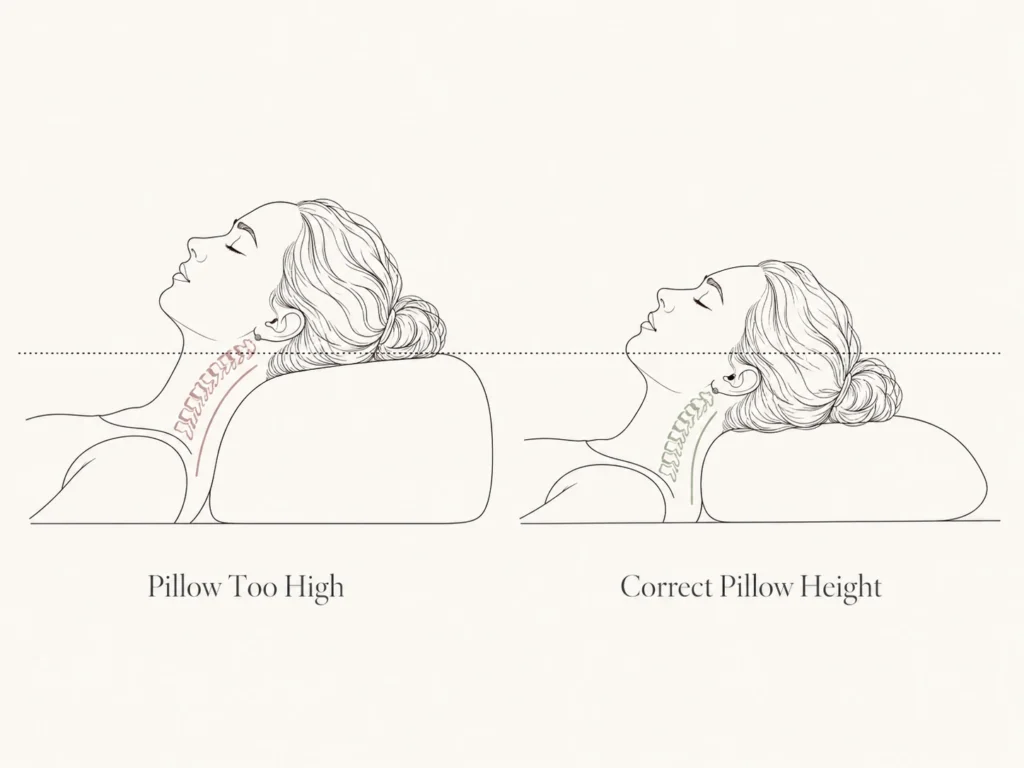
When you lie on your back, the natural curve of your cervical spine — the gentle inward arc at the back of your neck — needs to be supported. Your pillow should fill the space between the back of your head and the mattress surface while keeping your head level with your spine.
A pillow that is too thick pushes the back of your head upward, which drives your chin toward your chest. This is cervical flexion. Your neck spends the night in a forward-bent position, under sustained compression, with the posterior cervical muscles held in a lengthened, resisting state.
A pillow that is too flat lets the head drop back toward the mattress, removing all support from the cervical curve. The muscles at the front of the neck are left to compensate. The cervical curve collapses into extension.
Both are problematic. But the far more common error — and the one most responsible for morning neck pain in back sleepers — is a pillow that is far too thick. Often because a back sleeper was previously a side sleeper and simply kept the same pillow without understanding that the loft requirements are entirely different.
The Physical Mechanism: Your Cervical Spine Under Sustained Load
This is the section most sleep articles skip. It is also the section that explains everything.
What Happens to Your Cervical Discs Overnight
Your cervical spine has seven vertebrae. Between each pair of vertebrae is an intervertebral disc — a dense, fibrous cushion that absorbs compressive load and permits controlled movement. When your neck is in a neutral position, these discs bear weight evenly across their surface.
When your neck is held in forward flexion — chin pressed toward the chest by a pillow that is too thick — the pressure shifts dramatically to the anterior portion of each disc. The posterior muscles of the neck, including the semispinalis, the splenius capitis, and the suboccipital muscle group, are held in a sustained eccentric contraction: elongated, under tension, unable to release.
Why Muscles Under Sustained Stretch Do Not Rest
Muscles that are held under prolonged stretch do not relax into recovery. They respond by increasing their baseline tension — a physiological protective response called muscle guarding. By the time you wake up, those muscles have spent the entire night in a state of low-level contraction, resisting the forward load imposed by your pillow.
The stiffness you feel at the base of your skull and along the back of your neck is not random. It is the accumulated tension of eight hours of muscular resistance.
And it fades during the day — not because anything has been fixed, but because movement and gravity shift the load. By the time you are upright, walking, turning your head, the sustained flexion is released and the muscles gradually decompress. Until the next night, when the same pillow recreates the same position and the cycle begins again.
I spent a long time believing my neck pain was related to how I sat at my desk. It seemed logical — I worked from home, I was at a screen for long hours, tension in the neck made sense. What I did not understand was that eight hours of sustained cervical flexion every night was an entirely separate and far more significant load than anything happening during the day.
The desk posture was a contributing factor. The pillow was the foundation.
Why Neck Pain Destroys Your Sleep Quality — Even When You Do Not Wake Up
This is the part that connects the physical to the exhaustion — and it is the part most people never hear.
Micro-Arousals and Sleep Fragmentation
When your neck is uncomfortable during the night — even if you are not consciously aware of it — your brain registers the physical distress signal and responds. It produces micro-arousals: brief, partial awakenings that last only a few seconds and leave no memory trace.
You do not wake up. You do not remember shifting positions. But your brain lifts fractionally out of deep sleep, registers the discomfort, and drops back. This cycle repeats across the night — potentially dozens of times — each time pulling you out of the restorative slow-wave and REM sleep stages your body needs to recover.
The Exhaustion That Makes No Sense
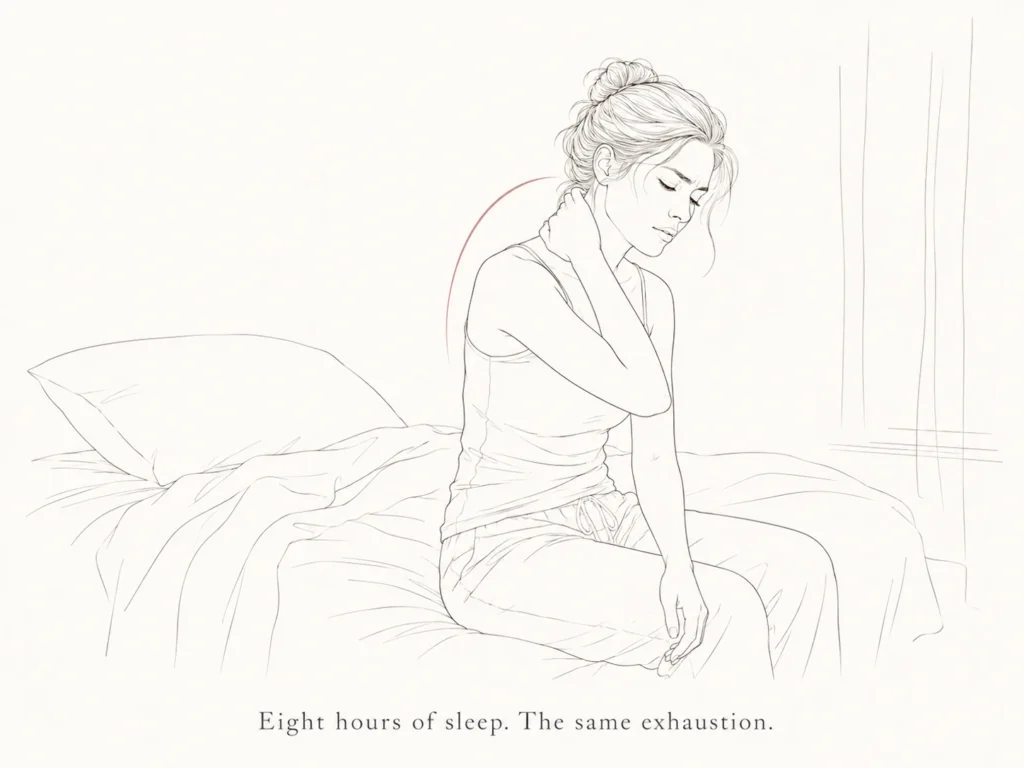
The result is not just a stiff neck in the morning. It is the exhaustion that makes no sense given the number of hours you slept. You tracked seven hours on your phone. The alarm went off on schedule. And you feel like you have not slept at all.
This is exactly the experience described by women who wake up more tired than when they went to bed — not because they did not sleep long enough, but because their deep sleep was quietly fragmented all night by physical discomfort they never consciously felt.
Neck pain and non-restorative sleep are not two separate problems for back sleepers using the wrong pillow. They are the same problem, expressing itself in two different ways.
Adjusting the pillow loft addresses both.
How to Check If Your Pillow Is Too High — Tonight
You can run this test in your own bed, right now, without buying anything.
The Neutral Cervical Alignment Test
- Lie flat on your back in your normal sleeping position.
- Have someone look at you from the side — or take a photo of your profile against the bed.
- Your ear should be roughly level with your shoulder. Your chin should be parallel to the ceiling — not angled toward your chest, not tilted back toward the headboard.
- If your chin is pressing downward toward your chest, your pillow is pushing your head into cervical flexion. It is too high.
- If your head falls back and there is a visible gap between the back of your neck and the pillow surface, your pillow may be too flat.
The Morning Stiffness Location Test
The location of your pain tells you something specific about what is happening overnight.
- Pain at the base of the skull or back of the neck that fades within two hours of waking → characteristic of overnight cervical flexion from a pillow that is too high.
- Tension along the sides of the neck → can indicate the head is rolling laterally, often linked to insufficient loft or a pillow that is too soft to maintain position.
- Headache at the back of the head on waking → frequently connected to suboccipital muscle tension from sustained cervical compression overnight. If this type of headache is something you recognise, the connection between morning headaches and overnight cervical compression is worth reading before you make any changes to your setup.
The Correct Pillow Loft Range for Back Sleeping
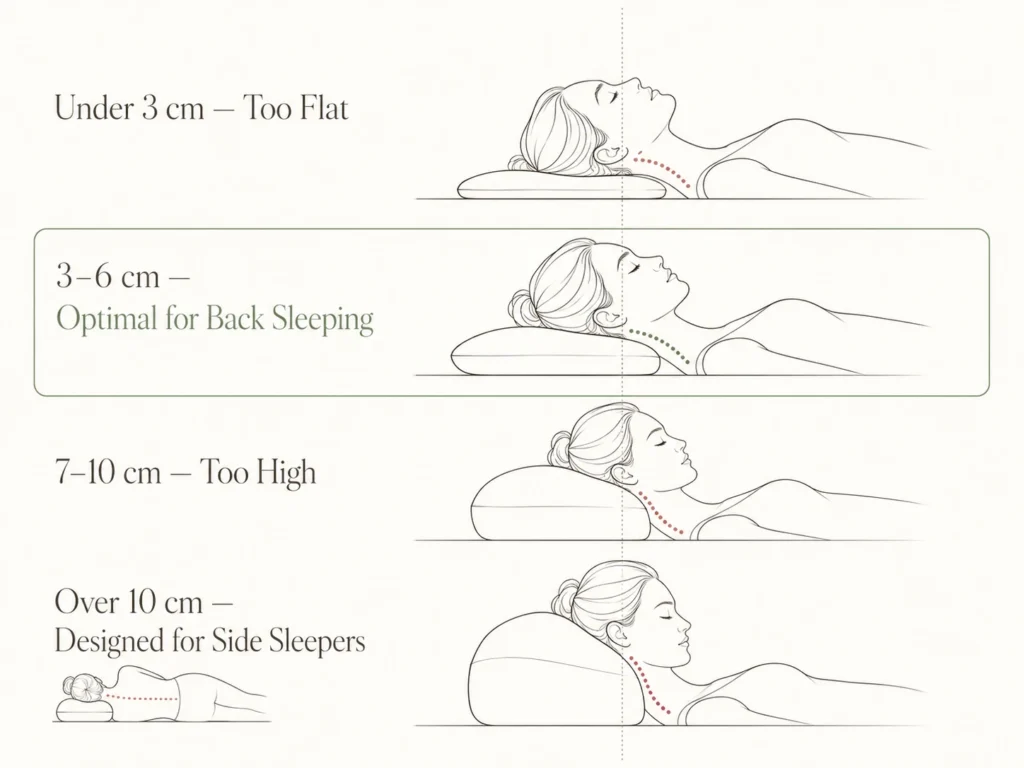
Back sleepers need a significantly lower pillow than side sleepers. Side sleepers need enough loft to fill the full gap between the ear and the mattress — roughly the width of the shoulder, which is typically 10 to 14 cm. Back sleepers need only enough loft to support the natural cervical curve while keeping the head level with the spine.
Pillow loft reference guide for back sleepers:
| Pillow loft | What it may do | What you may notice |
|---|---|---|
| Under 3 cm | Insufficient cervical support — head drops back | Aching at the front of the neck, tension headache |
| 3–6 cm | Optimal range for most back sleepers — supports cervical curve without forward flexion | Neutral alignment, reduced morning stiffness |
| 7–10 cm | Pushes head into forward flexion — common cause of back sleeper neck pain | Stiff neck at base of skull, chin tucked on waking |
| Over 10 cm | Almost always excessive for back sleeping — designed for side sleepers | Significant cervical flexion, suboccipital pain |
The exact measurement that works for you will vary slightly depending on the natural curvature of your cervical spine and the firmness of your mattress. A firmer mattress surface allows less body sink and may require slightly less loft. A softer surface that allows the shoulders to sink may require slightly more. But the principle holds across almost all body types: most back sleepers are currently sleeping on a pillow that is too high.
Why Most Ergonomic Pillows Fail Back Sleepers
There is a frustration worth naming directly — one I have heard many times, and experienced in a different form myself.
Someone buys a pillow labelled “ergonomic” or “orthopaedic.” The packaging mentions spinal alignment. The reviews are strong. And it makes no difference — or actually makes things worse.
The reason is almost always this: the pillow was engineered for side sleepers.
The majority of contour and cervical pillows on the market are sized, profiled, and lofted for the side sleeping position. They are built around the geometry of the shoulder gap — the distance from the ear to the mattress when lying on one side, which is typically 10 to 14 cm depending on shoulder width. That loft is structurally necessary for a side sleeper. For a back sleeper, it is far too high. The pillow pushes the head forward, the chin angles toward the chest, and the cervical flexion problem continues — now with an expensive, well-intentioned product underneath it.
Understanding what actually separates a cervical pillow from a standard pillow — in terms of geometry and support zones, not just marketing — makes it significantly easier to choose one that works for back sleeping specifically, rather than for the sleep position a pillow happens to have been designed for.
What to Look for in a Pillow If You Sleep on Your Back
Before looking at any specific product, understand what the right design must do mechanically.
1. A Dual-Zone Geometry
The single most important structural feature for back sleepers is a pillow with two distinct loft zones built into the same design.
A lower central cavity — in the 3 to 6 cm range — that cradles the head when lying on your back, keeping it level with the spine. And raised side wings — typically 10 to 14 cm — that provide the correct loft when you roll onto your side during the night.
This geometry solves the problem that no standard flat pillow and no standard side-sleeper contour pillow can solve: most back sleepers change position during the night without realising it, often moving from the back to one side and back again. The body shifts instinctively when it is looking for a neutral position. A pillow that only works correctly in one position will create a misalignment problem the moment that shift happens — which, for most people, happens multiple times before morning.
2. Stable Loft Through the Night
A pillow that starts at the correct height and collapses to flat by 3am provides no consistent support. High-density memory foam is significantly better at holding its shape through the night than fibre fill or standard foam — which compress under the weight of the head and do not return to their original height until the morning.
3. Cervical Support Under the Neck, Not Just Beneath the Head
A standard flat pillow supports the back of the head. A true cervical support pillow fills the gap underneath the neck — the space between the cervical curve and the mattress that a flat pillow leaves entirely unsupported. Filling that gap keeps the cervical muscles passively decompressed across the full night.
4. Breathable Cover Material
A pillow that traps heat causes discomfort that triggers positional changes — which compounds the alignment problem. A breathable cover and open-cell memory foam structure help regulate sleep surface temperature and reduce the movement caused by thermal discomfort.
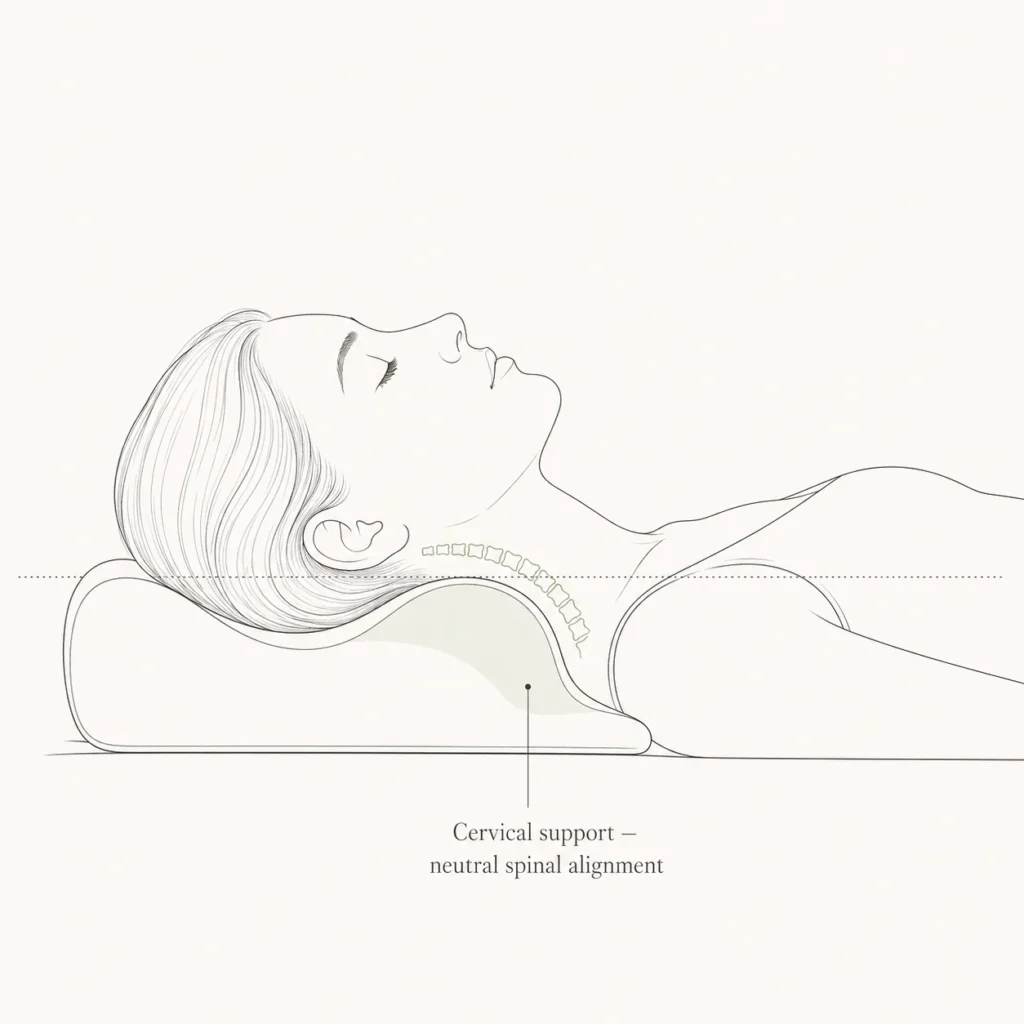
The Dual-Zone Pillow We Recommend
Most ergonomic pillows on the market are built exclusively for side sleepers — high, firm, and designed to fill the shoulder gap. They are the wrong tool for back sleeping. The pillow we recommend uses a different geometry entirely.
Its central cavity sits at 3 to 6 cm — the correct loft range for back sleeping, keeping the head level and the cervical spine in a neutral position. Its raised side wings provide the full shoulder-width support needed when you roll onto your side during the night. High-density CertiPUR-US® certified memory foam holds both zones at consistent height from the moment you lie down to the moment you wake up — with no collapse, no flat spots, and a breathable cover that regulates temperature across the night.
If your current pillow was designed for side sleeping, this is not a minor upgrade. It is a fundamentally different piece of architecture.
The 7-Night Adjustment Period
If you move to a new contour or cervical pillow, expect an adjustment period of five to seven nights. This is not a sign that the pillow is wrong for you. It is the time your cervical muscles need to decompress and recalibrate to a new alignment position after months or years of sustained flexion.
During the first few nights, the position may feel unfamiliar. That is expected. Track your morning stiffness each day: it should reduce progressively across the seven nights, not remain static or worsen. The 7-night pillow test gives you a simple daily tracking structure to make that observation precise — so you know by day seven whether the change is working, rather than relying on a vague impression.
If significant pain persists beyond seven nights, the specific loft of the pillow may not match your cervical anatomy — and it is worth adjusting before concluding that the approach itself is wrong.
Practical Checklist: Check Your Back Sleeper Setup Tonight
- Lie flat on your back and check your head position — is your chin angled toward your chest?
- Measure your current pillow height under load — is it above 7 cm when your head is resting on it?
- Does your pillow hold its shape through the night, or does it collapse flat by 3am?
- Where is your neck pain located in the morning — base of skull, sides, or upper back?
- Does the stiffness fade within one to two hours of being upright?
- Do you shift position during the night — and does your pillow accommodate that shift?
If you answered yes to more than two of these, your pillow loft is one of the first things worth addressing.
Free 7-Night Pillow Test
Use the free checklist to track your pillow height, sleep position, and morning neck comfort across seven nights. Simple, practical, no purchase required.
When to Look Beyond Your Sleep Setup
Your pillow is one of the first things worth checking — but it is not the only possible cause of morning neck pain.
Speak with a healthcare professional if any of the following apply:
- Your neck pain is severe, or arrived suddenly rather than gradually
- The pain radiates into your arm, hand, or fingers
- You are experiencing numbness, tingling, or unexplained weakness in the arm or hand
- You have had a recent injury to the neck or upper spine
- The accompanying headache feels different in character from standard tension headaches
- Your stiffness does not improve at all during the day, regardless of movement
- You have a fever alongside the neck pain
Morning neck stiffness that is linked to sleep position and pillow loft tends to fade progressively over the first one to two hours of being upright. If your pain does not follow this pattern, a healthcare professional can help identify whether a structural or medical cause requires attention beyond sleep setup adjustments.
Back Sleeper Neck Pain: Your Questions Answered
Yes. A pillow that is too thick pushes the head into cervical flexion — the chin angles toward the chest. Held in this position for seven or eight hours, the cervical discs experience uneven anterior compression and the posterior neck muscles remain in sustained tension. The result is the stiffness and pain you feel when you wake up.
Most back sleepers need a pillow with a loft of approximately 3 to 6 centimetres under load — significantly lower than the 10 to 14 cm loft that side sleepers typically require. The right height keeps the ear level with the shoulder and the cervical spine in a neutral arc rather than forward flexion.
Back sleeping is not inherently harmful for neck pain — it is one of the most structurally neutral sleep positions available. The issue is almost always pillow height, not the position itself. With the correct low-loft cervical support pillow, back sleeping may reduce neck pain rather than contribute to it.
Morning neck pain that fades over one to two hours is characteristic of sustained overnight cervical tension. During sleep, the muscles are held in a strained position by incorrect pillow height. Once upright and moving, the sustained load is released and the muscles gradually decompress. If the pain does not follow this pattern, speak with a healthcare professional.
Lie flat on your back and look straight at the ceiling. If your chin is angled downward toward your chest rather than parallel to the ceiling, your pillow is pushing your head into forward flexion and is too high. A neutral position means your ear is approximately level with your shoulder and your chin is neither tucked nor elevated.
If your neck pain is severe, radiates into the arm or hand, involves numbness or tingling, or does not improve at all during the day, speak with a healthcare professional. These patterns can indicate a structural issue — such as cervical disc herniation or nerve compression — that goes beyond pillow height.
Your Pillow Height Is the Variable You Have Not Checked Yet
If you sleep on your back and wake up with neck pain every morning, your sleep position is not the cause. Back sleeping, with the right setup, is one of the most structurally sound positions available. The problem is almost always the pillow height — and specifically a pillow that was designed for side sleeping, pushing your cervical spine into forward flexion for the entire night, fragmenting your deep sleep through micro-arousals you never feel, and leaving you stiff and exhausted every morning.
Start tonight. Lie flat and check your head position. If your chin is angled toward your chest, your pillow is too high. Track how you feel across the next seven mornings. The results will tell you quickly whether pillow loft was the variable you have been missing.
Your morning does not have to start with a stiff neck. The cause is physical. And physical things can be checked, adjusted, and changed tonight.