

You’ve already tried two or three pillows. Maybe more. You ordered the memory foam one with the good reviews. You tried the thick one, then the flat one, then the one that came in a box rolled up like a yoga mat. And every single morning, the same thing: a stiff neck that takes an hour and two coffees to finally loosen up.
So when someone mentions a cervical pillow, your first instinct is probably scepticism. And honestly? That’s fair. Because most of what’s sold as “ergonomic” or “orthopedic” is just a differently shaped rectangle with a premium price tag. The packaging changes. The problem doesn’t.
But there is a real structural difference between a cervical pillow and a regular pillow. Not a marketing difference — a mechanical one. And once you understand it, you’ll know exactly why the pillows you’ve tried haven’t worked — and what to actually look for.
This article may contain affiliate links. If you purchase through our links, Fondielle may earn a small commission at no extra cost to you. We only recommend products we have researched and genuinely believe can support a better sleep environment.
Quick Answer
A cervical pillow is structurally different from a regular pillow in three specific ways: it maintains a stable loft throughout the night, it fills the gap between your neck and the mattress rather than just supporting the back of your head, and it’s shaped to accommodate your shoulder width and sleep position. A regular pillow — including most memory foam options — collapses under pressure, leaves the cervical curve unsupported, and treats your head like an isolated object rather than part of a connected spine. If you wake up with a stiff neck, tight shoulders, or morning headaches consistently, the design of your pillow may be a contributing factor worth checking.
Free 7-Night Pillow Test
Not sure if your pillow is the problem? Download the free checklist and track your pillow height, sleep position, and morning neck comfort over seven nights — before you buy anything new.
In this guide
What does a regular pillow actually do to your neck while you sleep?
This is the part nobody explains — and it’s the most important part.
When you lie on your side, there is a gap between your neck and the mattress. Your head sits higher than your shoulder creates space for. A regular pillow fills that space — but only partially, and only for a while. Most conventional pillows, including standard memory foam options, compress under the weight of your head over the course of the night. By 2am, the loft has dropped. By 5am, it may have dropped significantly.
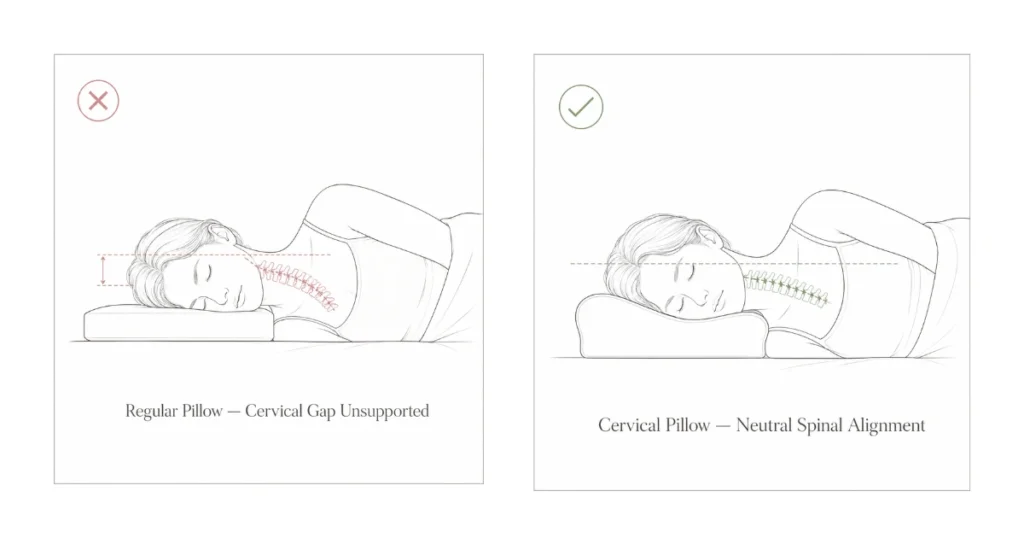
creating overnight tension in the neck and shoulders. Right: a
cervical contour pillow fills that gap and keeps the spine in a
neutral position throughout the night.
That drop matters because your cervical spine — the seven vertebrae that form the curve of your neck — needs to stay in a neutral position for the full duration of your sleep. Not just when you first lie down. All night.
When the pillow compresses, your neck tilts. The muscles along the side of your neck and the base of your skull activate to compensate — not fully, not consciously, but enough to accumulate tension over seven or eight hours. When you wake up, that tension is what you feel as stiffness. If it spreads toward the base of your skull, it can also cause the kind of morning headache that improves as the day goes on. If it affects the side you sleep on, you may feel it across your shoulder and into your upper back.
This is why waking up with a stiff neck every morning can feel so confusing. You slept. You rested. And yet your body behaves as if it spent the night working.
It did. Just not the way you wanted.
If this is the exact pattern you deal with most mornings, our complete guide on why does my neck hurt every morning walks through every contributing factor — pillow loft, sleep position, temperature, and the muscles doing the compensating. This article focuses specifically on what makes a cervical pillow structurally different.
What is a cervical pillow — and what makes it structurally different?
A cervical pillow — sometimes called a contour pillow or orthopedic pillow — is designed around one specific goal: keeping your cervical spine in a neutral alignment for the full night, regardless of how you move.
The structural differences are not cosmetic. Here is what actually changes.
Shape — the contour is functional, not decorative
A regular pillow is a rectangle. A cervical pillow has a contoured shape — typically lower in the centre where your head rests, and raised at the edges where your neck sits. That raised section is called the cervical bolster. Its job is to fill the gap between your neck and the mattress — the gap a flat pillow leaves empty — and support the natural inward curve of your cervical spine.
That curve is called cervical lordosis. It exists for a reason. When a pillow forces it flat or compresses it over several hours, the surrounding muscles absorb the load. The contour of a cervical pillow is designed so those muscles don’t have to.
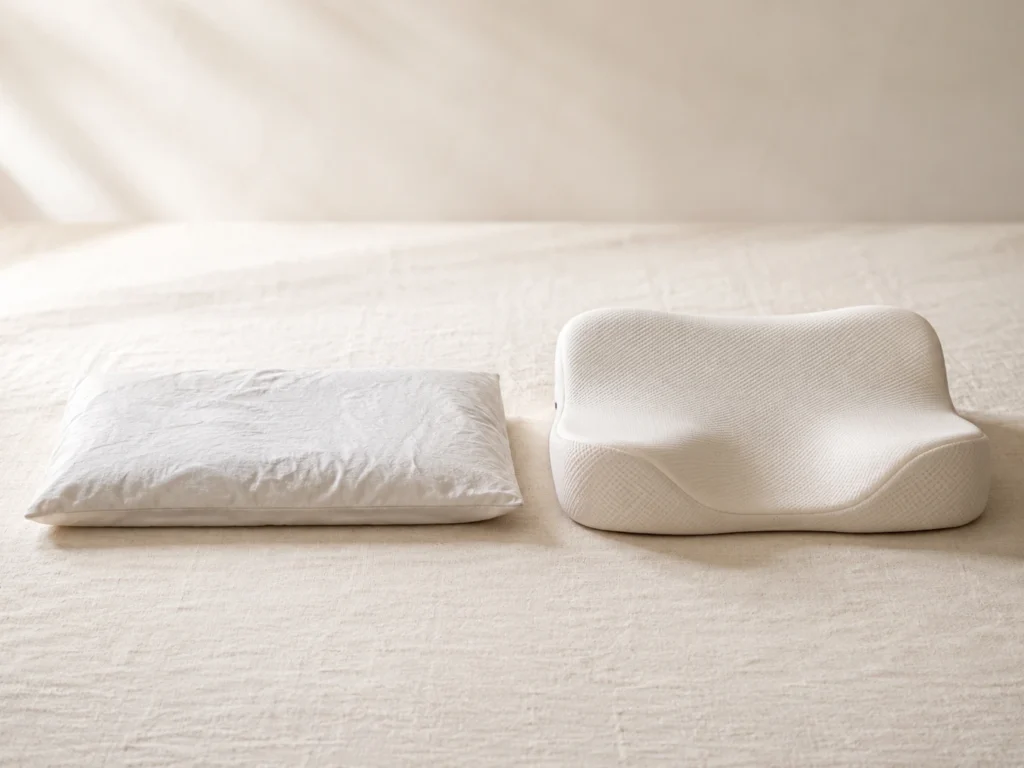
contour pillow is visible before you even use it. The raised cervical
bolster, lower center head zone, and defined shoulder areas are
functional design features — not aesthetic ones.
Loft — stable height across the full night
Pillow loft refers to the height of the pillow when compressed under the weight of your head. A regular pillow — even a dense memory foam one — typically loses loft as the night progresses. The material compresses, redistributes, and flattens. By the early hours of the morning, your neck may be sitting significantly lower than it was when you fell asleep.
A well-designed cervical pillow is built with high-density foam that maintains its loft throughout the night. The height when you fall asleep should be very close to the height when you wake up. That consistency is what allows your neck muscles to fully release, rather than continuing to make micro-adjustments as the pillow shifts beneath you.
If you want to understand more about how loft affects morning pain, this guide on what pillow height side sleepers actually need explains the measurement in detail.
Shoulder accommodation — the part most pillows ignore
This is the difference that surprised me most when I first researched it.
When you sleep on your side, your shoulder is on the mattress. Your head is raised above it. The distance between your head and your shoulder — the gap the pillow needs to fill — is not the same for everyone. It depends on the width of your shoulder, the firmness of your mattress, and your body weight.
A cervical pillow designed for side sleepers accounts for this. The shoulder support zone allows your shoulder to rest naturally without being pushed upward by the edge of the pillow. This matters because side sleepers who wake up with shoulder pain are often experiencing pressure that accumulates at the shoulder joint overnight — not because of the mattress, but because the pillow isn’t creating enough clearance.
A regular pillow doesn’t address this. It holds the head. The shoulder adapts to whatever space is left — and that adaptation builds tension across the night.
The comparison — regular pillow vs cervical pillow
| Feature | Regular Pillow | Cervical Pillow |
|---|---|---|
| Shape | Rectangular — uniform height | Contoured — raised cervical bolster |
| Loft stability | Compresses over the night | Maintains height through the night |
| Cervical support | Supports the back of the head | Fills the neck-to-mattress gap |
| Shoulder accommodation | None | Designed for side sleeper geometry |
| Sleep position fit | Generic | Specific to side and back sleepers |
| Arm and nerve pressure | Not addressed | Better alignment may reduce pressure |
| Material | Variable — often loses shape | High-density foam with memory response |
Do cervical pillows actually work for neck pain?
The honest answer is: for some people, yes — and the reason is physical and measurable.
If your morning neck stiffness is caused by cervical misalignment during sleep — which is one of the most common physical causes — then a pillow that maintains neutral alignment throughout the night may reduce or eliminate that stiffness. The mechanism is direct: less postural strain overnight means less accumulated tension to wake up with.
The research on sleep posture and cervical pain supports this broadly. Studies on neck pain and sleep position consistently identify pillow support as a modifiable factor — meaning it’s one of the things you can actually change. It won’t address every cause of neck pain, but it addresses one of the most common ones that is genuinely within reach.
What cervical pillows won’t fix is neck pain caused by injury, disc problems, nerve compression, or structural issues that exist independently of sleep posture. If your pain is severe, comes with tingling or numbness down your arm, or doesn’t improve at all after adjusting your sleep setup, that’s a signal to speak with a healthcare professional. More on that below.
The other thing worth knowing: most people don’t adjust to a new pillow in a single night. There is a physical adaptation period. Your muscles and spine have been compensating for a misaligned sleep position for months, possibly years. Give it at least five to seven nights of consistent use before drawing conclusions. The first two or three nights may feel unfamiliar — that’s normal.
Is a cervical pillow worth it for side sleepers specifically?
Side sleeping is the most common sleep position — and it’s also the position that places the most demand on a pillow, because the gap between the neck and the mattress is at its widest.
For side sleepers, the three factors that matter most are:
1. Loft that matches shoulder width. The pillow needs to be high enough to keep your head level with your spine — not tilted toward the mattress, and not pushed upward by a pillow that’s too thick. Most standard pillows are either too flat (which causes a downward tilt) or too thick for the wrong body type.
2. A cervical bolster that fills the neck gap. When you lie on your side, your neck hangs slightly above the mattress unless something supports it. A regular pillow doesn’t reach that space. A contour pillow with a raised rear section does — and that support is what allows your neck muscles to stop working while you sleep.

clearance for the shoulder to rest without upward pressure —
keeping the spine neutral from the neck to the upper back.
3. Shoulder clearance. Your shoulder needs space. A pillow that pushes against it creates upward pressure that affects alignment all the way to the neck and into the upper back.
If you’ve been tossing and turning all night without ever finding a position that feels right, this is often the root cause. Your body is searching for a neutral position that the pillow geometry isn’t providing.
How to know if you need a cervical pillow
You don’t need to guess. There are specific signs that your current pillow may not be providing the structural support your sleep position requires.
Check your mornings. Stiffness that appears immediately upon waking and takes 30 to 60 minutes to ease is a classic sign of overnight postural tension — not injury, not stress. The fact that it resolves during the day tells you it’s positional.
Check your pillow’s loft. Press your fist into your current pillow and hold it for 30 seconds. If the pillow doesn’t return to its original height, it’s losing loft under pressure. That collapse is happening while your head is on it all night.

If it doesn’t return to its original height, it’s losing loft
under pressure — the same thing that happens while your head
is on it all night.
Check where your pain is. Tension at the base of the skull, across one shoulder (the side you sleep on), or a sense of tightness between the shoulder blade and spine are all consistent with side sleeper postural strain. If you also wake up more tired than when you went to bed despite a full night’s sleep, the physical discomfort may be causing micro-arousals — brief partial wakings your brain registers but you don’t consciously experience — that fragment your deep sleep.
Check your sleep position when you wake up. If you regularly wake up in a completely different position from where you started, or if you find yourself repositioning constantly during the night, your body may be searching for comfort that your current setup isn’t providing.
What to look for in a cervical pillow — the criteria that matter
When I finally understood what I was looking for, choosing became much simpler. Here are the criteria that should guide your decision — regardless of brand.
Stable high-density foam. Not all memory foam is the same. Standard memory foam compresses and loses shape. High-density memory foam maintains its form across the full night. The material should respond to pressure and body heat without flattening permanently.
A raised cervical bolster. The back edge of the pillow — the part that contacts your neck — should be meaningfully raised compared to the centre. This is the structural feature that fills the cervical gap. Without it, you have a contoured rectangular pillow, not a true cervical support.
Appropriate loft for your shoulder width. This varies by person. As a rough guide, side sleepers with broader shoulders need more loft (around 5 inches). Those with narrower shoulders or who sleep on their back generally need less. If the pillow comes in multiple heights, this is a significant advantage.
A shape that accommodates the shoulder. The pillow should not press against your shoulder or push it upward. Look for designs with a lower front section that allows the shoulder to rest without interference.
A 60-day return window. Given the adaptation period, any reputable cervical pillow brand should offer at least 60 days to evaluate the product properly. A seven-day trial is not sufficient for something your body needs time to adjust to.
What to ignore when choosing a cervical pillow
A few things that appear often in product descriptions but don’t reliably indicate quality:
The word “orthopedic” on its own. This is a marketing term, not a structural specification. Ask what makes it orthopedic — what specific design features support spinal alignment. If the answer is vague, the product probably is too.
Generic five-star reviews without specifics. Reviews that say “best pillow I’ve ever had” without mentioning sleep position, body type, or specific symptoms are not useful for evaluating fit. Look for reviews from people in the same situation as you: same sleep position, similar symptoms, similar build.
Price alone as a quality signal. Expensive pillows are not always better designed. Cheap pillows are not always poorly constructed. Focus on the structural criteria above, not the number on the label.
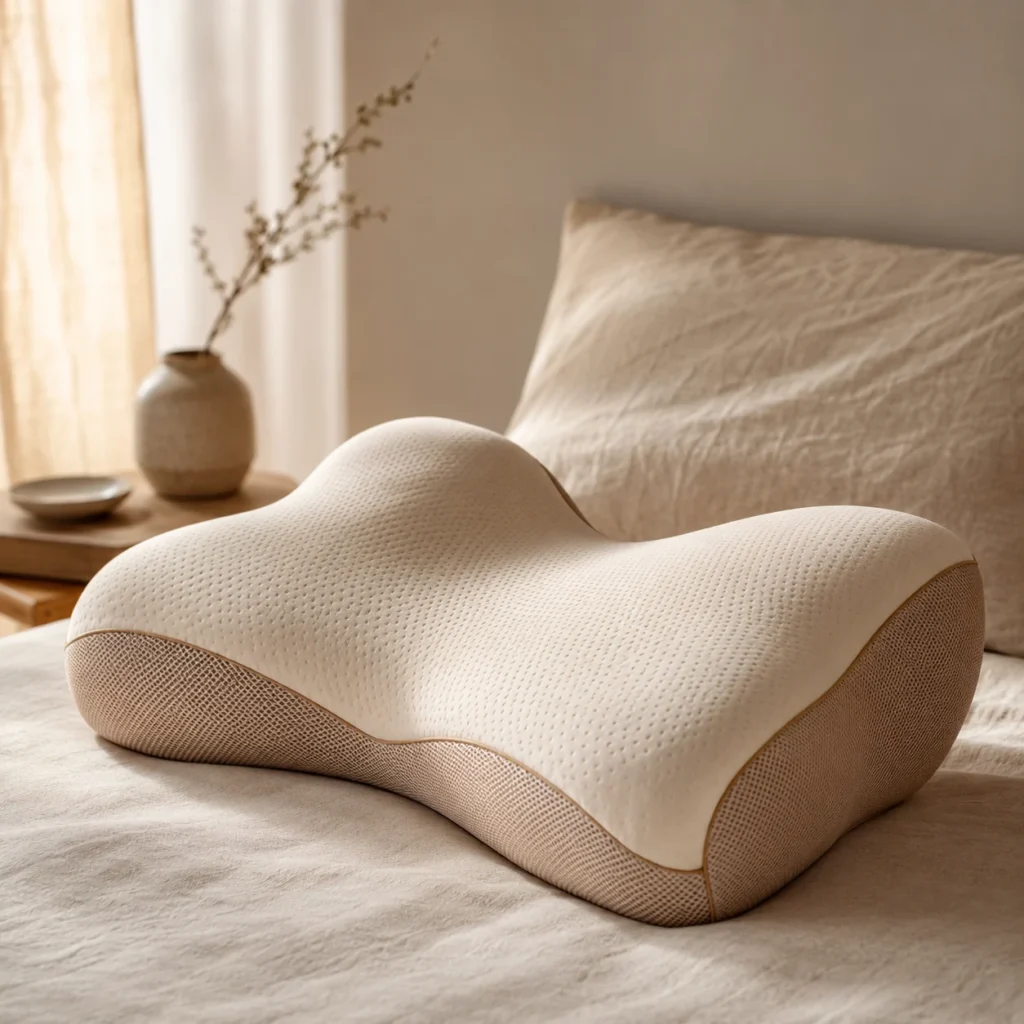
The ergonomic pillow we recommend
If your current pillow collapses overnight, leaves your neck unsupported, or doesn’t account for your shoulder width as a side sleeper, an ergonomic contour pillow may be worth considering.
The pillow we recommend is designed around the same criteria this article describes: stable high-density foam that holds its loft through the night, a raised cervical bolster that supports the natural curve of the neck, a shoulder zone designed for side sleeper geometry, and a dedicated arm support area that most standard pillows don’t address at all. It comes with a 60-day return window — enough time to complete a proper adaptation period and assess whether it’s working.
How long does it take to adjust to a cervical pillow?
Most people begin to notice a change between nights three and five. The full benefit typically becomes clearer after five to seven nights, as the body adjusts to a new sleep position and the muscles begin to release tension they’ve been holding for months.
The first night or two may feel unfamiliar — not uncomfortable, but different. That’s normal. Your body has been compensating for a misaligned position for a long time. Neutral alignment can feel strange at first.
Track your mornings during the adaptation period. Not just pain, but how quickly stiffness eases, whether headaches are less frequent, how your shoulder feels on the side you sleep on. The changes are often gradual rather than dramatic — which is why the 7-night pillow test exists as a structured way to evaluate your experience without drawing premature conclusions.
When neck pain may not be about your pillow
Your pillow may be contributing to your neck pain — but it’s not the only possible cause, and it’s worth being clear about that.
If any of the following apply to you, speak with a healthcare professional before attributing your pain to your sleep setup:
- Neck pain that is severe, constant, or significantly worsening
- Pain that follows an injury or accident
- Pain that radiates down one or both arms, or is accompanied by numbness, tingling, or weakness in the hands
- Headaches that are intense, sudden, or different from your usual pattern
- Pain accompanied by fever, unexplained fatigue, or other systemic symptoms
A cervical pillow addresses postural strain during sleep. It does not address structural disc problems, nerve impingement, cervical stenosis, or any condition that requires clinical assessment. If your symptoms are beyond morning stiffness that resolves during the day, please consult a professional.
Cervical Pillow Questions — Answered
A cervical pillow is designed with a contoured shape that supports the natural curve of the neck, maintains a stable loft throughout the night, and accommodates the shoulder geometry of side sleepers. A regular pillow supports the back of the head without addressing the cervical gap or shoulder alignment, and typically compresses over the course of the night.
For neck pain caused by cervical misalignment during sleep — one of the most common causes of morning stiffness — a cervical pillow may reduce or eliminate symptoms by supporting a neutral spinal position throughout the night. They are not a treatment for injury-related pain, disc problems, or other structural conditions.
Side sleeping places the greatest demand on pillow support because the shoulder-to-neck gap is at its widest. A cervical pillow designed for side sleepers — with appropriate loft and shoulder clearance — addresses this specifically in a way most regular pillows do not.
Press your fist into your pillow and hold for 30 seconds. If the pillow doesn’t recover its original height, it’s compressing under pressure — which means it’s doing the same thing under your head all night. If you also wake up with stiffness that resolves during the day, low or unstable loft is likely a factor.
Yes. When a pillow doesn’t provide enough clearance for the shoulder, or pushes against it during side sleeping, pressure accumulates at the shoulder joint overnight. This can cause tension across the shoulder and into the upper back that is often mistaken for a posture or exercise problem.
If your neck pain is severe, doesn’t improve with positional changes, comes with arm symptoms such as tingling, numbness or weakness, or follows an injury, speak with a healthcare professional. Morning stiffness that eases during the day is typically postural — but persistent, radiating, or worsening pain warrants clinical assessment.
Start With What You Sleep On
You’ve been waking up stiff for months, possibly longer. And every pillow you’ve tried has looked different but worked the same way — or rather, not worked the same way. The difference isn’t in the packaging. It’s in whether the pillow actually fills the cervical gap, holds its shape across the night, and gives your shoulder the room it needs. That’s what makes a cervical pillow structurally different. And that’s what’s worth looking for.