

You’ve been calling it stress for months. Maybe longer. Every morning, the same stiff neck, the same tight shoulders, the same dull ache at the base of your skull. And every morning, you tell yourself the same thing: I just need to slow down. I need to manage my stress better. This is what burnout feels like.
But here’s something worth considering. If your neck pain was truly caused by stress, why does it always feel worst the moment you wake up — before your day has even started?
That detail matters more than most people realize.
This article may contain affiliate links. If you purchase through our links, Fondielle may earn a small commission at no extra cost to you. We only recommend products we have researched and genuinely believe can support a better sleep environment.
Quick Answer
Stress can contribute to muscle tension, and that tension can affect your neck. But stress-related neck pain tends to build throughout the day — it worsens as pressure accumulates, and it eases when you rest. Morning neck stiffness that appears immediately at wake-up and improves within 30 to 60 minutes of moving around follows a completely different pattern. That pattern points more strongly to cervical misalignment during sleep than to stress. Your pillow, your sleep position, and how your neck is supported for seven or eight hours every night may be a more direct cause than the stress in your life.
📋 Free 7-Night Pillow Test
Not sure if your neck stiffness is physical or stress-related? The free 7-Night Pillow Test checklist helps you track your morning pain, sleep position, and pillow setup over one week — so you have real data, not guesswork.
In This Guide
- Can stress actually cause neck pain?
- What stress neck pain feels like
- What sleep posture neck pain feels like
- How to tell the difference — a simple self-check
- Why the wrong pillow can mimic stress symptoms
- What happens to your neck while you sleep
- What to check in your bedroom first
- When to look beyond your sleep setup
- FAQ
- The Part Nobody Told You
Can Stress Actually Cause Neck Pain?
Yes — stress genuinely can cause neck pain. This is not a myth worth dismissing.
When you experience stress, your nervous system triggers a tension response across the muscles in your shoulders, upper back, and neck. Over time, that sustained tension can create real discomfort. Stress can also make you more sensitive to pain signals you might otherwise ignore, and it can disrupt your sleep quality in ways that leave you feeling less recovered in the morning.
So stress is a real factor. The question is not whether stress causes pain — it is whether stress is causing your specific pattern of pain.
Because stress-related neck pain has a particular signature. This tension tends to accumulate and worsen as your day progresses. The discomfort is often linked to specific triggers — a difficult conversation, a stressful deadline, or an afternoon of tension at your desk. You will usually feel it affect both sides of the neck and upper shoulders relatively evenly. And crucially, it does not follow a predictable morning-only pattern.
If your neck pain is genuinely stress-driven, it should be at its worst when your stress is at its highest — not at the moment you open your eyes before you have checked a single email. If you are still not sure why your neck hurts every morning, that guide covers the full range of physical causes in one place.
What Stress Neck Pain Actually Feels Like
Stress-related neck tension has recognizable characteristics. Understanding these makes it easier to identify when something else may be happening.
Stress neck pain tends to spread. It rarely isolates itself to one specific area. Instead, it creates a diffuse tightness across the upper shoulders, the base of the neck, sometimes the jaw, and often the temples or the forehead. Many people describe it as feeling like they are carrying something heavy on their shoulders even when they are not.
It responds to stress triggers. You might notice it worsens after a difficult phone call, a long meeting, or a period of concentrated focus at a screen. It is reactive — it rises and falls in relation to what is happening in your environment and your mind.
It eases with genuine rest. A weekend away from pressure, a quiet afternoon, or a genuinely low-stress day often provides noticeable relief. The pain is not fixed — it moves with your emotional state.
And it is usually present throughout the day, not concentrated in the first hour after waking.
What Sleep Posture Neck Pain Actually Feels Like
Sleep posture neck pain has a very different profile. Once you know what to look for, the distinction becomes clear.
It is worst immediately at wake-up. Before you have done anything, before you have spoken to anyone, before any stress has had the chance to build — your neck is already stiff. That stiffness was already there before your day began.
It improves with movement. Within 30 to 60 minutes of being upright and moving around, the stiffness begins to ease. Your muscles warm up, the accumulated compression releases, and by mid-morning you often feel noticeably better than you did when you first got out of bed.
It is frequently one-sided. If you tend to sleep on your right side, the stiffness often concentrates on the right. The shoulder on that side may feel tight or tender. The base of the skull on that side may ache in a specific, localized way. This is one of the clearest signs that your pillow is causing your stiff neck rather than anything happening in your waking life.
It returns the next morning regardless of how your day went. Whether yesterday was calm or chaotic, the stiffness is waiting for you again when you wake up. It does not respond to changes in your stress level — because it is not being driven by stress.
How to Tell the Difference — A Simple Self-Check
Before assuming your neck pain is stress-related, work through these questions honestly.
When is your pain at its worst? If the answer is immediately when I wake up — that pattern aligns more with physical sleep posture than with stress.
Does your stiffness improve after 30 to 60 minutes of moving around? If yes, that improvement suggests the pain was caused by prolonged compression or muscular tension during sleep — not by psychological stress, which does not resolve simply because you have been upright for an hour.
Is the stiffness one-sided? Stress tension typically spreads across both sides. One-sided morning stiffness that correlates with your dominant sleep side is more characteristic of positional neck pain.
Does your neck feel the same regardless of how stressful your previous day was? If a calm, low-pressure day does not reliably mean a better neck the next morning, stress is unlikely to be the primary driver.
How old is your pillow, and when did you last evaluate its height? Most people have never considered this. If your pillow is flat, compresses significantly during the night, or sits too low to fill the space between your neck and the mattress, it cannot keep your cervical spine in a neutral position — regardless of your stress levels. If you are not sure what height your pillow should be, the right pillow height for side sleepers depends on your shoulder width and frame — and most standard pillows fall short.
Stress vs. Sleep Posture — A Simple Comparison
| Sign | More likely stress-related | More likely sleep posture |
|---|---|---|
| When pain is worst | Throughout the day, peaks with stress | Specifically at wake-up |
| Improves with movement | Partially, inconsistently | Yes — within 60 minutes |
| Location | Both sides, jaw, shoulders, temples | Often one-sided, base of skull |
| Responds to rest days | Often yes | No consistent pattern |
| Triggers | Stressful events, concentrated focus | Always present at wake-up |
| Pattern day to day | Varies with stress levels | Consistent regardless of prior day |
📋 Free 7-Night Pillow Test
Seven nights of tracking your morning pain alongside your sleep position and pillow setup can tell you more than months of guessing. Download the free checklist and start building real data about what is happening to your neck while you sleep.
Why the Wrong Pillow Can Mimic Stress Symptoms
This is the part that most people — and most articles — never explain.
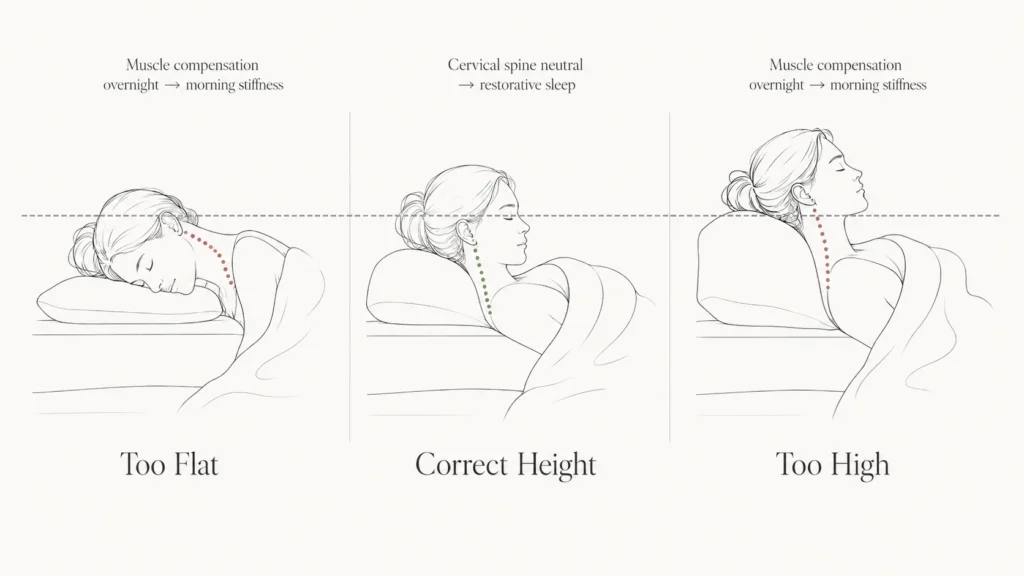
A pillow that is too flat, too soft, or the wrong height for your sleep position creates a specific physical problem: it leaves a gap between your neck and the mattress. That gap means your cervical spine is unsupported for the entire night. Your muscles do not switch off when you sleep — they compensate. They hold. They work quietly throughout the night to maintain what support your pillow cannot provide.
The result is muscular tension. The same kind of muscular tension that stress creates.
The muscles in your neck and upper shoulders — particularly the sternocleidomastoid and the suboccipital group at the base of your skull — spend the night in a state of sustained, low-level contraction. By the time you wake up, they are fatigued, tight, and sore. Exactly as they would be after a tense, stressful day.
The symptoms overlap almost completely. Stiffness. Tightness at the base of the skull. Tension across the upper shoulders. In some cases, a dull headache. In some cases, a vague sense of not having rested, even after seven or eight hours of sleep.
This is why so many women spend years attributing physical pain to psychological causes. Not because they are wrong to take stress seriously — but because nobody explained that the physical mechanism of poor cervical support produces almost identical symptoms.
What Happens to Your Neck While You Sleep
Understanding this mechanism is what changes the conversation.
When you lie down on a pillow that is too flat for your frame and sleep position, your head drops toward the mattress. That creates a lateral bend in your cervical spine — your neck is no longer in a neutral, aligned position. It is held at a slight angle for the duration of your sleep.
Your muscles adapt. Your muscles tighten on one side to prevent the angle from becoming worse. This constant compensation goes on silently for seven or eight hours, every night.
Over the course of that time, your brain registers the discomfort through what are called micro-arousals — brief, partial wake signals that prevent you from fully entering deep, restorative sleep stages without bringing you to full consciousness. You are not aware of them. But they fragment your sleep architecture in ways that leave you feeling unrested even after a full night. This is often why you wake up more tired than when you went to bed — not because you slept too little, but because your sleep was physically fragmented throughout.
You wake up stiff. You wake up tired. And because you cannot identify a physical cause, you blame stress.
The problem was never in your head. It was in the position your neck spent the night in.
What to Check in Your Bedroom First
If this pattern sounds familiar, here are the specific things worth evaluating before drawing any conclusions about stress.
Your pillow height. As a side sleeper, your pillow needs to fill the full distance between your ear and your mattress — typically 4 to 6 inches depending on your frame. If your pillow compresses below that through the night, your neck is unsupported for most of it.
Your pillow’s condition overnight. Press your pillow down firmly and release it. Does it recover fully and quickly? A pillow that stays compressed is not providing the support it appears to offer when you first lie down. The loft you feel at bedtime may be significantly lower by 3am.
Your sleep position. Side sleepers carry the most risk for misalignment-related neck pain because the gap between neck and mattress is largest in this position. If you consistently wake with pain on the side you sleep on, position and pillow height are the first places to investigate. Many side sleepers also find that shoulder pain on the side they sleep on develops alongside neck stiffness — and has the same root cause.
Your pillow’s age. Most standard pillows lose significant structural integrity within 12 to 18 months. If your pillow is older than that and you cannot remember the last time you replaced it, that is relevant information worth acting on.
Ergonomic Pillow Option
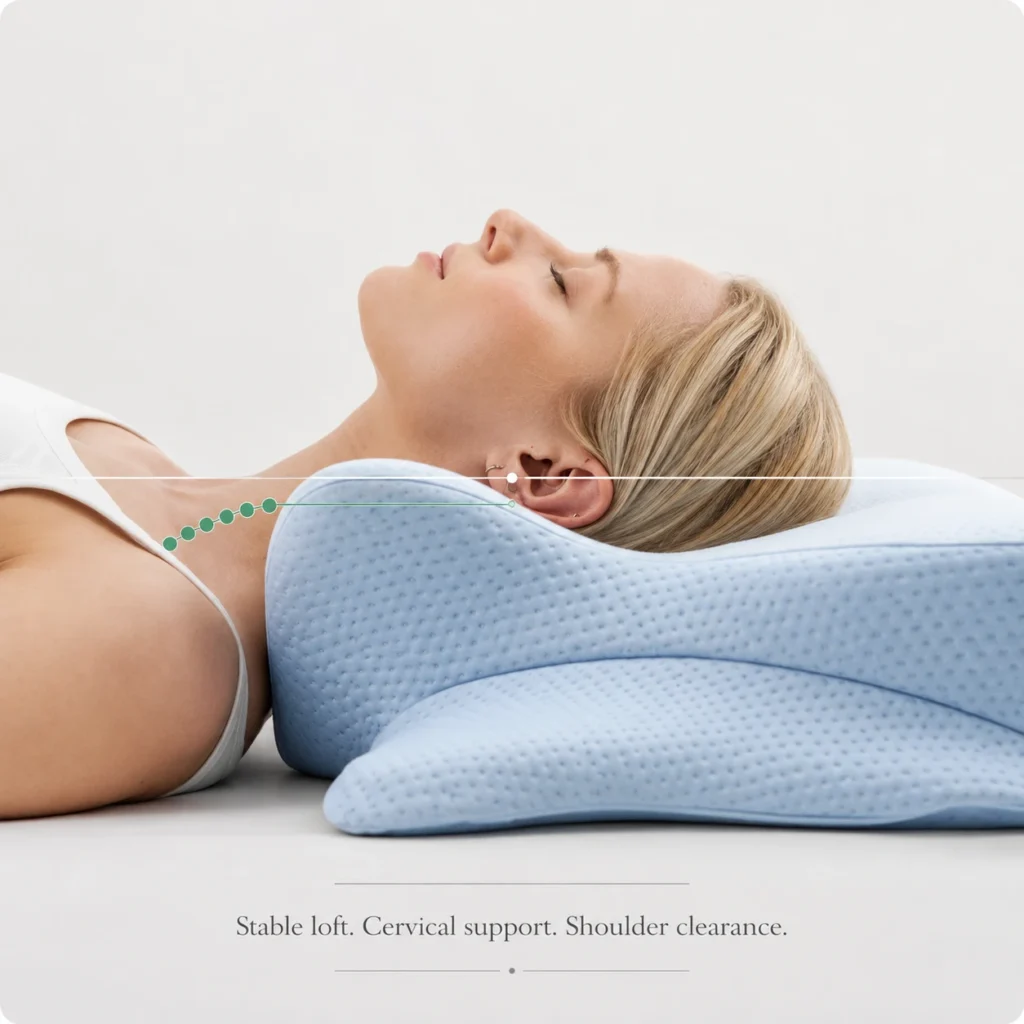
If your current pillow loses shape overnight, sits too flat, or leaves your neck feeling unsupported — an ergonomic contour pillow may be worth considering. The pillow we recommend is designed around stable loft, cervical support, and a shape that accommodates the shoulder clearance side sleepers need. It includes a dedicated neck support zone designed to fill the gap between the neck and the mattress that standard pillows leave empty.
When to Look Beyond Your Sleep Setup
Your sleep environment may be contributing to your neck pain — but it is not the only possible cause.
If your neck pain is severe, came on suddenly, followed an injury or accident, is accompanied by numbness or tingling in your arm or hand, spreads down between your shoulder blades, or is linked to fever, unexplained weight loss, or symptoms that feel unusual for you — speak with a healthcare professional. These signs warrant medical evaluation and are outside the scope of what a sleep environment adjustment can address.
If you experience arm numbness while you sleep, that symptom can sometimes overlap with cervical misalignment but may also indicate nerve compression that needs professional assessment. Similarly, if you are waking up with a headache at the base of your skull alongside neck stiffness, that combination is worth taking seriously — both as a sleep setup signal and as something to mention to a healthcare professional if it persists.
Persistent neck pain with neurological symptoms should always be assessed by a qualified professional, regardless of what you suspect the cause to be.
Frequently Asked Questions
Stress can contribute to muscle tension that affects the neck, but stress-related pain typically worsens as the day progresses and eases with genuine rest. Stiffness that is specifically worst at wake-up and improves within an hour of movement is more consistent with sleep posture and cervical misalignment than with stress.
Check the timing. If your stiffness is worst immediately at wake-up, is often one-sided, and improves after 30 to 60 minutes of being upright — that pattern points toward a physical sleep setup cause rather than stress. Stress pain tends to build during the day and respond to changes in your environment.
If your neck pain follows you into low-stress periods without improving, the cause is likely physical rather than psychological. Cervical misalignment during sleep creates muscular tension that is independent of your emotional state — it happens regardless of how calm or pressured your life is.
Yes. A pillow that is too flat or too soft leaves the cervical spine unsupported during sleep. The muscles compensate by holding tension through the night — producing stiffness, upper shoulder pain, and base-of-skull discomfort that closely mirrors the symptoms of stress-related tension.
Stress neck pain tends to worsen throughout the day, responds to stress triggers, and eases during genuinely restful periods. Sleep posture neck pain is present immediately at wake-up, often one-sided, improves with movement within an hour, and returns every morning regardless of how the previous day felt.
If your neck pain is severe, sudden in onset, came after an injury, is accompanied by numbness, tingling, or weakness in your arms or hands, or includes symptoms like fever or unexplained weight loss — seek medical evaluation. These signs go beyond what a sleep environment adjustment can address.
The Part Nobody Told You
You were not wrong to take your stress seriously. You were not wrong to try to slow down, to take better care of yourself, to look for answers in your habits and your schedule.
But the habits were never the problem. Your bedroom was.
The stiffness that greets you every morning before your day begins is not a personality trait. It is not proof that you cannot handle pressure. It is a physical signal from muscles that spent the night compensating for an environment that did not support them properly.
That is not a character flaw. That is a fixable problem.
Start with your pillow tonight. Check its height, its recovery, its age. Give it seven nights of honest attention. If you want a structured way to do that, the 7-Night Pillow Test walks you through exactly what to track and what your results mean. And if you are unsure whether an ergonomic pillow is actually different from what you already own, the comparison between a cervical pillow and a regular pillow explains the structural difference in plain terms. The results will tell you more than months of blaming stress ever could.
You’ve been waking up this way for months. Possibly years. The cause is physical. And physical things can be checked, tested, and changed.
📋 Free 7-Night Pillow Test
Track your morning neck comfort, sleep position, and pillow setup over seven nights. Download the free checklist and find out whether your stiffness is physical — and what to do about it.